There are two framed full size Gamy/Montaut prints available framed but not listed as impossible to transport to USA ! Ask
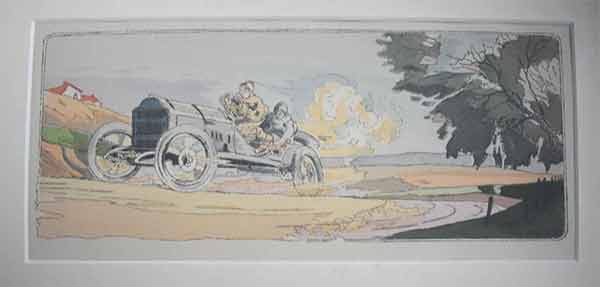
1905 Auvergene / ERNEST MONTAUT & MARGUERITE (GAMY) MONTAUT /Pochoir/Lithograph
Original Lithographs with hand finishing . These are done identical to the earlier large Pochoir prints ie as an exact version but tinier and as a pochoir finished lithograph Size averages 37 x 23 cm but all vary a bit £85 mounted inc delivery
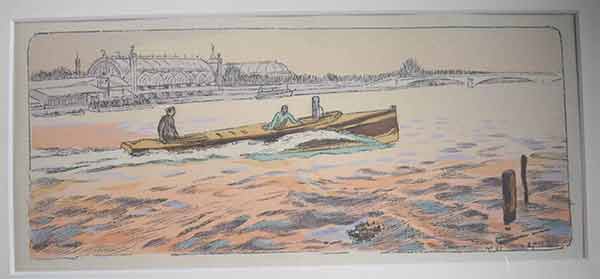
1904 Salon Cup / ERNEST MONTAUT & MARGUERITE (GAMY) MONTAUT /Pochoir/Lithograph
Original Lithographs with hand finishing . These are done identical to the earlier large Pochoir prints ie as an exact version but tinier and as a pochoir finished lithograph Size averages 37 x 23 cm but all vary a bit £85 mounted inc delivery
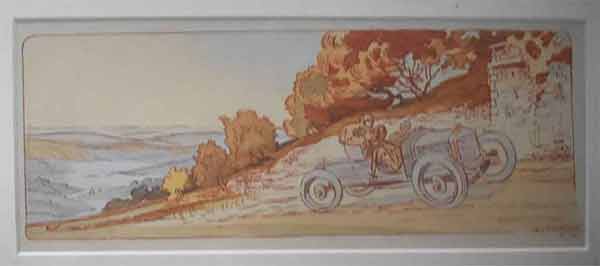
1907Regina/2 / ERNEST MONTAUT & MARGUERITE (GAMY) MONTAUT /Pochoir/Lithograph
Original Lithographs with hand finishing . These are done identical to the earlier large Pochoir prints ie as an exact version but tinier and as a pochoir finished lithograph Size averages 37 x 23 cm but all vary a bit £85 mounted inc delivery 2 available
Now for the tasty cars ,ore fun to drive ! Unfortunately rarer and this more costly ! Various portfolio sold in differing numbers so are cheaper. Also the first editions had text to the page in some but being lazy I used existing pics
Vintage historic racing car lithographs by George A. Oliver 1963 to 1967 Size of pages was approx 23.5 x 39.5cm, 9.25 x 15.5 inches with wide margins and printed on excellent quality cartridge paper. Illustrated and written by George A. Oliver from the folio Historic Racing Cars (1907–1960): or below English Sports Cars by Oliver and text by Laurence Pomeroy (included) £45 inc delivery
Historic Racing Cars (1907–1960). . . from the days when red for racing = Italian etc
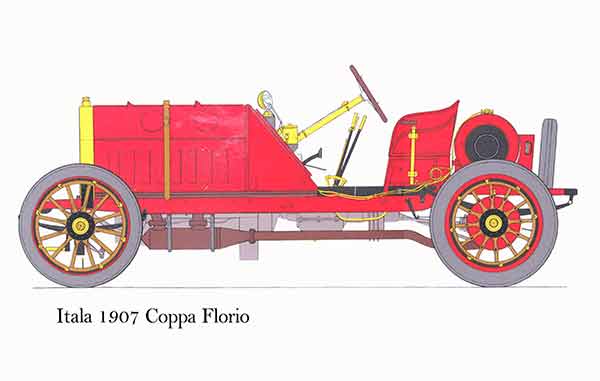
1907 Itala Coppa Florio
The Itala Company was formed in 1904, in Turin, by Matteo Ceirano and Guido Bigio. One of Italy's leading car brands before WW1, Itala are not as popular as Lancia, Ferrari or Alfa Romeo but their cars were usually reliable and although not as powerful as some, and sometimes heavier than others, they did have success. Like many motor manufacturers Itala saw the benefits of competing in motor sports and started making very large engined racing cars In 1905. These vehicles had big engines a 14.8 Litre 5 cylinder model which won the 1905 Coppa Florio a year later winning the inaugural Targa Florio. 1907 saw Count Scipione Borghese driving a 7,433 cc, 35/45hp model, win the Peking to Paris motor race, by three weeks. This was backed up by a win in the Coppa della Velocita too.. Vintage historic racing car lithographs by George A. Oliver 1963 to 1967 Size of pages was approx 23.5 x 39.5cm, 9.25 x 15.5 inches with wide margins and printed on excellent quality cartridge paper. Illustrated and written by George A. Oliver from the folio Historic Racing Cars (1907–1960): by Oliver and text by Laurence Pomeroy (included) £45 inc delivery
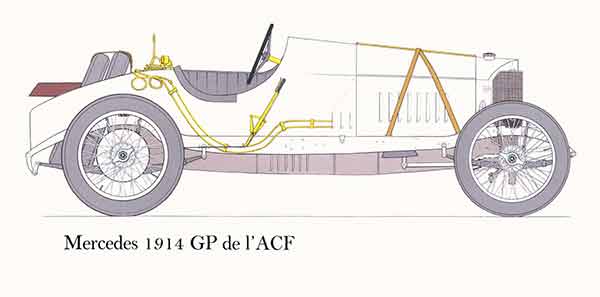
- 1914 Mercedes GP de l'ACF
The 1914 G.P. De l’A.C.F. is considered by many to be the race of the century. It was one of the most competitive and exciting of all races to that point and proved to be the end of the "heroic age" of motor racing. The small companies pioneer spirit, that had seen car racing grow from an amateur amusement of the rich into a highly professional sport, was about to be lost in the fog of mass production. Archduke Franz Ferdinand had been assassinated less than a week before making this the last Grand Prix before World War One. For the 1914 Grand Prix season cars were restricted to a maximum weight of 1,100 kg and an engine capacity of 4500cc. Altogether 37 cars from 13 manufacturers in 6 countries were entered including full works backed teams from Delage, Peugeot, Vauxhall, Sunbeam, Fiat, Opel and Mercedes. Vintage historic racing car lithographs by George A. Oliver 1963 to 1967 Size of pages was approx 23.5 x 39.5cm, 9.25 x 15.5 inches with wide margins and printed on excellent quality cartridge paper. Illustrated and written by George A. Oliver from the folio Historic Racing Cars (1907–1960): by Oliver and text by Laurence Pomeroy (included) £45 inc delivery
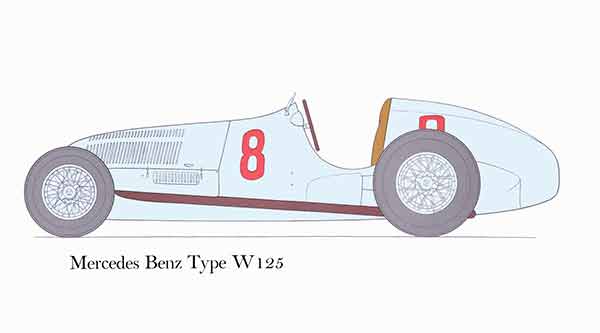
- 1937 Mercedes-Benz Type W125
The Mercedes-Benz W125 was a Grand Prix racing car produced by German auto manufacturer Mercedes-Benz to race during the 1937 Grand Prix season. Designed by head designer Rudolf Uhlenhaut, the car was used by Rudolf Caracciola to win the 1937 European Championship and W125 drivers also finished in the second, third and fourth positions in the championship.£45 inc delivery
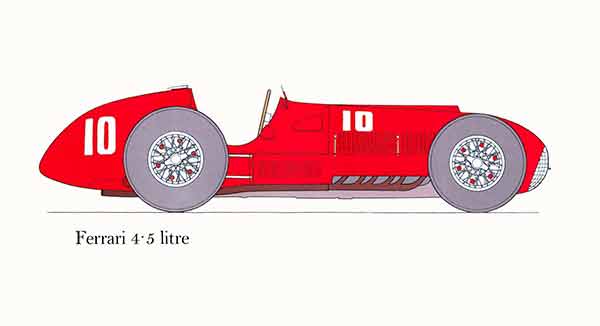
- 1950/53 Ferrari 4.5 litre
Ferrari achieved the 4.5-litre goal of the formula with the 375 F1, two of which debuted at Monza on September 3, 1950. This 4.5-litre (4493.73 cc/274 in³) engine produced roughly the same power as its 4.1-litre predecessor, but its tractability earned Ascari second place in that debut race. £45 inc delivery
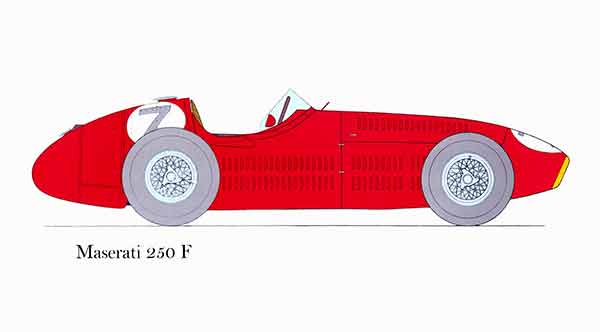
- 1954/57 Maserati 250 F
The Maserati 250F was produced from 1954 through 1957 with a total of 26 examples being produced. The frame was a multi-tubular design with aluminum body panels. The rear suspension was a DeDion type axle while the front was independent with coil springs. Hydraulic drum brakes were fitted on all four corners. £45 inc delivery

- 1955/58 Vanwall
Vanwall was a British motor racing team and racing car constructor that was active in Formula One during the 1950s. Founded by Tony Vandervell, the Vanwall name was derived by combining the name of the team owner with that of his Thinwall bearings produced at the Vandervell Products factory at Acton, London. Originally entering modified Ferraris in non-championship races, Vanwall constructed their first cars to race in the 1954 Formula One season. £45 inc delivery

- 1960 Lotus Type 18
English Sports-Cars (1925–1939)
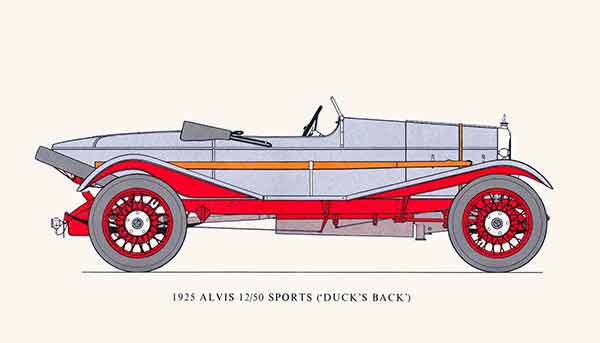
1925 Alvis 12/50 Sports Aluminium panelled 'Duck's-Back' three-seat body: Drawn by George A. Oliver
Vintage historic racing car lithographs by George A. Oliver 1963 to 1967 Size of pages was approx 23.5 x 39.5cm, 9.25 x 15.5 inches with wide margins and printed on excellent quality cartridge paper. Illustrated and written by George A. Oliver from the folio English Sports-Cars (1925–1939): by Oliver and text by Laurence Pomeroy (included) £45 inc delivery
NOT as per image but the first edition with text beneath the image
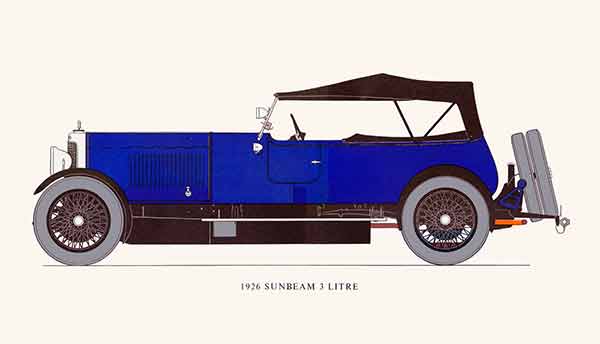
1926 Sunbeam 3 Litre:
The Sunbeam 3-litre is a 26 long cwt (2,912 lb; 1,321 kg) sports car introduced by Sunbeam in October 1925[3] at the London Motor Show,[2] and was offered from 1926 until 1930. It was seen at the time and subsequently as the retort of Louis Hervé Coatalen, Sunbeam's energetic chief engineer, to the Bentley 3 Litre which by then was beginning to make its mark, having won at Le Mans earlier that year. £45 inc delivery
NOT as per image but the first edition with text beneath the image
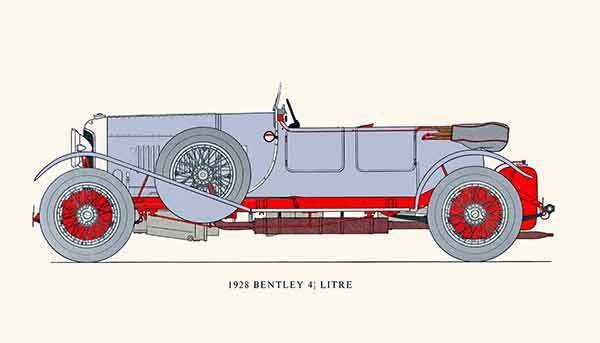
1928 Bentley 4½ Litre Metal-panelled 'short' four-seat body by Van den Plas (England):
The Bentley 4½ Litre is a British car based on a rolling chassis built by Bentley Motors. Walter Owen Bentley replaced the Bentley 3 Litre with a more powerful car by increasing its engine displacement to 4.4 litres (270 cubic inches). A racing variant was known as the Blower Bentley. £45 inc delivery
NOT as per image but the first edition with text beneath the image

1930 Austin 7 'Ulster':

1932 Lagonda 2 Litre 'Continental':
Lagonda's early success had been founded on the production of light cars, but the company changed direction in the mid-1920s with the introduction of the 14/60. The latter abandoned the firm's traditional in-unit gearbox in favour of a midships-mounted transmission, but of greater technical interest was the engine. Designed by Arthur Davidson, the 2.0-litre 'four' featured twin camshafts that were mounted high in the block, operating inclined valves in hemispherical combustion chambers. Power output of this advanced design was a highly respectable 60bhp. £45 inc delivery
NOT as per image but the first edition with text beneath the image

1933 Aston Martin 1½ Litre 'Le Mans':
Only a dozen or so of the 'New' International were built until the Le Mans model was introduced in October 1932 to celebrate the success on the marque in the great race. It was available with both 2 and 2/4 seater coachwork and was a true production car unlike the rare Le Mans teamcar 'replica' of 1931. The Le Mans had a much lower radiator line than the International together with a more powerful 70 bhp engine.£45 inc delivery
NOT as per image but the first edition with text beneath the image

1933 Invicta 4½ Litre 'S':
Invicta was founded by motor engineer and former racer,
Captain Noel Macklin in 1924 and was backed by Oliver Lyle,
of the famous sugar family.Macklin insisted that the quality
of Invicta cars were to be on the same level as Rolls-Royce
and rival the performance of Bentley. Invicta became the
only other British car besides Rolls-Royce to have a
three-year chassis guarantee.Launched in 1930 at the London
Motor Show held at Olympia, the 4 ½ Litre S-type featured an
‘under-slung’ chassis, which achieved a much lower centre of
gravity by positioning the axles above the frame rails
instead of below as was normal practice at the time. The car
was powered by the reliable 4 ½ Litre Meadows.£45 inc
delivery
NOT as per image but the first edition with text
beneath the image
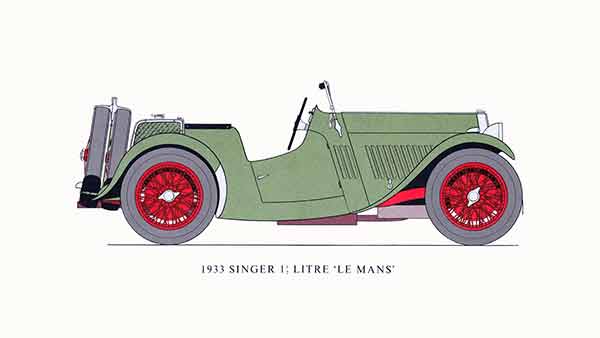
1933 Singer 1½ Litre 'Le Mans':
in May 1933 Singer had introduced a 1½-Litre Sports based on the existing six-cylinder 14hp model, and predictably followed that up with a Le Mans version for '34. The six-cylinder 1½-Litre's 7th and 8th place finishes at Le Mans in 1934 would prove to be the highlight of its endurance racing career. In trials, rallies and other competitions though, the 1½-litre Singer remained a force to be reckoned with for many years. £45 inc delivery
NOT as per image but the first edition with text beneath the image

1935 Frazer Nash 'T.T. Replica':
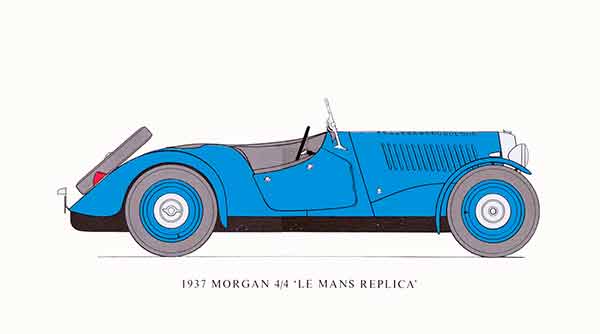
1937 Morgan 4/4 'Le Mans Replica':
In 1938 commemorate their first success at Le Mans, Morgan produced a limited number of “Le Mans Replicas.” These were hand-built in the Morgan factory to the same specification as the car raced by Ms. Fawcett. Of the seven Le Mans 4/4 replicas, six were standard two-seater roadsters, but one was special ordered as a four-seater. so 1937 ?£45 inc delivery
NOT as per image but the first edition with text beneath the image
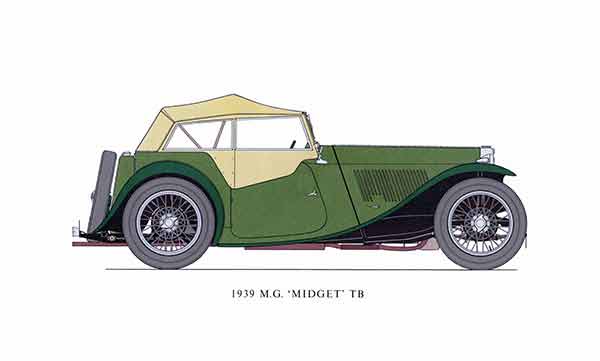
1939 M.G. 'Midget' TB:
Launched in May 1939, the TB did not look anything different from the TA and it was not until the bonnet was opened that the differences became apparent. During late 1938 and early 1939 that the XPAG engine was developed. It was a totally new engine with a fairly high state of tune and featured an enlarged cylinder bore of 66.5mm giving a capacity of 1250cc, which was down 42ccs on the TA engine. Despite this drop in capacity, the car ended up in the next taxation class going from to 10 to 11 horsepower. £45 inc delivery
NOT as per image but the first edition with text beneath the image
Vintage historic car lithographs by George A. Oliver 1963 to 1967
Size of pages was approx 23.5 x 39.5cm, 9.25 x 15.5 inches with wide margins and printed on excellent quality cartridge paper. Illustrated and written by George A. Oliver who also wrote numerous pre war car books that tended to be well researched and accurate
George Oliver was a wide-ranging car observer. Born in Birmingham but brought up in Glasgow, George was educated at Bellahouston Academy, then enrolled at Glasgow School of Art in 1938, called up for war service in the RAF where he ended in New Delhi. Back to GSA for a Diploma in Commercial Art, he then worked for 18 months in London before becoming art editor of 'Scotland's SMT Magazine' then, for much of his life a freelance. During the 1960s George became known to a much wider audience for a series of distinctive books generically titled 'Early Motor Cars'. Covering the veteran and vintage years, English sports cars and early cars, these were books of full-page profile scale drawings of specific vehicles, many of which were destined to be cut out and framed. Veteran Motor Cars (1894–1904):

Panhard et Levassor (double Phaeton) 1898
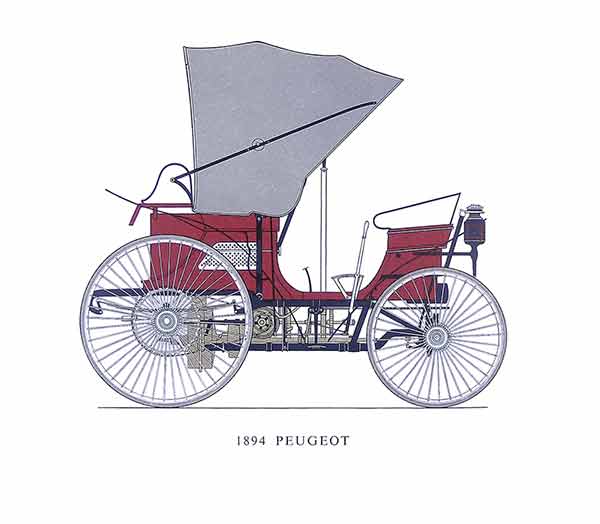
Peugeot 1894

Benz 'Ideal' 1899
The Benz 6-HP Ideal 1899 is a historically important vehicle that sits at the intersection of technological innovation and automotive design. Built by the Benz & Cie. company, this vehicle is an example of the power and potential of early automobile engineering. At the core of this vehicle is its impressive engine. The 6-HP (5 kW) internal combustion engine features a 1-cylinder design with a displacement of 1045 cc (63.8 cubic inches). This leads to an impressive power output of 6 horsepower (4.5 kW) at a speed of 900 RPM. Vintage historic car lithographs by George A. Oliver 1963 to 1967 Size of pages was approx 23.5 x 39.5cm, 9.25 x 15.5 inches with wide margins and printed on excellent quality cartridge paper. Illustrated and written by George A. Oliver £25
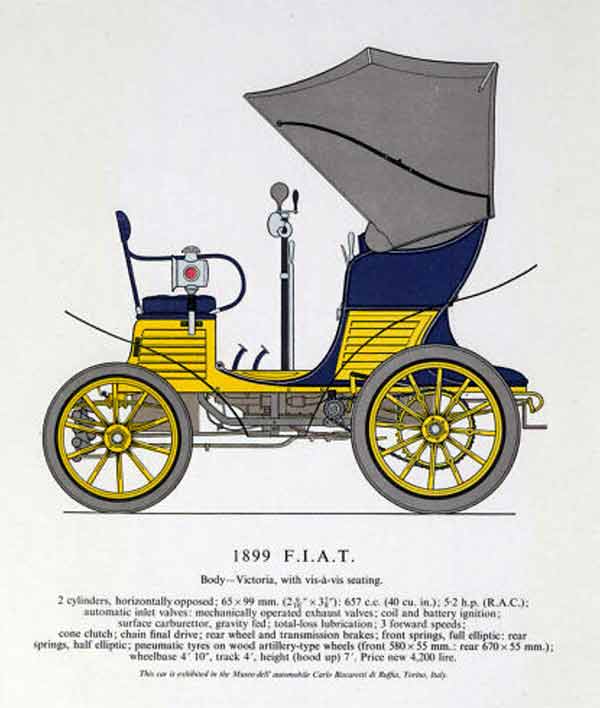
Fiat /F.I.A.T. 1899

Albion 1901
Scottish : Once the largest commercial vehicle company in the British Empire, Albion was established in December 1899 in Finnieston Street, Glasgow by Arrol-Johnston émigrés T Blackwood Murray and Norman Fulton. The firm manufactured cars to begin with, concentrating on its commercial vehicle business from the end of 1913. Vintage historic car lithographs by George A. Oliver 1963 to 1967 Size of pages was approx 23.5 x 39.5cm, 9.25 x 15.5 inches with wide margins and printed on excellent quality cartridge paper. Illustrated and written by George A. Oliver £25

Locomobile 1900
American : The Locomobile Company of America was a pioneering American automobile manufacturer founded in 1899, and known for its dedication to precision before the assembly-line era.[1] It was one of the earliest car manufacturers in the advent of the automobile age. For the first two years after its founding, the company was located in Watertown, Massachusetts. Production was transferred to Bridgeport, Connecticut, in 1900, where it remained until the company's demise in 1929. The company manufactured affordable, small steam cars until 1903, when production switched entirely to internal combustion-powered luxury automobiles. All cars ever produced by the original company were always sold under the brand name Locomobile. Vintage historic car lithographs by George A. Oliver 1963 to 1967 Size of pages was approx 23.5 x 39.5cm, 9.25 x 15.5 inches with wide margins and printed on excellent quality cartridge paper. Illustrated and written by George A. Oliver £25
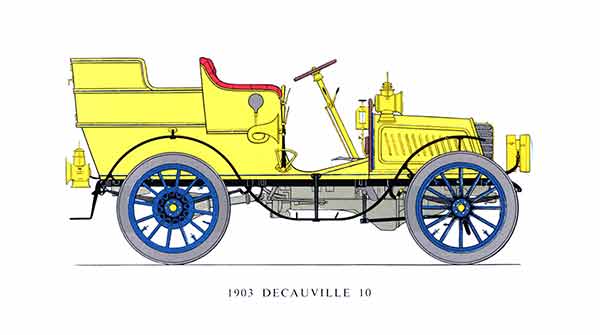
Decauville 1903
French : The famous Decauville firm of locomotive manufacturers began their series of road vehicles by making the Gyédon small car, which they renamed the Decauville. This first Decauville car would have been called a Decauville voiturette, but for the fact that Léon Bollée had already appropriated the word for his own little machine. Thus it was termed the Decauville Voiturelle. It had four wheels, unlike the Bollée, and was powered by a vertical twin-cylinder air-cooled engine of 3½hp, at first mounted at the rear. There were two forward speeds. However the remarkable feature of the Decauville Voiturelle for sale was its front suspension, which was independent – the first known instance of this on a production petrol car was by Decauville. Vintage historic car lithographs by George A. Oliver 1963 to 1967 Size of pages was approx 23.5 x 39.5cm, 9.25 x 15.5 inches with wide margins and printed on excellent quality cartridge paper. Illustrated and written by George A. Oliver £25

De Dietrich 1902
French: 1902 the Paris-Vienna race, was run concurrently with the Gordon Bennett Trophy, saw De Dietrich of Lunéville (Lorraine) enter four of their new 16-hp cars, built under a licence signed earlier that year with Turcat-Méry of Marseille. 1897 De Dietrich of Lunéville had acquired the licence to build cars designed by Amédée Bollée, but these idiosyncratic flat-twin automobiles had become thoroughly outmoded by 1901. Board member Baron Adrien de Türckheim, whose father had married into the de Dietrich family and ran the Lunéville factory, looked around for an up-to-date successor. Early in 1902, Adrien de Türckheim visited Nice probably for the Automobile Meeting at the beginning of April and saw an unfamiliar car that interested him. It was a Turcat-Méry driven by the crack driver, Rougier, and the influential journalist Paul Mayan introduced Adrien de Türckheim to its makers, the cousins Léon Turcat and Simon Méry. They had built a car as early as 1896 and established a manufacturing company in their home town of Marseille in 1899. Their latest models had been built for the proposed 418-mile Nice-Abazzia contest, in which they were thought likely to "prove one of the revelations of the coming race", but the last-minute prohibition of the contest gave them no chance to prove their mettle. Vintage historic car lithographs by George A. Oliver 1963 to 1967 Size of pages was approx 23.5 x 39.5cm, 9.25 x 15.5 inches with wide margins and printed on excellent quality cartridge paper. Illustrated and written by George A. Oliver £25
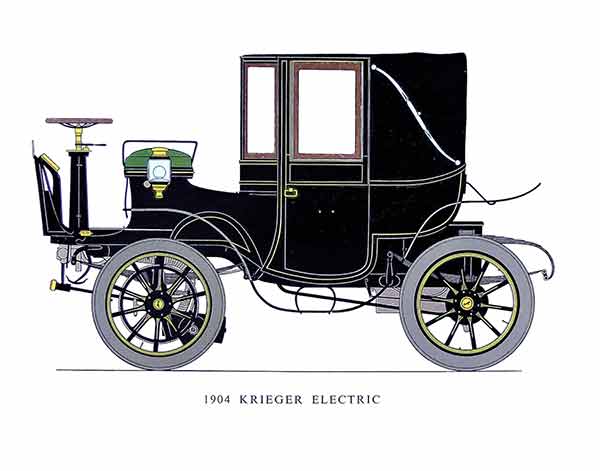
Kriéger Electric car 1904

Mercedes 40 1904
German: Mercedes Simplex models of 1904 essentially carried on from the 1902 model range. Production of the 60 hp model from the sales range of 1903 continued largely without modifications, the 18/22 hp, however, was discontinued in favor of the 18/28 hp. The latter once again featured an engine with conventional valve configuration, i.e. with lateral upright intake and exhaust valves, thereby largely corresponding to the 20 hp Mercedes Simplex of 1902. However, in the 1904 model year at least, the 18/28 hp also had the three-quarter-elliptical springs on the front wheels like its direct predecessor, the 8/22 hp. Vintage historic car lithographs by George A. Oliver 1963 to 1967 Size of pages was approx 23.5 x 39.5cm, 9.25 x 15.5 inches with wide margins and printed on excellent quality cartridge paper. Illustrated and written by George A. Oliver £25

Lanchester 12 1904
Brimingham, UK : Work on the first Lanchester car had been started in 1895, significantly designed from first principles as a car, not a horseless carriage, and it ran on the public roads in February or March 1896. It had a single-cylinder 1306 cc engine with the piston having two connecting rods to separate crankshafts and flywheels rotating in opposite directions giving very smooth running. A two-cylinder engine was fitted to the same chassis in 1897 and a second complete car was built alongside it. This led on to the first production cars in 1900, when six were made as demonstrators. Vintage historic car lithographs by George A. Oliver 1963 to 1967 Size of pages was approx 23.5 x 39.5cm, 9.25 x 15.5 inches with wide margins and printed on excellent quality cartridge paper. Illustrated and written by George A. Oliver £25

Rolls Royce 1904
Manchester's finest :The Rolls-Royce 10 hp was the first car to be produced as a result of an agreement of 23 December 1904 between Charles Rolls and Henry Royce,and badged as a Rolls-Royce. The 10 hp was produced by Royce's company, Royce Ltd., at its factory in Cooke Street, Hulme, Manchester, and was sold exclusively by Rolls' motor dealership, C.S.Rolls & Co., at a price of £395.[a] The 10 hp was exhibited at the Paris Salon in December 1904, along with 15 hp and 20 hp cars and engine for the 30 hp models. Vintage historic car lithographs by George A. Oliver 1963 to 1967 Size of pages was approx 23.5 x 39.5cm, 9.25 x 15.5 inches with wide margins and printed on excellent quality cartridge paper. Illustrated and written by George A. Oliver £25
Edwardian Motor Cars (1904–1915)
NOT as per image but the first edition with text beneath the image
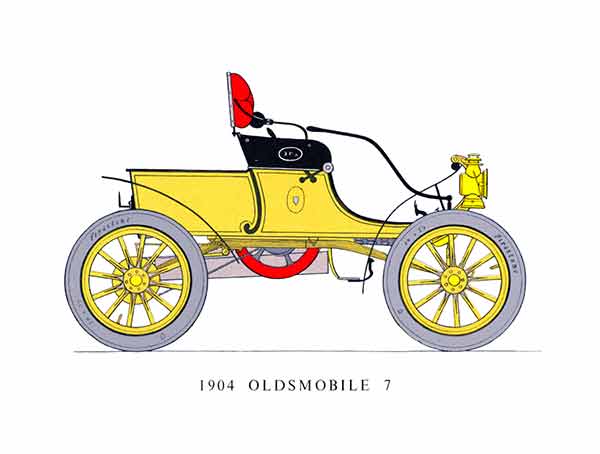
Oldsmobile 7hp 1904
American : Ransom Eli Olds is generally considered to be the father of mass production with his Curved Dash Oldsmobile, significantly predating Henry Ford’s Model ‘T’. Although dabbling in steam and internal combustion-engined cars from as early as 1887, it was not until March 1901 that his business seriously took off. A disastrous fire at the factory saw just one gasoline-engined runabout rescued from the blaze. It was a simple curved dash, lightweight, single-cylinder engined runabout that was rescued from the fire – the rest is history. Factory manager Frederick Smith referred to the fire in later years as “the best move ever made by the management”. Vintage historic car lithographs by George A. Oliver 1963 to 1967 Size of pages was approx 23.5 x 39.5cm, 9.25 x 15.5 inches with wide margins and printed on excellent quality cartridge paper. Illustrated and written by George A. Oliver £25 NOT as per image but the first edition with text beneath the image

De Dion Bouton 8hp 1904
French : Count Albert De Dion commissioned Messrs Bouton and Trépardoux, brothers-in-law and jobbing engineers, to build light steam carriages for him as early as 1882. In 1895 attention was switched to the fashionable new internal combustion engine and De Dion Bouton et Cie were marketing a diminutive petrol engined tricycle. These early tricycles were powered by Bouton’s new, high speed, single cylinder, vertical engine which revved at almost twice the speed of the contemporary Daimlers. By 1899 the company was marketing a 3 1/2hp Voiturette, an all new generation of four wheel motor car with rear mounted engine driving through a system of gears to the rear wheels. With the new car came the renowned De Dion rear axle – then years ahead of its time. A larger 4 1/2hp engine was offered in the vis-à-vis models from 1900 and with this power unit the car had a comfortable running speed of 25mph although braking ability was a limiting factor. Vintage historic car lithographs by George A. Oliver 1963 to 1967 Size of pages was approx 23.5 x 39.5cm, 9.25 x 15.5 inches with wide margins and printed on excellent quality cartridge paper. Illustrated and written by George A. Oliver £25 NOT as per image but the first edition with text beneath the image

White 15hp 1905
American : The White steam cars were described as 'Incomparable', but White steamers, products of the White Sewing Machine Company of Cleveland, looked little different from other steam buggies, Produced after 1900 as the brain child of Rollin H. White, they had full-elliptic suspension. and wooden reach-bars linking front and rear axles which were a normal feature of the design of such vehicles. Vintage historic car lithographs by George A. Oliver 1963 to 1967 Size of pages was approx 23.5 x 39.5cm, 9.25 x 15.5 inches with wide margins and printed on excellent quality cartridge paper. Illustrated and written by George A. Oliver £25 NOT as per image but the first edition with text beneath the image
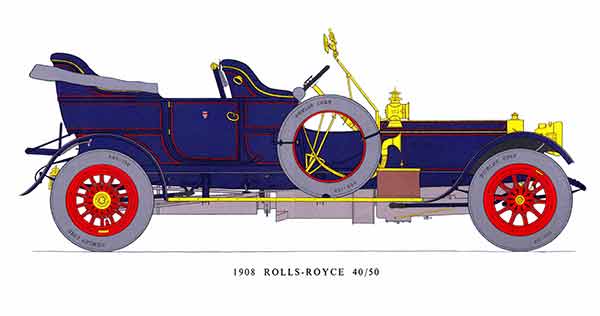
Rolls Royce 40/50hp 1908
The Rolls-Royce Silver Ghost name refers both to the car model and one specific car from that series. Originally named the "40/50 h.p." the chassis was first made at Royce's Manchester works ( Hulme + Moss Side area ), with production moving to Derby in July 1908, Vintage historic car lithographs by George A. Oliver 1963 to 1967 Size of pages was approx 23.5 x 39.5cm, 9.25 x 15.5 inches with wide margins and printed on excellent quality cartridge paper. Illustrated and written by George A. Oliver £25 NOT as per image but the first edition with text beneath the image

Renault 12/16hp 1910
French . The Renault Type CB Landaulet 1910 was a four-cylinder car with a displacement of 3.3 liters. The engine is capable of producing up to 45 horsepower and is coupled with a three-speed manual gearbox. This combination provides a top speed of 56 miles per hour while still maintaining an impressive fuel efficiency rating for its time. Vintage historic car lithographs by George A. Oliver 1963 to 1967 Size of pages was approx 23.5 x 39.5cm, 9.25 x 15.5 inches with wide margins and printed on excellent quality cartridge paper. Illustrated and written by George A. Oliver £25 NOT as per image but the first edition with text beneath the image
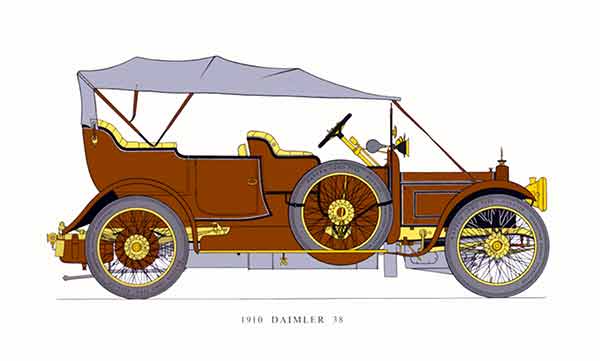
Daimler 38hp 1910
Now very rare this 1910 Daimler 38 Hp Landaulette was on display in the Museum and seems to have been drawn from the car in the National Motor Museum, Birdwood, South Australia. Vintage historic car lithographs by George A. Oliver 1963 to 1967 Size of pages was approx 23.5 x 39.5cm, 9.25 x 15.5 inches with wide margins and printed on excellent quality cartridge paper. Illustrated and written by George A. Oliver £25 NOT as per image but the first edition with text beneath the image

Lanchester 28hp 1910
The Lanchester 28-HP Landaulette, first introduced in 1910, was a luxurious vehicle designed to meet the high expectations of the wealthy upper class. One of the finest vehicles produced by Lanchester, a British carmaker . At the heart of the Lanchester 28-HP Landaulette was a powerful 4-cylinder engine, capable of producing 28 horsepower at 1600 RPM. It had a bore of 101.6mm and a stroke of 152.4mm, giving it a displacement of 5572cc. The engine was connected to a four-speed manual transmission, which provided smooth and effortless gear changes Vintage historic car lithographs by George A. Oliver 1963 to 1967 Size of pages was approx 23.5 x 39.5cm, 9.25 x 15.5 inches with wide margins and printed on excellent quality cartridge paper. Illustrated and written by George A. Oliver £25 NOT as per image but the first edition with text beneath the image
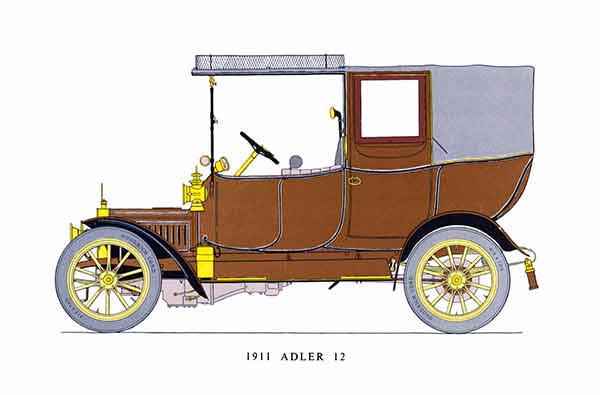
Adler 12hp 1911
A German company built the Adler motor car at Frankfurt. Like so many of its contemporaries (Riley etc) Adler graduated from bicycle production to motor cars at the turn of the 19th/20th Centuries. The marque made its debut at the 1900 Frankfurt Motor Show with a lightweight voiturette powered by a 3 1/2hp De Dion Bouton engine. From 1902 onwards Adler manufactured their own engines and were to pioneer the construction of engines and gearboxes built in unit. The four-cylinder, 12hp Adler introduced in about 1907 was a conventional car with shaft drive and three speed gearbox, with excellent gearing ensuring that the model tackled hills like a mountain goat. Vintage historic car lithographs by George A. Oliver 1963 to 1967 Size of pages was approx 23.5 x 39.5cm, 9.25 x 15.5 inches with wide margins and printed on excellent quality cartridge paper. Illustrated and written by George A. Oliver £25 NOT as per image but the first edition with text beneath the image

Vermorel 12/16hp 1912
Établissements V. Vermorel was a French engineering business that existed between 1850 and 1965: for more than a century, until the death in 1957 of Édouard Vermorel, it was a family-run business. The company presented its first automobile in 1899, but waited for some years before becoming a regular automobile producer. Between 1908 and 1930 Vermorel was noteworthy as an automobile manufacturer, and commercial vehicle production continued till 1932. Vintage historic car lithographs by George A. Oliver 1963 to 1967 Size of pages was approx 23.5 x 39.5cm, 9.25 x 15.5 inches with wide margins and printed on excellent quality cartridge paper. Illustrated and written by George A. Oliver £25 NOT as per image but the first edition with text beneath the image

Morris Oxford 9hp 1913
The 'Bullnose' Oxford had its roots in the Edwardian era. The first examples, fitted with 1,018cc 8.9hp White & Poppe engines, were manufactured in 1913. . . then sold everywhere Vintage historic car lithographs by George A. Oliver 1963 to 1967 Size of pages was approx 23.5 x 39.5cm, 9.25 x 15.5 inches with wide margins and printed on excellent quality cartridge paper. Illustrated and written by George A. Oliver £25 NOT as per image but the first edition with text beneath the image
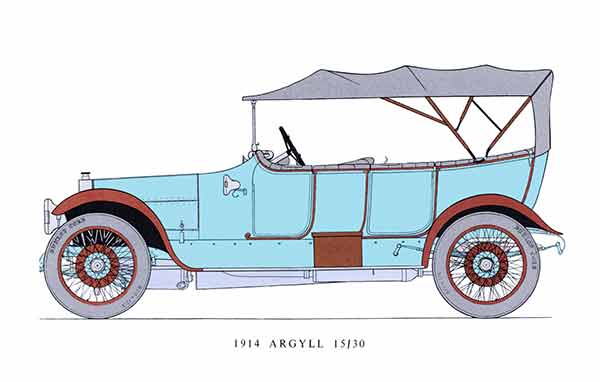
Argyll 15/30hp 1914
Scottish made: Argyll 15/30hp is one of the earliest British production cars with 4-wheel brakes, a feature that did not become commonplace until the 1920s. This car is @ Beaulieu Vintage historic car lithographs by George A. Oliver 1963 to 1967 Size of pages was approx 23.5 x 39.5cm, 9.25 x 15.5 inches with wide margins and printed on excellent quality cartridge paper. Illustrated and written by George A. Oliver £25 NOT as per image but the first edition with text beneath the image
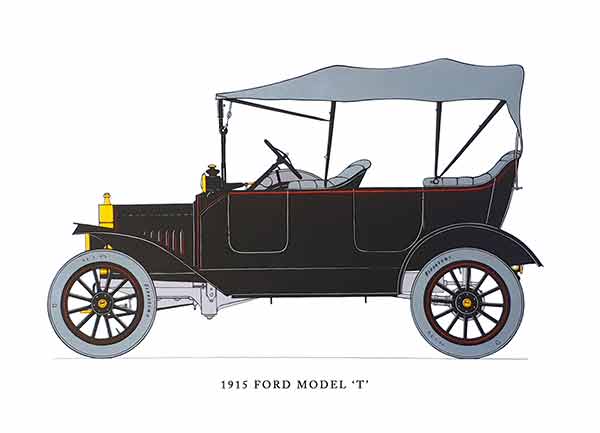
Ford model t
The indestructible 'tin lizzie' Vintage historic car lithographs by George A. Oliver 1963 to 1967 Size of pages was approx 23.5 x 39.5cm, 9.25 x 15.5 inches with wide margins and printed on excellent quality cartridge paper. Illustrated and written by George A. Oliver £25 NOT as per image but the first edition with text beneath the image
Vintage Motor Cars (1919–1930)
Vintage historic car lithographs by George A. Oliver 1963 to 1967 Size of pages was approx 23.5 x 39.5cm, 9.25 x 15.5 inches with wide margins and printed on excellent quality cartridge paper. Illustrated and written by George A. Oliver from
Vintage Motor Cars (1919–1930) £25

1919 Chevrolet Model 490 Standard Touring body £25
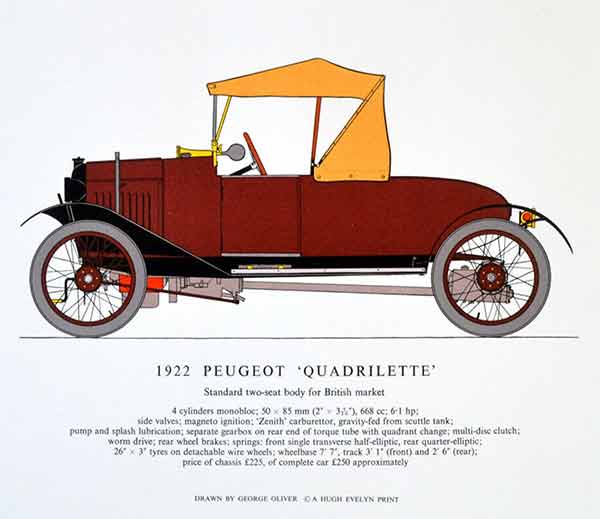
- 1922 Peugeot 'Quadrilette' Standard Two-Seat body for British market £25
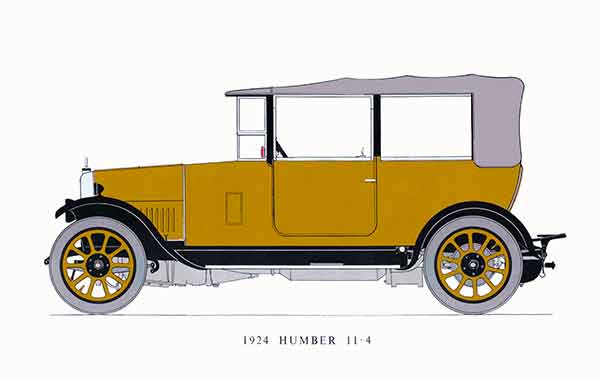
- 1924 Humber 11·4 All-Weather body by Humber Limited, Coventry, England £25

- 1926 Bentley 3-Litre Four-Seat body by Vanden Plas (England) 1923 Limited, London, England £45 inc delivery

- 1926 Bugatti Type 30 Four-Seat Sports-Touring body £45 inc delivery
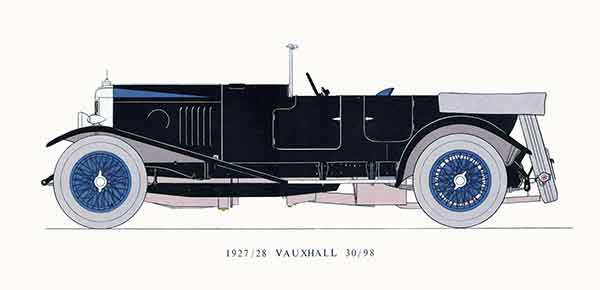
- 1927/28 Vauxhall 30/98 Four-Seat body by Vauxhall Motors Limited, Luton, England v
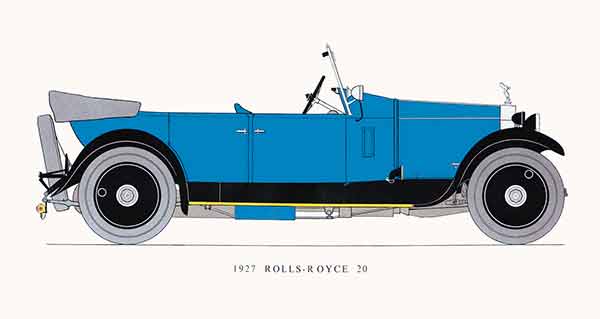
- 1927 Rolls-Royce 20 Touring body by Hooper & Co (Coachbuilders) Limited, London, England £45 inc delivery
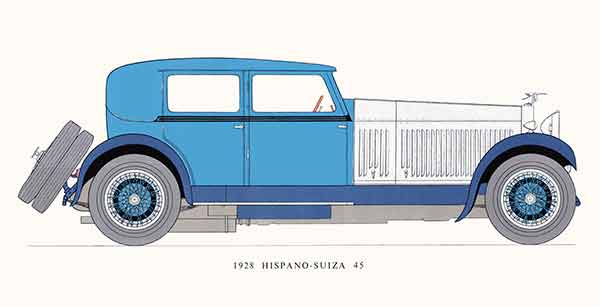
- 1928 Hispano-Suiza 45 Sports Saloon by J. Gurney Nutting & Company Limited, London, England £45 inc delivery
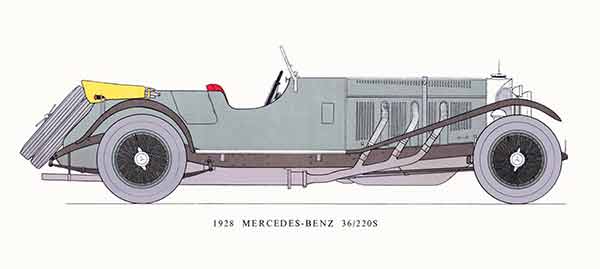
1928 Mercedes-Benz 36/220S Standard Four-Seat Sports-Touring body £45 inc delivery

- 1929 Stutz 36·4 Weymann-type Sports Saloon £45 inc delivery
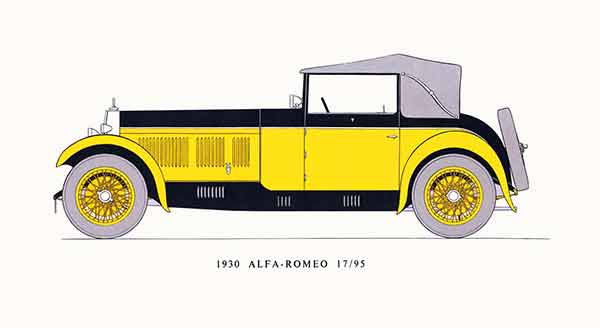
1930 Alfa-Romeo 17/95 Drophead Coupé by James Young & Company Limited, Bromley, England £45 inc delivery
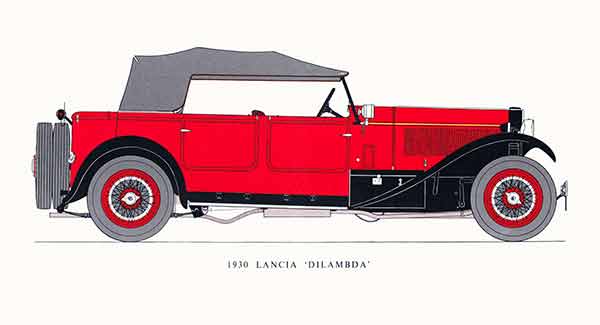
1930 Lancia 'Dilambda' Five-Seat Touring body £45 inc delivery
Card Adverts from days gone all original
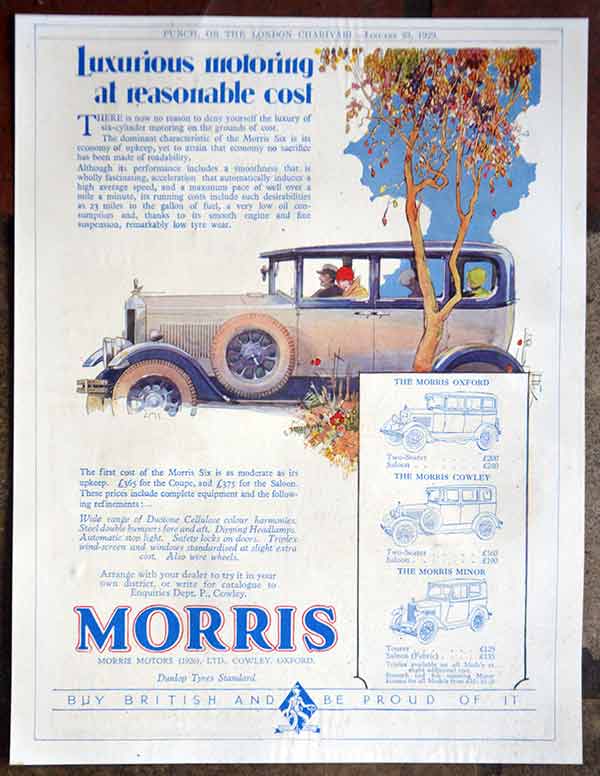
Morris Six 1929 from Punch or the London Chivari £15 all pics done through cellophane or plastic sleeves

Morris Six May 8 1929 /2 from Punch or the London Chivari £15

Ford V8 from Punch or the London Chivari 1936 £15

Morris Isis 1930 from Punch or the London Chivari £15

Morris Isis DHC/Sports Coupe 1932 from Punch or the London Chivari £15

Nash 1928 from the Sketch £15. . . grubby folder as these came from a London dealers store £15
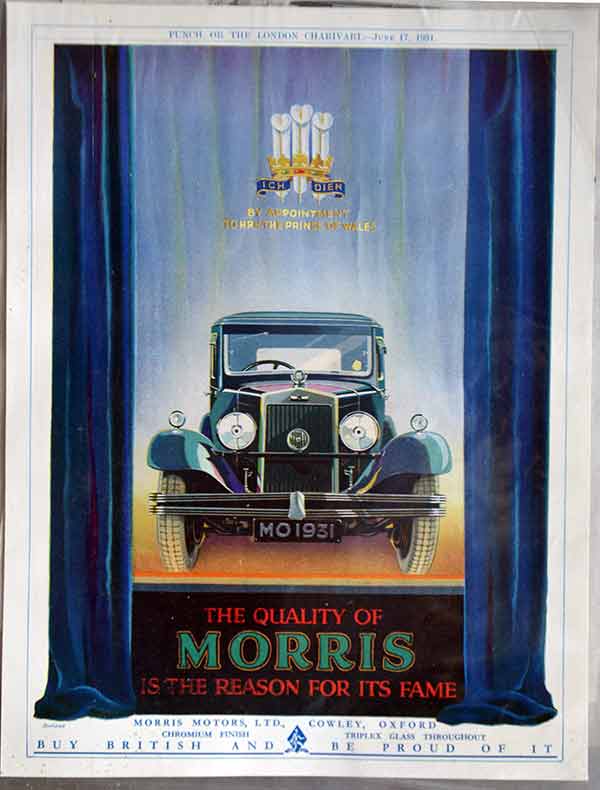
Morris 1931 from Punch or the London Chivari £15
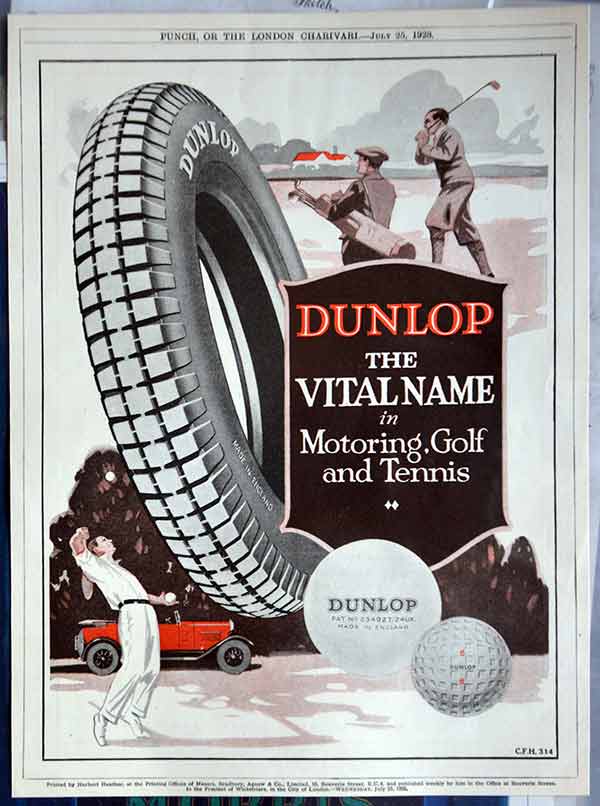
Dunlop. . Motoring, tennis,golf 1928 from Punch or the London Chivari £15

Napier six Cylinder from the Connisseur £10
The Shop
All copyright © reserved by Ros King 2023 (rosking AT freenetname.co.uk)