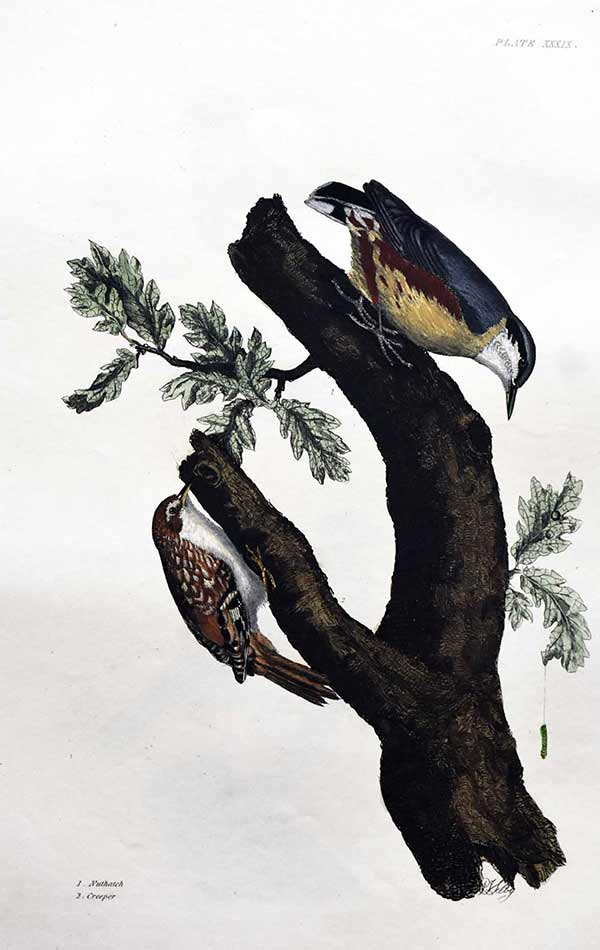
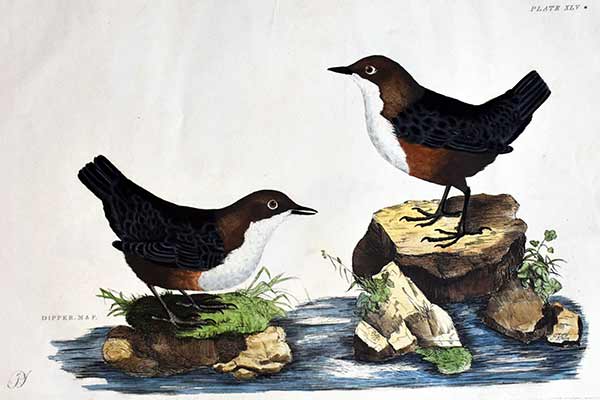
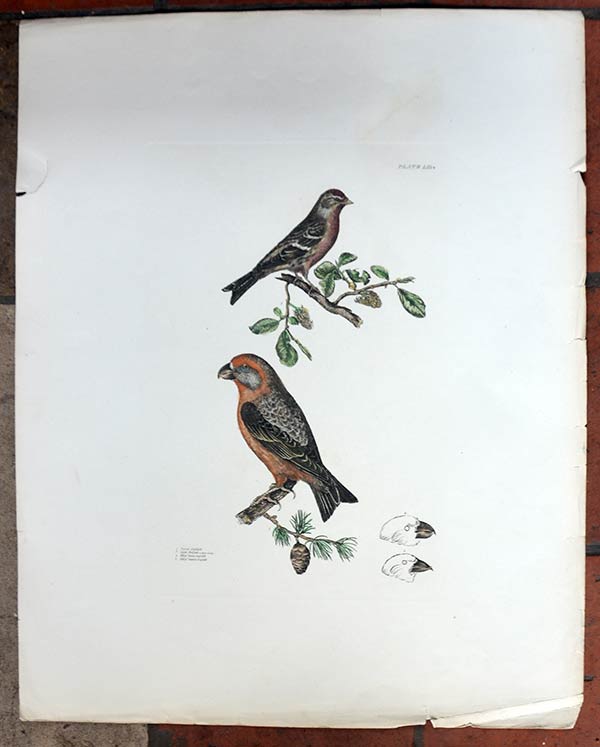
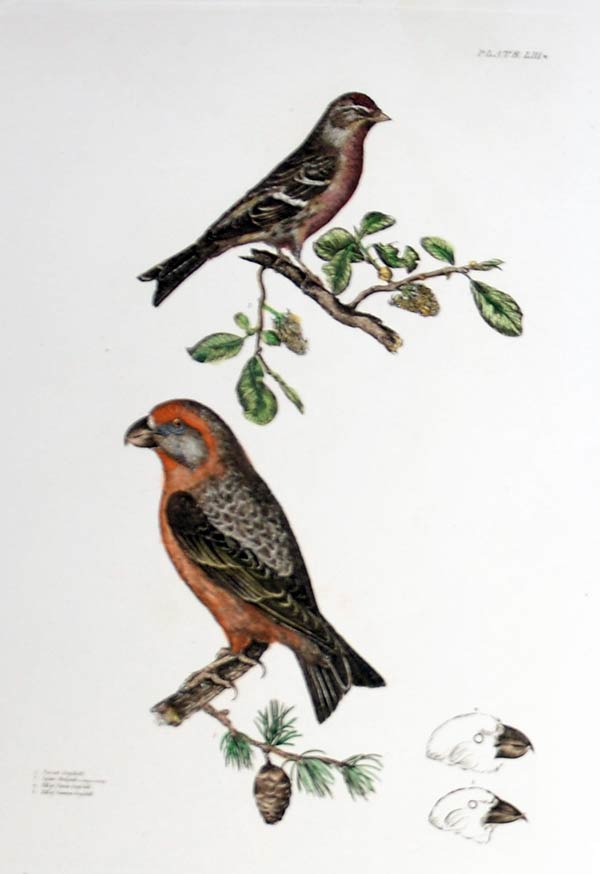
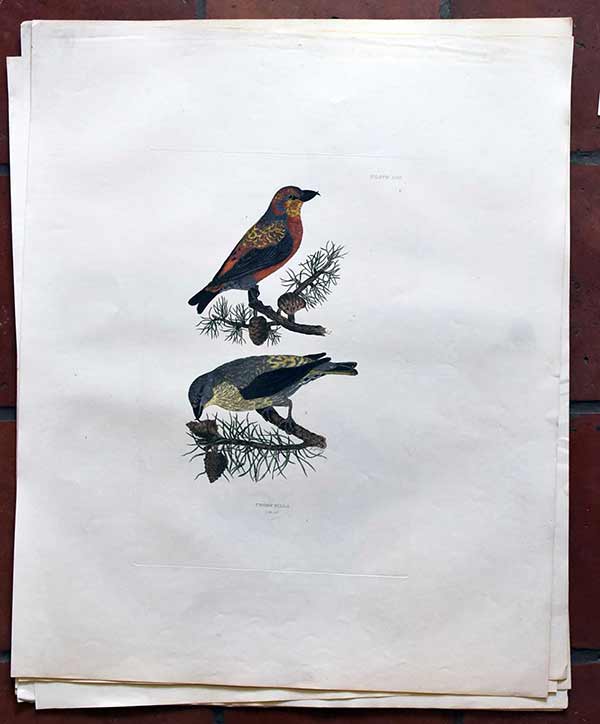
Prideaux John Selby
(1788-1867) Selby's Illustrations of British
Ornithology. Edinburgh: Daniel Lizars and London: Longman, Rees,
Orme [ca 1818-1823]. Engravings with original hand-coloring.
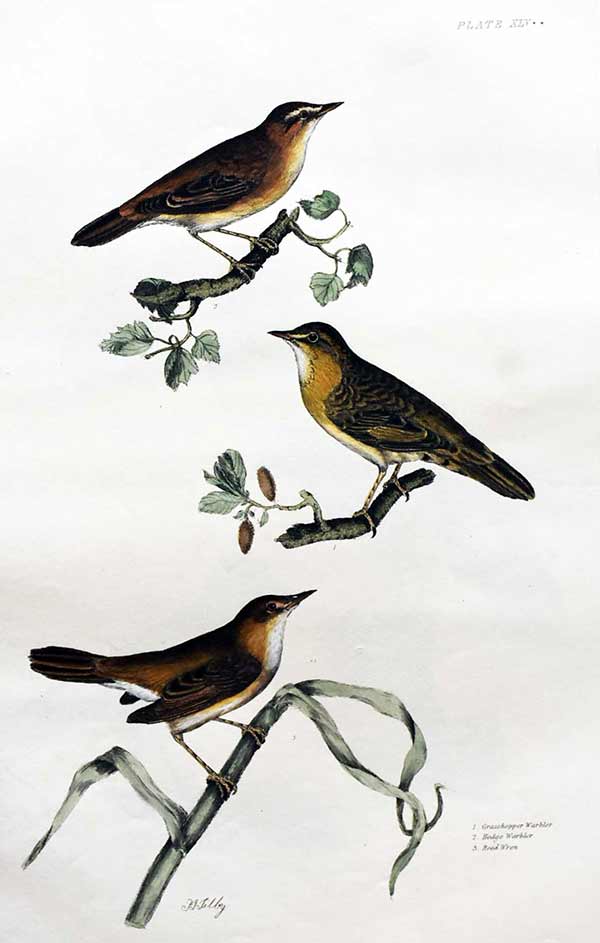
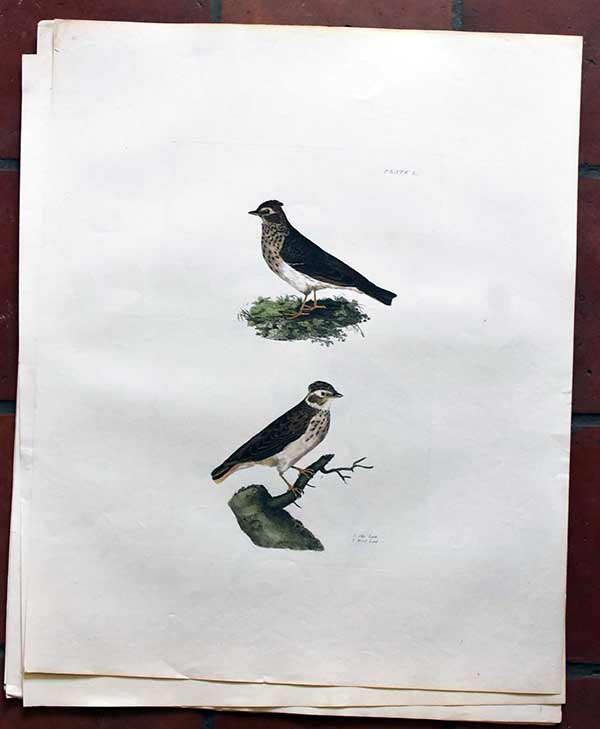
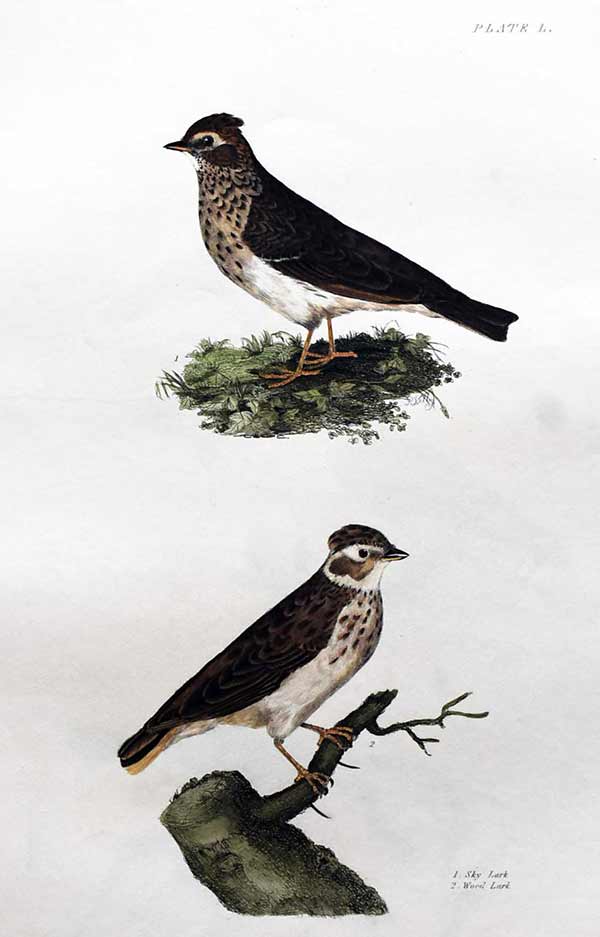
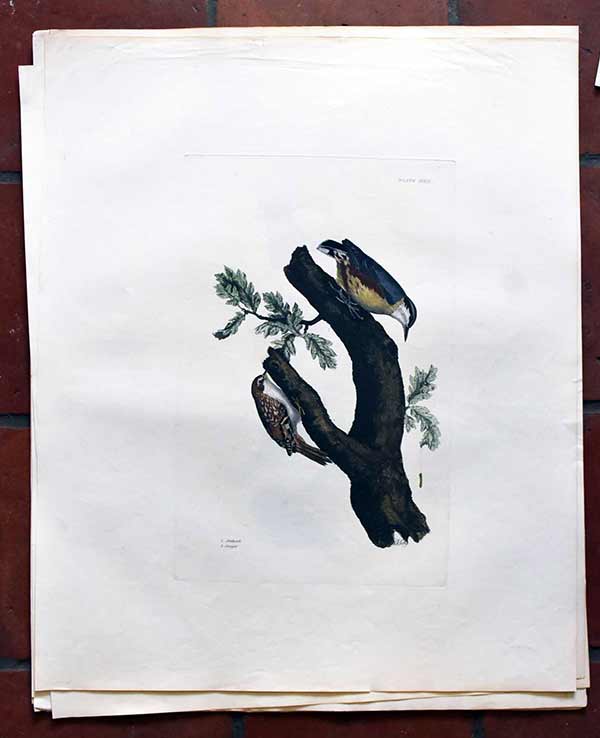
Prideaux John Selby "was very gifted as an artist, and the two
volumes of "Illustrations of British Ornithology" are
outstanding. Selby's bird figures were the most accurate
delineations of British birds to that date. After so many books
with small, stiff bird portraits, this new atlas with its
life-size figures and more relaxed drawing was a great
achievement in the long history of bird illustration"
Selby showed a "great interest
in ornithology from an early age and made his own notes and
careful, coloured drawings of the birds in his district... his
main interests were ornithology, forestry, and entomology. He
was a skilful fisherman and an excellent shot. Selby's major
work, "Illustrations of British Ornithology", was published in
nineteen parts between 1821 and 1833. It contained some 222
plates etched by Selby (mostly after his own drawings) with the
assistance of his brother-in-law Admiral Robert Mitford. In 1819
Mitford was taught to etch by Thomas Bewick in Newcastle; he
then taught Selby at Twizell House. Two volumes of text
appeared, "Land Birds" in 1825 (revised in 1833) and "Water
Birds" in 1833. The specimens on which the figures were based
were nearly all collected and set up by Selby, aided by his
butler, Richard Moffitt. "From 1825 until 1841 Selby assisted
his friend Sir William Jardine (1800–1874) with the
descriptions, drawings, and etchings for their joint
publication,'Illustrations of Ornithology' (1836–43). During
this period, in 1835 and 1836 respectively, he also wrote the
volumes 'Pigeons and Parrots' for Jardine's 'Naturalist's
Library'. Together, in conjunction with George Johnston, Selby
and Jardine founded the 'Magazine of Zoology and Botany' in
1836, which was widened in scope in 1838 when the name was
changed to 'Annals of Natural History'. Selby remained an editor
until his death, contributing notes and articles up to 1841. He
joined the Berwickshire Naturalists' Club soon after it was
founded in 1831 and served as its president in 1834 and again in
1844. Between 1832 and 1859 he contributed many papers to the
'History of the Berwickshire Naturalists' Club'. Further papers
were published in other journals between 1823 and 1838"
The plates were issued in parts
over 13 years, while the text volumes were issued separately in
1833/4, in order to secure copyright without providing the
copyright libraries with the costly plates; consequently, volumes
with plates from the original parts are usually found without the
text. A re-issue by Henry Bohn in 1841 combined the text and
plates, and is the version more commonly seen in the marketplace.
These are from the Ist edition and the 1833/4 edition with one
only from the Bohn . . . distinctive as ever from using bad paper
All of the large plate are full page but differing sizes of birds
so ask if size is crucial for a whole plate image. Also many are
heightened with amounts of gum arabic showing they are from the
original tinted version
Red Woodpecker
Wryneck
Plate from Illustrations of British Ornithology, 1821 34 by
Prideaux John Selby, hand-coloured engraving . Selby s large-scale
engravings were the first work of British ornithology to depict
many birds in the size of life. Comprising two volumes with a
total of 222 engravings, Illustrations of British Ornithology was
published in Edinburgh in 19 parts from 1821 to 1834. Created
during the same period that Audubon was publishing the Birds of
America, Both Audubon and Selby employed the Scottish engraver W.
H. Lizars. A highly skilled engraver himself, Selby employed
Lizars services only for printing and coloring his own exquisite
copper plates. Copies vary, and depending on the folio 222 or 218
of the engravings were hand-coloured, many by Daniel McNee.
Twenty-six of the plates were drawn by Selby s brother-in-law,
Admiral Mitford, and the rest were executed by Selby, who obtained
most of the specimens for the drawings himself. Selby engravings
are printed on elephant folio size Whatman paper that is
watermarked with the date the paper was made. Audubon also used
Whatman paper for the Havell edition of Birds of America. This
major work was etched/engraved by Selby, mostly after his own
drawings, with the assistance of his brother-in-law Captain Robert
Mitford. In 1816 Mitford was taught to etch and engrave by Thomas
Bewick in Newcastle; he then taught Selby at Twizell House . These
are shown large full size image plus the birds to compare sizing.
Elephant folio size, 20.375 x 25.5 inches £225
Spotted Sandpiper
Plate from Illustrations of British Ornithology, 1821 34 by
Prideaux John Selby, hand-coloured engraving . Selby s large-scale
engravings were the first work of British ornithology to depict
many birds in the size of life. Comprising two volumes with a
total of 222 engravings, Illustrations of British Ornithology was
published in Edinburgh in 19 parts from 1821 to 1834. Created
during the same period that Audubon was publishing the Birds of
America, Both Audubon and Selby employed the Scottish engraver W.
H. Lizars. A highly skilled engraver himself, Selby employed
Lizars services only for printing and coloring his own exquisite
copper plates. Copies vary, and depending on the folio 222 or 218
of the engravings were hand-coloured, many by Daniel McNee.
Twenty-six of the plates were drawn by Selby s brother-in-law,
Admiral Mitford, and the rest were executed by Selby, who obtained
most of the specimens for the drawings himself. Selby engravings
are printed on elephant folio size Whatman paper that is
watermarked with the date the paper was made. Audubon also used
Whatman paper for the Havell edition of Birds of America. This
major work was etched/engraved by Selby, mostly after his own
drawings, with the assistance of his brother-in-law Captain Robert
Mitford. In 1816 Mitford was taught to etch and engrave by Thomas
Bewick in Newcastle; he then taught Selby at Twizell House . These
are shown large full size image plus the birds to compare sizing.
Elephant folio size, 20.375 x 25.5 inches £225
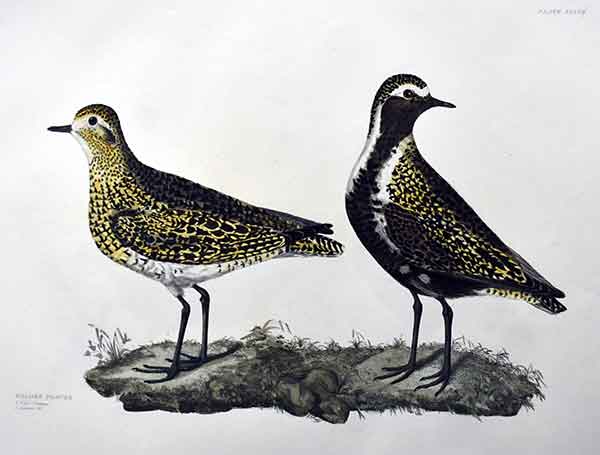
Plover
Plate from Illustrations of British Ornithology, 1821 34 by
Prideaux John Selby, hand-coloured engraving . Selby s large-scale
engravings were the first work of British ornithology to depict
many birds in the size of life. Comprising two volumes with a
total of 222 engravings, Illustrations of British Ornithology was
published in Edinburgh in 19 parts from 1821 to 1834. Created
during the same period that Audubon was publishing the Birds of
America, Both Audubon and Selby employed the Scottish engraver W.
H. Lizars. A highly skilled engraver himself, Selby employed
Lizars services only for printing and coloring his own exquisite
copper plates. Copies vary, and depending on the folio 222 or 218
of the engravings were hand-coloured, many by Daniel McNee.
Twenty-six of the plates were drawn by Selby s brother-in-law,
Admiral Mitford, and the rest were executed by Selby, who obtained
most of the specimens for the drawings himself. Selby engravings
are printed on elephant folio size Whatman paper that is
watermarked with the date the paper was made. Audubon also used
Whatman paper for the Havell edition of Birds of America. This
major work was etched/engraved by Selby, mostly after his own
drawings, with the assistance of his brother-in-law Captain Robert
Mitford. In 1816 Mitford was taught to etch and engrave by Thomas
Bewick in Newcastle; he then taught Selby at Twizell House . These
are shown large full size image plus the birds to compare sizing.
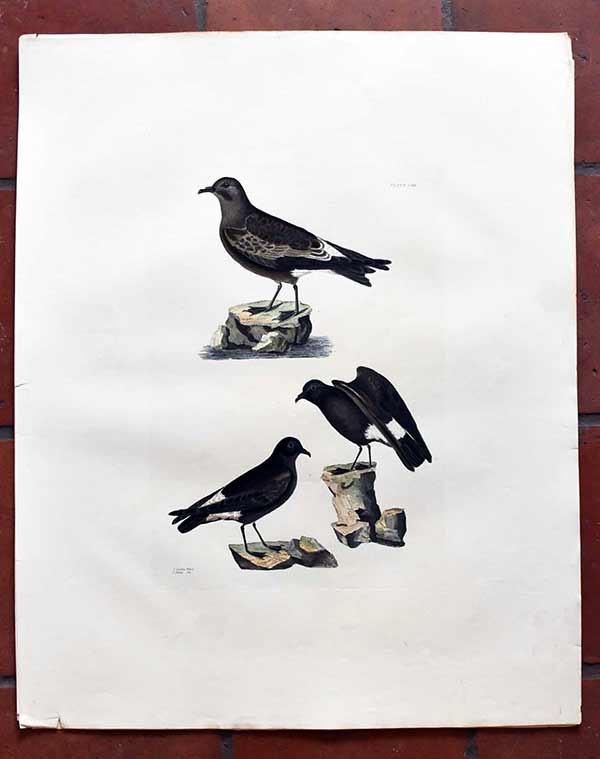
Elephant folio size, 20.375 x 25.5 inches £225
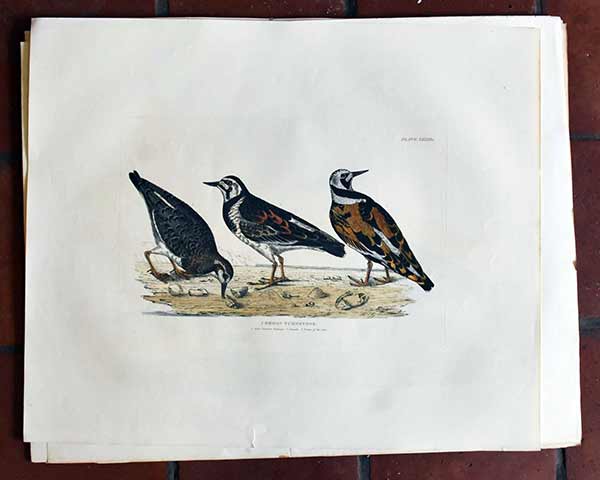
Turnstone
Plate from Illustrations of British Ornithology, 1821 34 by
Prideaux John Selby, hand-coloured engraving . Selby s large-scale
engravings were the first work of British ornithology to depict
many birds in the size of life. Comprising two volumes with a
total of 222 engravings, Illustrations of British Ornithology was
published in Edinburgh in 19 parts from 1821 to 1834. Created
during the same period that Audubon was publishing the Birds of
America, Both Audubon and Selby employed the Scottish engraver W.
H. Lizars. A highly skilled engraver himself, Selby employed
Lizars services only for printing and coloring his own exquisite
copper plates. Copies vary, and depending on the folio 222 or 218
of the engravings were hand-coloured, many by Daniel McNee.
Twenty-six of the plates were drawn by Selby s brother-in-law,
Admiral Mitford, and the rest were executed by Selby, who obtained
most of the specimens for the drawings himself. Selby engravings
are printed on elephant folio size Whatman paper that is
watermarked with the date the paper was made. Audubon also used
Whatman paper for the Havell edition of Birds of America. This
major work was etched/engraved by Selby, mostly after his own
drawings, with the assistance of his brother-in-law Captain Robert
Mitford. In 1816 Mitford was taught to etch and engrave by Thomas
Bewick in Newcastle; he then taught Selby at Twizell House . These
are shown large full size image plus the birds to compare sizing.
Elephant folio size, 20.375 x 25.5 inches £225
Tringa
Plate from Illustrations of British Ornithology, 1821 34 by
Prideaux John Selby, hand-coloured engraving . Selby s large-scale
engravings were the first work of British ornithology to depict
many birds in the size of life. Comprising two volumes with a
total of 222 engravings, Illustrations of British Ornithology was
published in Edinburgh in 19 parts from 1821 to 1834. Created
during the same period that Audubon was publishing the Birds of
America, Both Audubon and Selby employed the Scottish engraver W.
H. Lizars. A highly skilled engraver himself, Selby employed
Lizars services only for printing and coloring his own exquisite
copper plates. Copies vary, and depending on the folio 222 or 218
of the engravings were hand-coloured, many by Daniel McNee.
Twenty-six of the plates were drawn by Selby s brother-in-law,
Admiral Mitford, and the rest were executed by Selby, who obtained
most of the specimens for the drawings himself. Selby engravings
are printed on elephant folio size Whatman paper that is
watermarked with the date the paper was made. Audubon also used
Whatman paper for the Havell edition of Birds of America. This
major work was etched/engraved by Selby, mostly after his own
drawings, with the assistance of his brother-in-law Captain Robert
Mitford. In 1816 Mitford was taught to etch and engrave by Thomas
Bewick in Newcastle; he then taught Selby at Twizell House . These
are shown large full size image plus the birds to compare sizing.
Elephant folio size, 20.375 x 25.5 inches £225
Red Throated Diver (Young) Plate LXXVIII
very large page filling image £385 Two available
Plate from Illustrations of British Ornithology, 1821 34 by
Prideaux John Selby, hand-coloured engraving . Selby s large-scale
engravings were the first work of British ornithology to depict
many birds in the size of life. Comprising two volumes with a
total of 222 engravings, Illustrations of British Ornithology was
published in Edinburgh in 19 parts from 1821 to 1834. Created
during the same period that Audubon was publishing the Birds of
America, Both Audubon and Selby employed the Scottish engraver W.
H. Lizars. A highly skilled engraver himself, Selby employed
Lizars services only for printing and coloring his own exquisite
copper plates. Copies vary, and depending on the folio 222 or 218
of the engravings were hand-coloured, many by Daniel McNee.
Twenty-six of the plates were drawn by Selby s brother-in-law,
Admiral Mitford, and the rest were executed by Selby, who obtained
most of the specimens for the drawings himself. Selby engravings
are printed on elephant folio size Whatman paper that is
watermarked with the date the paper was made. Audubon also used
Whatman paper for the Havell edition of Birds of America. This
major work was etched/engraved by Selby, mostly after his own
drawings, with the assistance of his brother-in-law Captain Robert
Mitford. In 1816 Mitford was taught to etch and engrave by Thomas
Bewick in Newcastle; he then taught Selby at Twizell House . These
are shown large full size image plus the birds to compare sizing.
Elephant folio size, 20.375 x 25.5 inches. £385
Crested Cormorant £295 this will include removing the offsetting
halo Plate from Illustrations of British Ornithology, 1821 34 by
Prideaux John Selby, hand-coloured engraving . Selby s large-scale
engravings were the first work of British ornithology to depict
many birds in the size of life. Comprising two volumes with a
total of 222 engravings, Illustrations of British Ornithology was
published in Edinburgh in 19 parts from 1821 to 1834. Created
during the same period that Audubon was publishing the Birds of
America, Both Audubon and Selby employed the Scottish engraver W.
H. Lizars. A highly skilled engraver himself, Selby employed
Lizars services only for printing and coloring his own exquisite
copper plates. Copies vary, and depending on the folio 222 or 218
of the engravings were hand-coloured, many by Daniel McNee.
Twenty-six of the plates were drawn by Selby s brother-in-law,
Admiral Mitford, and the rest were executed by Selby, who obtained
most of the specimens for the drawings himself. Selby engravings
are printed on elephant folio size Whatman paper that is
watermarked with the date the paper was made. Audubon also used
Whatman paper for the Havell edition of Birds of America. This
major work was etched/engraved by Selby, mostly after his own
drawings, with the assistance of his brother-in-law Captain Robert
Mitford. In 1816 Mitford was taught to etch and engrave by Thomas
Bewick in Newcastle; he then taught Selby at Twizell House . These
are shown large full size image plus the birds to compare sizing.
Elephant folio size, 20.375 x 25.5 inches light creasing
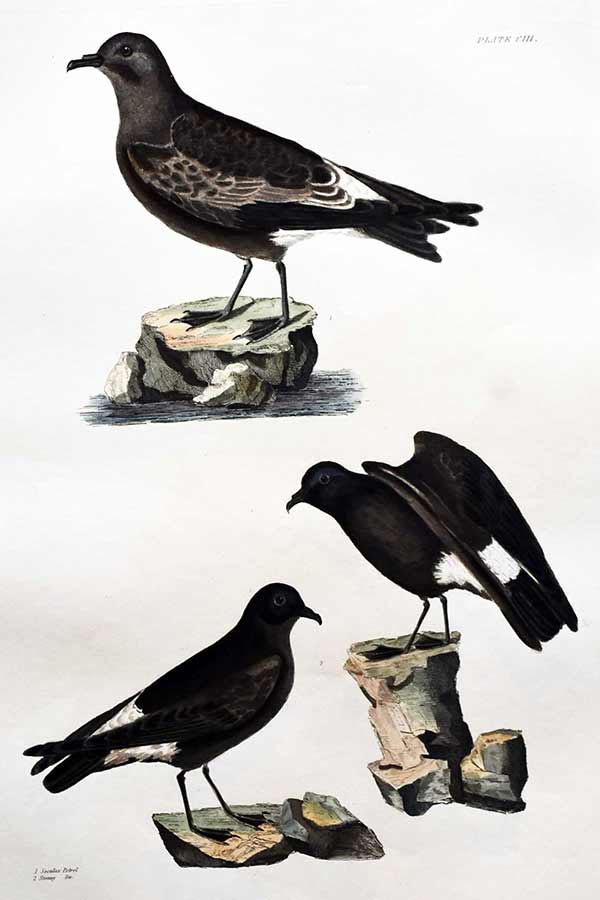
Cinnereous Shearwater £195 another sent with the offsetting
halo removed and clean
Plate from Illustrations of British Ornithology, 1821 34 by
Prideaux John Selby, hand-coloured engraving . Selby s large-scale
engravings were the first work of British ornithology to depict
many birds in the size of life. Comprising two volumes with a
total of 222 engravings, Illustrations of British Ornithology was
published in Edinburgh in 19 parts from 1821 to 1834. Created
during the same period that Audubon was publishing the Birds of
America, Both Audubon and Selby employed the Scottish engraver W.
H. Lizars. A highly skilled engraver himself, Selby employed
Lizars services only for printing and coloring his own exquisite
copper plates. Copies vary, and depending on the folio 222 or 218
of the engravings were hand-coloured, many by Daniel McNee.
Twenty-six of the plates were drawn by Selby s brother-in-law,
Admiral Mitford, and the rest were executed by Selby, who obtained
most of the specimens for the drawings himself. Selby engravings
are printed on elephant folio size Whatman paper that is
watermarked with the date the paper was made. Audubon also used
Whatman paper for the Havell edition of Birds of America. This
major work was etched/engraved by Selby, mostly after his own
drawings, with the assistance of his brother-in-law Captain Robert
Mitford. In 1816 Mitford was taught to etch and engrave by Thomas
Bewick in Newcastle; he then taught Selby at Twizell House . These
are shown large full size image plus the birds to compare sizing.
Elephant folio size, 20.375 x 25.5 inches mini edge tears Now
cleaner shown as 'before'
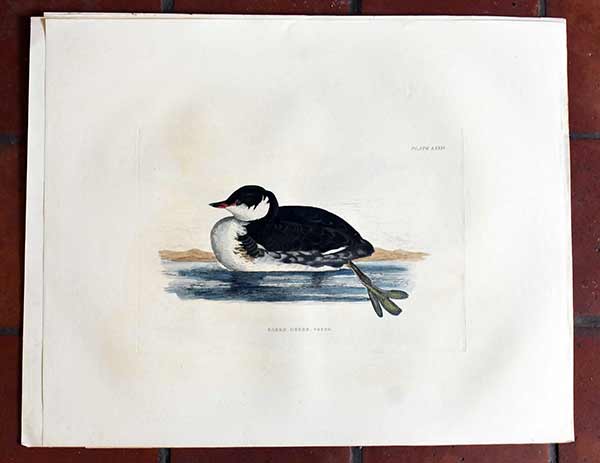
Red Necked Grebe Male £325
Plate from Illustrations of British Ornithology, 1821 34 by
Prideaux John Selby, hand-coloured engraving . Selby s large-scale
engravings were the first work of British ornithology to depict
many birds in the size of life. Comprising two volumes with a
total of 222 engravings, Illustrations of British Ornithology was
published in Edinburgh in 19 parts from 1821 to 1834. Created
during the same period that Audubon was publishing the Birds of
America, Both Audubon and Selby employed the Scottish engraver W.
H. Lizars. A highly skilled engraver himself, Selby employed
Lizars services only for printing and coloring his own exquisite
copper plates. Copies vary, and depending on the folio 222 or 218
of the engravings were hand-coloured, many by Daniel McNee.
Twenty-six of the plates were drawn by Selby s brother-in-law,
Admiral Mitford, and the rest were executed by Selby, who obtained
most of the specimens for the drawings himself. Selby engravings
are printed on elephant folio size Whatman paper that is
watermarked with the date the paper was made. Audubon also used
Whatman paper for the Havell edition of Birds of America. This
major work was etched/engraved by Selby, mostly after his own
drawings, with the assistance of his brother-in-law Captain Robert
Mitford. In 1816 Mitford was taught to etch and engrave by Thomas
Bewick in Newcastle; he then taught Selby at Twizell House . These
are shown large full size image plus the birds to compare sizing.
Elephant folio size, 20.375 x 25.5 inches
Greenshank £195
Plate from Illustrations of British Ornithology, 1821 34 by
Prideaux John Selby, hand-coloured engraving . Selby s large-scale
engravings were the first work of British ornithology to depict
many birds in the size of life. Comprising two volumes with a
total of 222 engravings, Illustrations of British Ornithology was
published in Edinburgh in 19 parts from 1821 to 1834. Created
during the same period that Audubon was publishing the Birds of
America, Both Audubon and Selby employed the Scottish engraver W.
H. Lizars. A highly skilled engraver himself, Selby employed
Lizars services only for printing and coloring his own exquisite
copper plates. Copies vary, and depending on the folio 222 or 218
of the engravings were hand-coloured, many by Daniel McNee.
Twenty-six of the plates were drawn by Selby s brother-in-law,
Admiral Mitford, and the rest were executed by Selby, who obtained
most of the specimens for the drawings himself. Selby engravings
are printed on elephant folio size Whatman paper that is
watermarked with the date the paper was made. Audubon also used
Whatman paper for the Havell edition of Birds of America. This
major work was etched/engraved by Selby, mostly after his own
drawings, with the assistance of his brother-in-law Captain Robert
Mitford. In 1816 Mitford was taught to etch and engrave by Thomas
Bewick in Newcastle; he then taught Selby at Twizell House . These
are shown large full size image plus the birds to compare sizing.
Elephant folio size, 20.375 x 25.5 inches
Golden Eagle Female
Plate from Illustrations of British Ornithology, 1821 34 by
Prideaux John Selby, hand-coloured engraving . Selby s large-scale
engravings were the first work of British ornithology to depict
many birds in the size of life. Comprising two volumes with a
total of 222 engravings, Illustrations of British Ornithology was
published in Edinburgh in 19 parts from 1821 to 1834. Created
during the same period that Audubon was publishing the Birds of
America, Both Audubon and Selby employed the Scottish engraver W.
H. Lizars. A highly skilled engraver himself, Selby employed
Lizars services only for printing and coloring his own exquisite
copper plates. Copies vary, and depending on the folio 222 or 218
of the engravings were hand-coloured, many by Daniel McNee.
Twenty-six of the plates were drawn by Selby s brother-in-law,
Admiral Mitford, and the rest were executed by Selby, who obtained
most of the specimens for the drawings himself. Selby engravings
are printed on elephant folio size Whatman paper that is
watermarked with the date the paper was made. Audubon also used
Whatman paper for the Havell edition of Birds of America. This
major work was etched/engraved by Selby, mostly after his own
drawings, with the assistance of his brother-in-law Captain Robert
Mitford. In 1816 Mitford was taught to etch and engrave by Thomas
Bewick in Newcastle; he then taught Selby at Twizell House . These
are shown large full size image plus the birds to compare sizing.
Elephant folio size, 20.375 x 25.5 inches. £385 a few flaws
at the base and light ripple reduced from £950 shown as 'before'
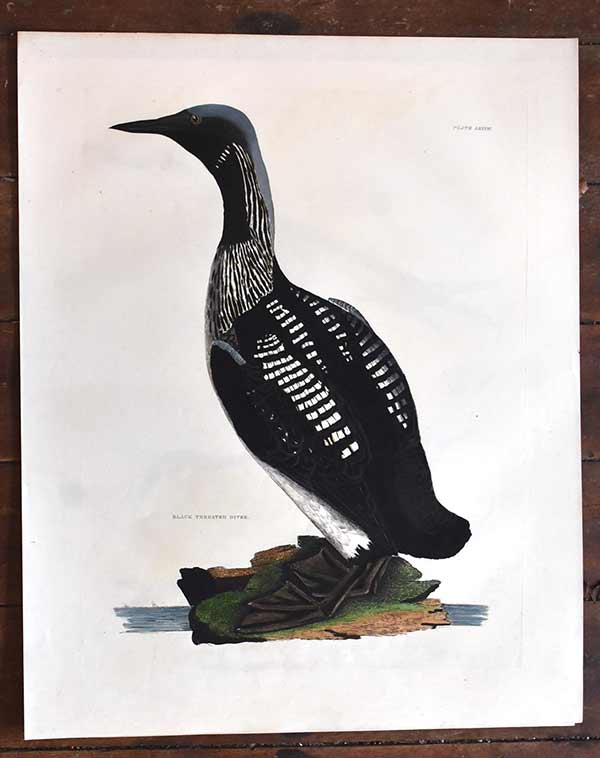
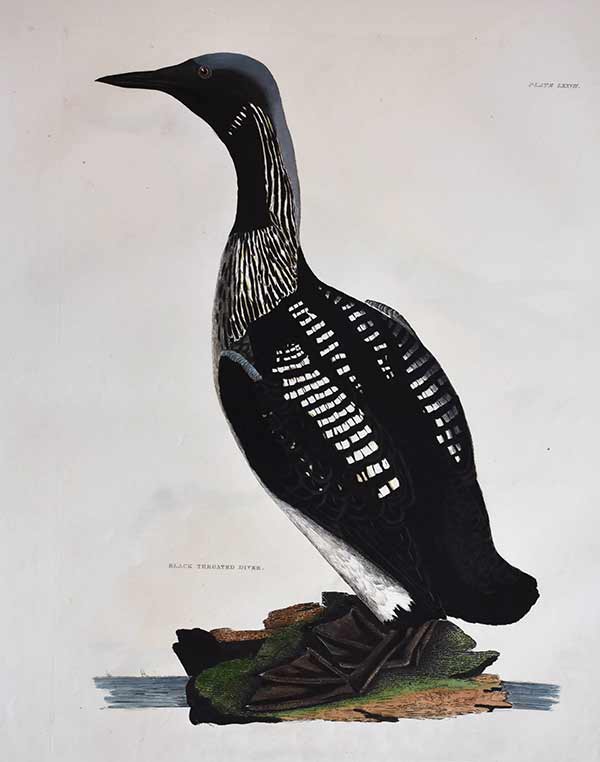
Black Throated Diver £285 Plate from Illustrations of British
Ornithology, 1821 34 by Prideaux John Selby, hand-coloured
engraving . Selby s large-scale engravings were the first work of
British ornithology to depict many birds in the size of life.
Comprising two volumes with a total of 222 engravings,
Illustrations of British Ornithology was published in Edinburgh in
19 parts from 1821 to 1834. Created during the same period that
Audubon was publishing the Birds of America, Both Audubon and
Selby employed the Scottish engraver W. H. Lizars. A highly
skilled engraver himself, Selby employed Lizars services only for
printing and coloring his own exquisite copper plates. Copies
vary, and depending on the folio 222 or 218 of the engravings were
hand-coloured, many by Daniel McNee. Twenty-six of the plates were
drawn by Selby s brother-in-law, Admiral Mitford, and the rest
were executed by Selby, who obtained most of the specimens for the
drawings himself. Selby engravings are printed on elephant folio
size Whatman paper that is watermarked with the date the paper was
made. Audubon also used Whatman paper for the Havell edition of
Birds of America. This major work was etched/engraved by Selby,
mostly after his own drawings, with the assistance of his
brother-in-law Captain Robert Mitford. In 1816 Mitford was taught
to etch and engrave by Thomas Bewick in Newcastle; he then taught
Selby at Twizell House . These are shown large full size image
plus the birds to compare sizing. Elephant folio size, 20.375 x
25.5 inches shown as 'before'
Cinnerous Eagle*** CREASED** £385
Plate from Illustrations of British Ornithology, 1821 34 by
Prideaux John Selby, hand-coloured engraving . Selby s large-scale
engravings were the first work of British ornithology to depict
many birds in the size of life. Comprising two volumes with a
total of 222 engravings, Illustrations of British Ornithology was
published in Edinburgh in 19 parts from 1821 to 1834. Created
during the same period that Audubon was publishing the Birds of
America, Both Audubon and Selby employed the Scottish engraver W.
H. Lizars. A highly skilled engraver himself, Selby employed
Lizars services only for printing and coloring his own exquisite
copper plates. Copies vary, and depending on the folio 222 or 218
of the engravings were hand-coloured, many by Daniel McNee.
Twenty-six of the plates were drawn by Selby s brother-in-law,
Admiral Mitford, and the rest were executed by Selby, who obtained
most of the specimens for the drawings himself. Selby engravings
are printed on elephant folio size Whatman paper that is
watermarked with the date the paper was made. Audubon also used
Whatman paper for the Havell edition of Birds of America. This
major work was etched/engraved by Selby, mostly after his own
drawings, with the assistance of his brother-in-law Captain Robert
Mitford. In 1816 Mitford was taught to etch and engrave by Thomas
Bewick in Newcastle; he then taught Selby at Twizell House . These
are shown large full size image plus the birds to compare sizing.
Elephant folio size, 20.375 x 25.5 inches. £385
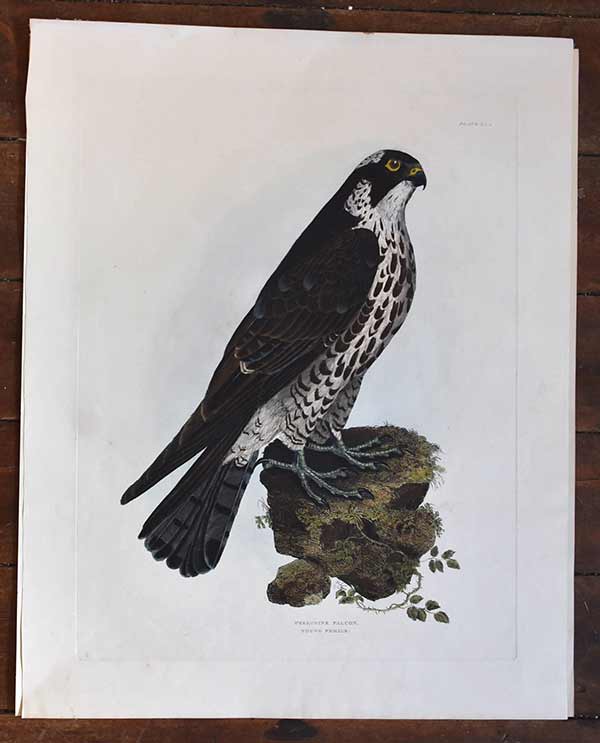
Peregrine Falcon £385 Plate from Illustrations of British
Ornithology, 1821 34 by Prideaux John Selby, hand-coloured
engraving . Selby s large-scale engravings were the first work of
British ornithology to depict many birds in the size of life.
Comprising two volumes with a total of 222 engravings,
Illustrations of British Ornithology was published in Edinburgh in
19 parts from 1821 to 1834. Created during the same period that
Audubon was publishing the Birds of America, Both Audubon and
Selby employed the Scottish engraver W. H. Lizars. A highly
skilled engraver himself, Selby employed Lizars services only for
printing and coloring his own exquisite copper plates. Copies
vary, and depending on the folio 222 or 218 of the engravings were
hand-coloured, many by Daniel McNee. Twenty-six of the plates were
drawn by Selby s brother-in-law, Admiral Mitford, and the rest
were executed by Selby, who obtained most of the specimens for the
drawings himself. Selby engravings are printed on elephant folio
size Whatman paper that is watermarked with the date the paper was
made. Audubon also used Whatman paper for the Havell edition of
Birds of America. This major work was etched/engraved by Selby,
mostly after his own drawings, with the assistance of his
brother-in-law Captain Robert Mitford. In 1816 Mitford was taught
to etch and engrave by Thomas Bewick in Newcastle; he then taught
Selby at Twizell House . These are shown large full size image
plus the birds to compare sizing. Elephant folio size, 20.375 x
25.5 inches
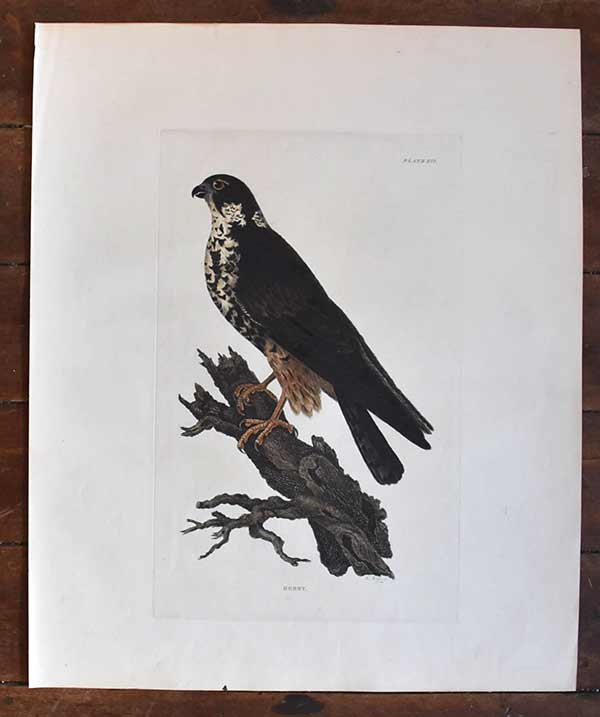
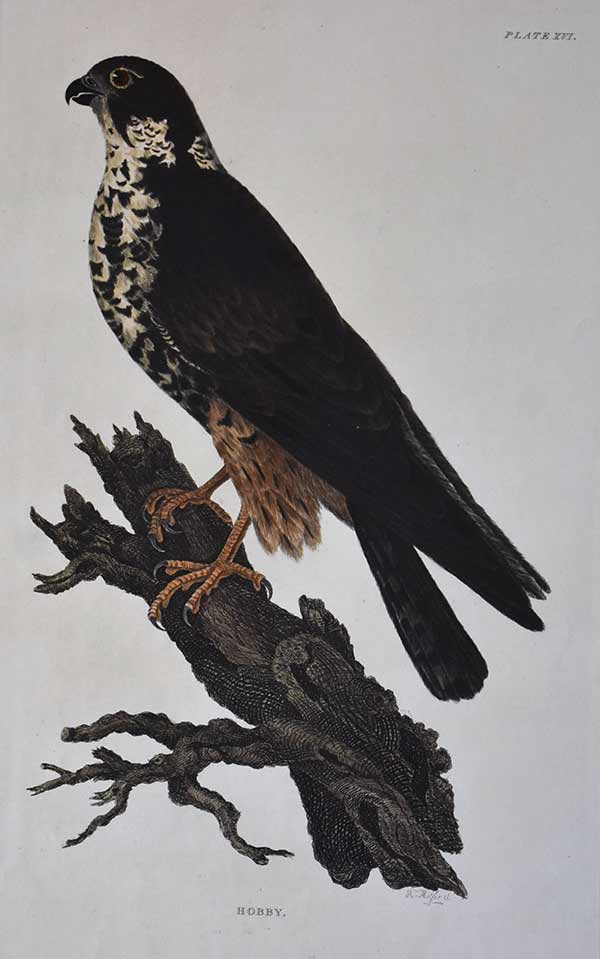
Hobby £385 Plate from Illustrations of British Ornithology, 1821
34 by Prideaux John Selby, hand-coloured engraving . Selby s
large-scale engravings were the first work of British ornithology
to depict many birds in the size of life. Comprising two volumes
with a total of 222 engravings, Illustrations of British
Ornithology was published in Edinburgh in 19 parts from 1821 to
1834. Created during the same period that Audubon was publishing
the Birds of America, Both Audubon and Selby employed the Scottish
engraver W. H. Lizars. A highly skilled engraver himself, Selby
employed Lizars services only for printing and coloring his own
exquisite copper plates. Copies vary, and depending on the folio
222 or 218 of the engravings were hand-coloured, many by Daniel
McNee. Twenty-six of the plates were drawn by Selby s
brother-in-law, Admiral Mitford, and the rest were executed by
Selby, who obtained most of the specimens for the drawings
himself. Selby engravings are printed on elephant folio size
Whatman paper that is watermarked with the date the paper was
made. Audubon also used Whatman paper for the Havell edition of
Birds of America. This major work was etched/engraved by Selby,
mostly after his own drawings, with the assistance of his
brother-in-law Captain Robert Mitford. In 1816 Mitford was taught
to etch and engrave by Thomas Bewick in Newcastle; he then taught
Selby at Twizell House . These are shown large full size image
plus the birds to compare sizing. Elephant folio size, 20.375 x
25.5 inches
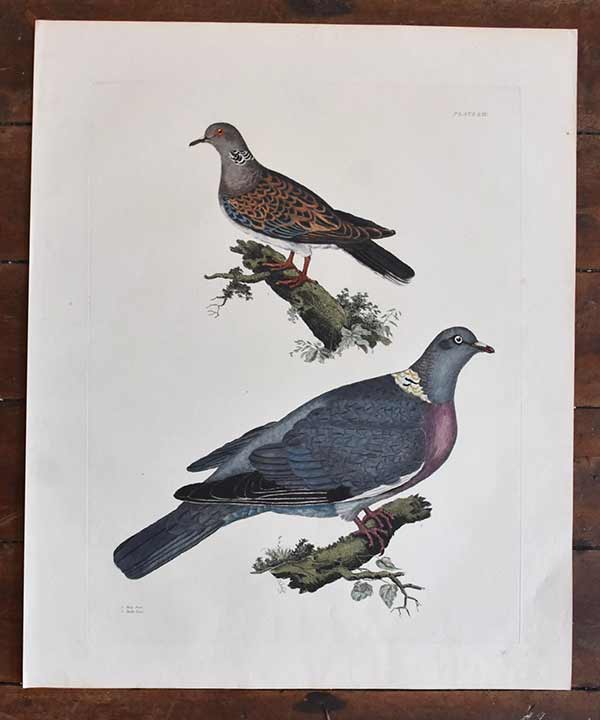
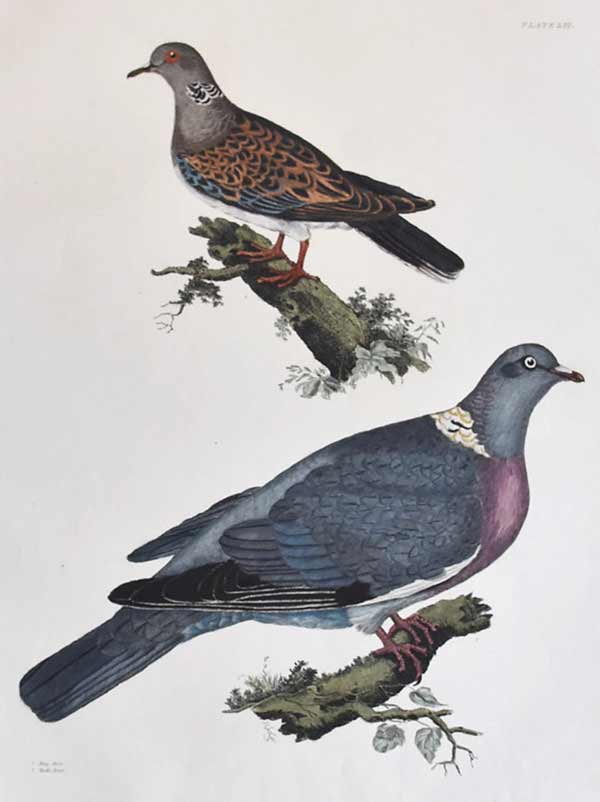
Turtle Dove + Ring Dove
Plate from Illustrations of British Ornithology, 1821 34 by
Prideaux John Selby, hand-coloured engraving . Selby s large-scale
engravings were the first work of British ornithology to depict
many birds in the size of life. Comprising two volumes with a
total of 222 engravings, Illustrations of British Ornithology was
published in Edinburgh in 19 parts from 1821 to 1834. Created
during the same period that Audubon was publishing the Birds of
America, Both Audubon and Selby employed the Scottish engraver W.
H. Lizars. A highly skilled engraver himself, Selby employed
Lizars services only for printing and coloring his own exquisite
copper plates. Copies vary, and depending on the folio 222 or 218
of the engravings were hand-coloured, many by Daniel McNee.
Twenty-six of the plates were drawn by Selby s brother-in-law,
Admiral Mitford, and the rest were executed by Selby, who obtained
most of the specimens for the drawings himself. Selby engravings
are printed on elephant folio size Whatman paper that is
watermarked with the date the paper was made. Audubon also used
Whatman paper for the Havell edition of Birds of America. This
major work was etched/engraved by Selby, mostly after his own
drawings, with the assistance of his brother-in-law Captain Robert
Mitford. In 1816 Mitford was taught to etch and engrave by Thomas
Bewick in Newcastle; he then taught Selby at Twizell House . These
are shown large full size image plus the birds to compare sizing.
Elephant folio size, 20.375 x 25.5 inches. reserved
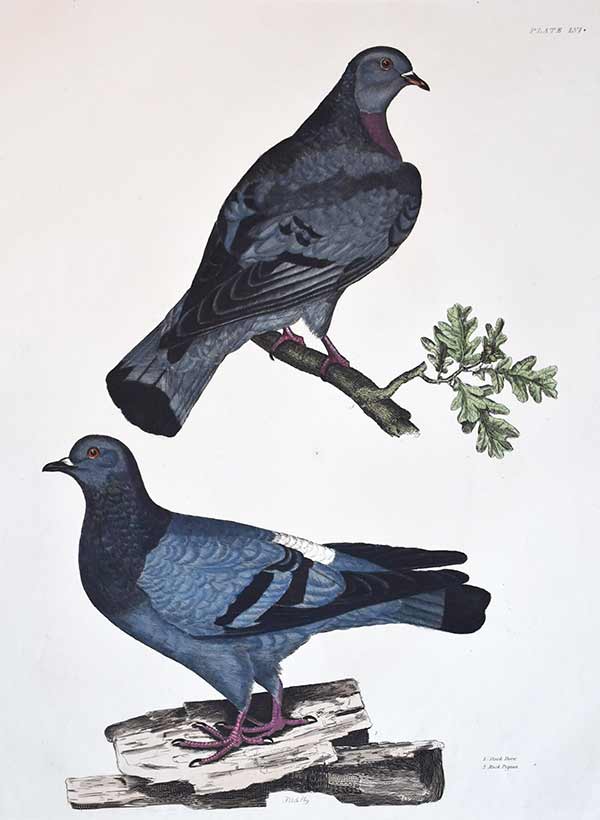
Stock Dove + Rock Pigeon £355
Plate from Illustrations of British Ornithology, 1821 34 by
Prideaux John Selby, hand-coloured engraving . Selby s large-scale
engravings were the first work of British ornithology to depict
many birds in the size of life. Comprising two volumes with a
total of 222 engravings, Illustrations of British Ornithology was
published in Edinburgh in 19 parts from 1821 to 1834. Created
during the same period that Audubon was publishing the Birds of
America, Both Audubon and Selby employed the Scottish engraver W.
H. Lizars. A highly skilled engraver himself, Selby employed
Lizars services only for printing and coloring his own exquisite
copper plates. Copies vary, and depending on the folio 222 or 218
of the engravings were hand-coloured, many by Daniel McNee.
Twenty-six of the plates were drawn by Selby s brother-in-law,
Admiral Mitford, and the rest were executed by Selby, who obtained
most of the specimens for the drawings himself. Selby engravings
are printed on elephant folio size Whatman paper that is
watermarked with the date the paper was made. Audubon also used
Whatman paper for the Havell edition of Birds of America. This
major work was etched/engraved by Selby, mostly after his own
drawings, with the assistance of his brother-in-law Captain Robert
Mitford. In 1816 Mitford was taught to etch and engrave by Thomas
Bewick in Newcastle; he then taught Selby at Twizell House . These
are shown large full size image plus the birds to compare sizing.
Elephant folio size, 20.375 x 25.5 inches. reserved
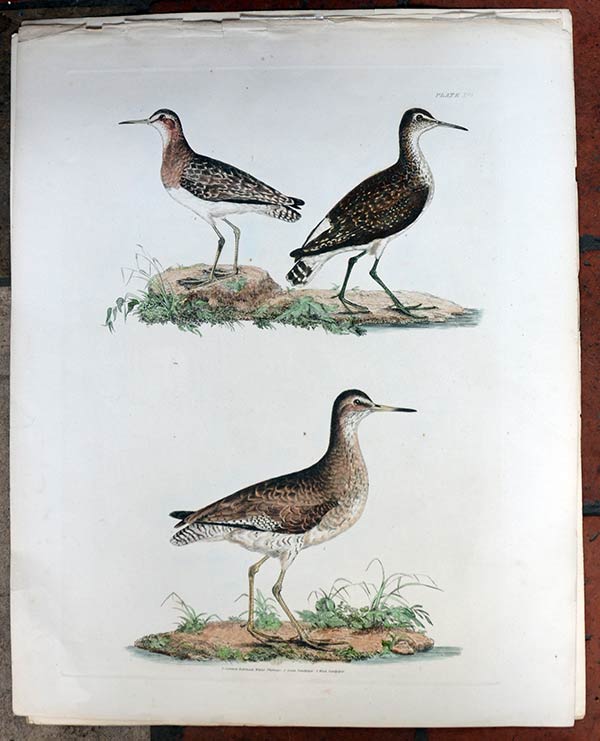
Dunlins in winter and summer plumage, Pygmy Curlews in winter and
summer plumage, and a Purple Tringa
Plate from Illustrations of British Ornithology, 1821 34 by
Prideaux John Selby, hand-coloured engraving . Selby s large-scale
engravings were the first work of British ornithology to depict
many birds in the size of life. Comprising two volumes with a
total of 222 engravings, Illustrations of British Ornithology was
published in Edinburgh in 19 parts from 1821 to 1834. Created
during the same period that Audubon was publishing the Birds of
America, Both Audubon and Selby employed the Scottish engraver W.
H. Lizars. A highly skilled engraver himself, Selby employed
Lizars services only for printing and coloring his own exquisite
copper plates. Copies vary, and depending on the folio 222 or 218
of the engravings were hand-coloured, many by Daniel McNee.
Twenty-six of the plates were drawn by Selby s brother-in-law,
Admiral Mitford, and the rest were executed by Selby, who obtained
most of the specimens for the drawings himself. Selby engravings
are printed on elephant folio size Whatman paper that is
watermarked with the date the paper was made. Audubon also used
Whatman paper for the Havell edition of Birds of America. This
major work was etched/engraved by Selby, mostly after his own
drawings, with the assistance of his brother-in-law Captain Robert
Mitford. In 1816 Mitford was taught to etch and engrave by Thomas
Bewick in Newcastle; he then taught Selby at Twizell House . These
are shown large full size image plus the birds to compare sizing.
Elephant folio size, 20.375 x 25.5 inches. £275
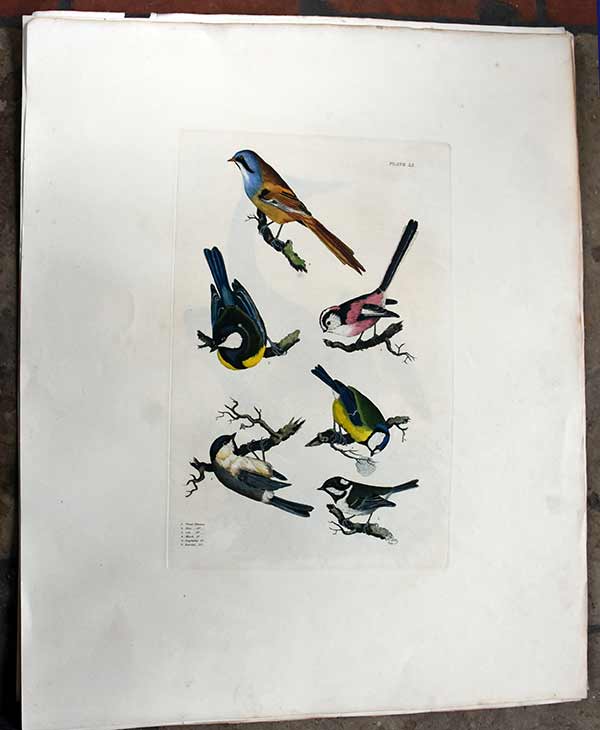
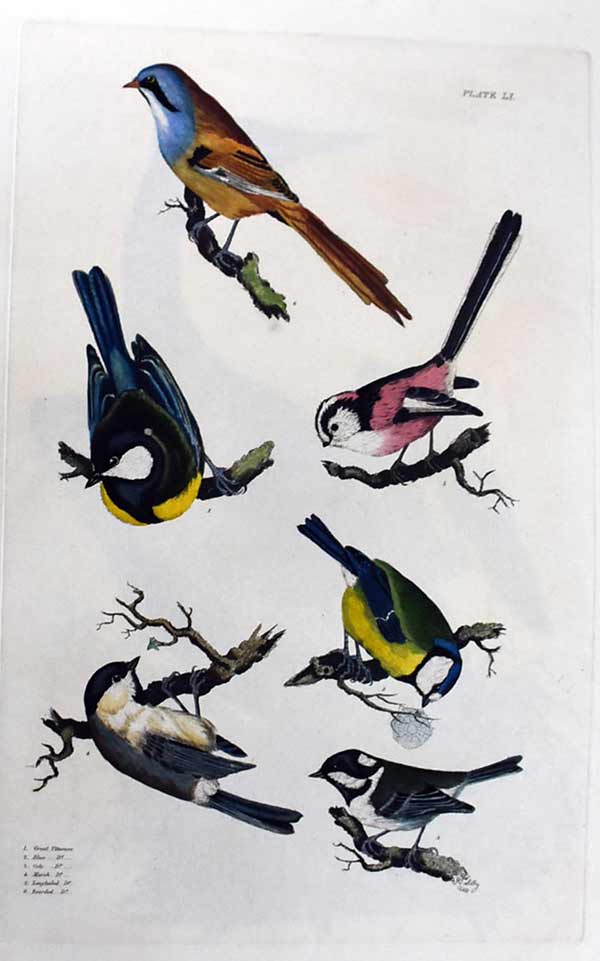
Blue Tits etc
Plate from Illustrations of British Ornithology, 1821 34 by
Prideaux John Selby, hand-coloured engraving . Selby s large-scale
engravings were the first work of British ornithology to depict
many birds in the size of life. Comprising two volumes with a
total of 222 engravings, Illustrations of British Ornithology was
published in Edinburgh in 19 parts from 1821 to 1834. Created
during the same period that Audubon was publishing the Birds of
America, Both Audubon and Selby employed the Scottish engraver W.
H. Lizars. A highly skilled engraver himself, Selby employed
Lizars services only for printing and coloring his own exquisite
copper plates. Copies vary, and depending on the folio 222 or 218
of the engravings were hand-coloured, many by Daniel McNee.
Twenty-six of the plates were drawn by Selby s brother-in-law,
Admiral Mitford, and the rest were executed by Selby, who obtained
most of the specimens for the drawings himself. Selby engravings
are printed on elephant folio size Whatman paper that is
watermarked with the date the paper was made. Audubon also used
Whatman paper for the Havell edition of Birds of America. This
major work was etched/engraved by Selby, mostly after his own
drawings, with the assistance of his brother-in-law Captain Robert
Mitford. In 1816 Mitford was taught to etch and engrave by Thomas
Bewick in Newcastle; he then taught Selby at Twizell House . These
are shown large full size image plus the birds to compare sizing.
Elephant folio size, 20.375 x 25.5 inches. £275
Wheatears and Whinchats
Plate from Illustrations of British Ornithology, 1821 34 by
Prideaux John Selby, hand-coloured engraving . Selby s large-scale
engravings were the first work of British ornithology to depict
many birds in the size of life. Comprising two volumes with a
total of 222 engravings, Illustrations of British Ornithology was
published in Edinburgh in 19 parts from 1821 to 1834. Created
during the same period that Audubon was publishing the Birds of
America, Both Audubon and Selby employed the Scottish engraver W.
H. Lizars. A highly skilled engraver himself, Selby employed
Lizars services only for printing and coloring his own exquisite
copper plates. Copies vary, and depending on the folio 222 or 218
of the engravings were hand-coloured, many by Daniel McNee.
Twenty-six of the plates were drawn by Selby s brother-in-law,
Admiral Mitford, and the rest were executed by Selby, who obtained
most of the specimens for the drawings himself. Selby engravings
are printed on elephant folio size Whatman paper that is
watermarked with the date the paper was made. Audubon also used
Whatman paper for the Havell edition of Birds of America. This
major work was etched/engraved by Selby, mostly after his own
drawings, with the assistance of his brother-in-law Captain Robert
Mitford. In 1816 Mitford was taught to etch and engrave by Thomas
Bewick in Newcastle; he then taught Selby at Twizell House . These
are shown large full size image plus the birds to compare sizing.
Elephant folio size, 20.375 x 25.5 inches. £275
Wagtails and Pipits
Plate from Illustrations of British Ornithology, 1821 34 by
Prideaux John Selby, hand-coloured engraving . Selby s large-scale
engravings were the first work of British ornithology to depict
many birds in the size of life. Comprising two volumes with a
total of 222 engravings, Illustrations of British Ornithology was
published in Edinburgh in 19 parts from 1821 to 1834. Created
during the same period that Audubon was publishing the Birds of
America, Both Audubon and Selby employed the Scottish engraver W.
H. Lizars. A highly skilled engraver himself, Selby employed
Lizars services only for printing and coloring his own exquisite
copper plates. Copies vary, and depending on the folio 222 or 218
of the engravings were hand-coloured, many by Daniel McNee.
Twenty-six of the plates were drawn by Selby s brother-in-law,
Admiral Mitford, and the rest were executed by Selby, who obtained
most of the specimens for the drawings himself. Selby engravings
are printed on elephant folio size Whatman paper that is
watermarked with the date the paper was made. Audubon also used
Whatman paper for the Havell edition of Birds of America. This
major work was etched/engraved by Selby, mostly after his own
drawings, with the assistance of his brother-in-law Captain Robert
Mitford. In 1816 Mitford was taught to etch and engrave by Thomas
Bewick in Newcastle; he then taught Selby at Twizell House . These
are shown large full size image plus the birds to compare sizing.
Elephant folio size, 20.375 x 25.5 inches. £275
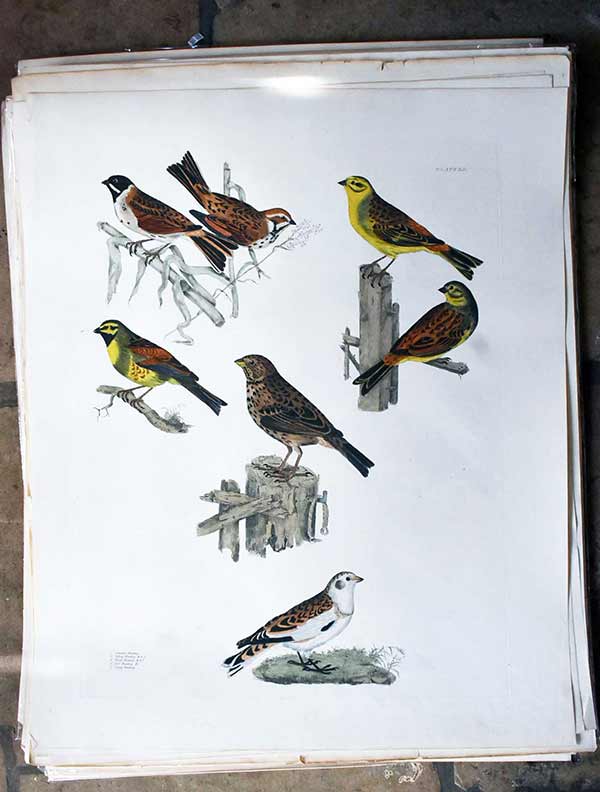
Common Bunting, Yellow Bunting, Reed Bunting
Plate from Illustrations of British Ornithology, 1821 34 by
Prideaux John Selby, hand-coloured engraving . Selby s large-scale
engravings were the first work of British ornithology to depict
many birds in the size of life. Comprising two volumes with a
total of 222 engravings, Illustrations of British Ornithology was
published in Edinburgh in 19 parts from 1821 to 1834. Created
during the same period that Audubon was publishing the Birds of
America, Both Audubon and Selby employed the Scottish engraver W.
H. Lizars. A highly skilled engraver himself, Selby employed
Lizars services only for printing and coloring his own exquisite
copper plates. Copies vary, and depending on the folio 222 or 218
of the engravings were hand-coloured, many by Daniel McNee.
Twenty-six of the plates were drawn by Selby s brother-in-law,
Admiral Mitford, and the rest were executed by Selby, who obtained
most of the specimens for the drawings himself. Selby engravings
are printed on elephant folio size Whatman paper that is
watermarked with the date the paper was made. Audubon also used
Whatman paper for the Havell edition of Birds of America. This
major work was etched/engraved by Selby, mostly after his own
drawings, with the assistance of his brother-in-law Captain Robert
Mitford. In 1816 Mitford was taught to etch and engrave by Thomas
Bewick in Newcastle; he then taught Selby at Twizell House . These
are shown large full size image plus the birds to compare sizing.
Elephant folio size, 20.375 x 25.5 inches. £275
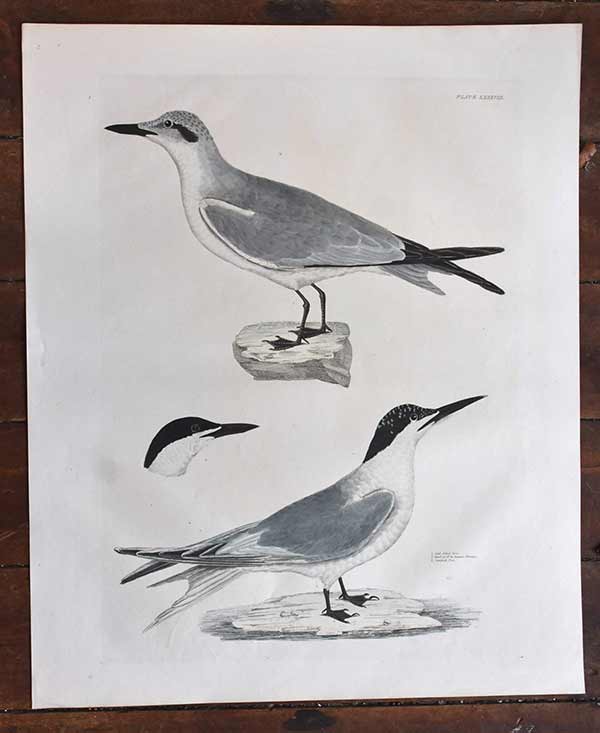
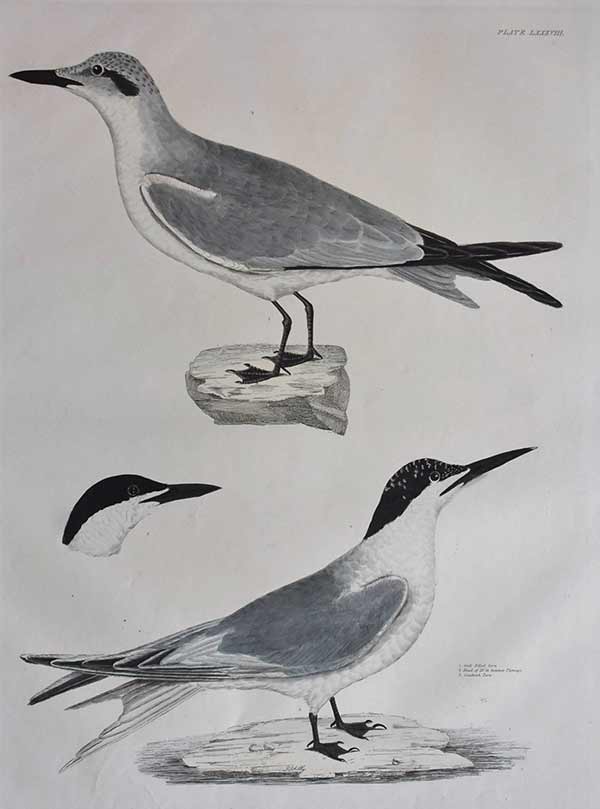
Gull Billed + Sandwich Tern
Plate from Illustrations of British Ornithology, 1821 34 by
Prideaux John Selby, hand-coloured engraving . Selby s large-scale
engravings were the first work of British ornithology to depict
many birds in the size of life. Comprising two volumes with a
total of 222 engravings, Illustrations of British Ornithology was
published in Edinburgh in 19 parts from 1821 to 1834. Created
during the same period that Audubon was publishing the Birds of
America, Both Audubon and Selby employed the Scottish engraver W.
H. Lizars. A highly skilled engraver himself, Selby employed
Lizars services only for printing and coloring his own exquisite
copper plates. Copies vary, and depending on the folio 222 or 218
of the engravings were hand-coloured, many by Daniel McNee.
Twenty-six of the plates were drawn by Selby s brother-in-law,
Admiral Mitford, and the rest were executed by Selby, who obtained
most of the specimens for the drawings himself. Selby engravings
are printed on elephant folio size Whatman paper that is
watermarked with the date the paper was made. Audubon also used
Whatman paper for the Havell edition of Birds of America. This
major work was etched/engraved by Selby, mostly after his own
drawings, with the assistance of his brother-in-law Captain Robert
Mitford. In 1816 Mitford was taught to etch and engrave by Thomas
Bewick in Newcastle; he then taught Selby at Twizell House . These
are shown large full size image plus the birds to compare sizing.
Elephant folio size, 20.375 x 25.5 inches. £245
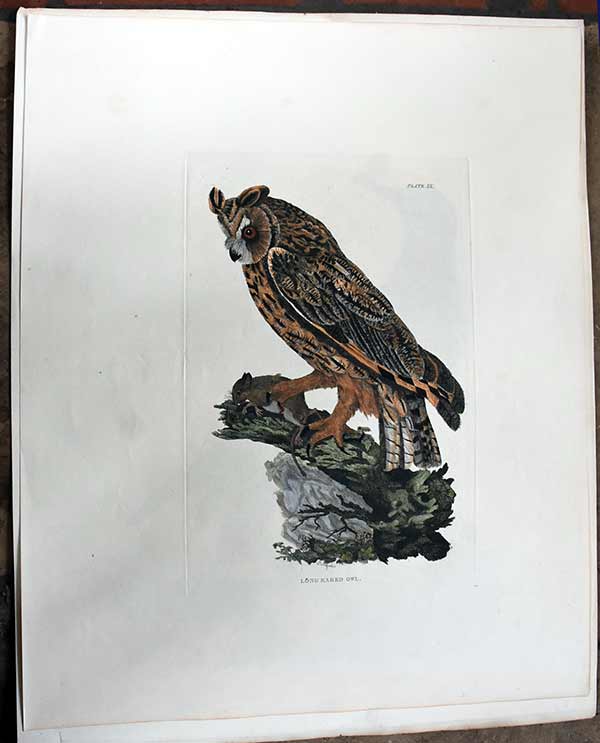
Long Eared Owl Plate XX
larger image than below very light page shading from white
£185
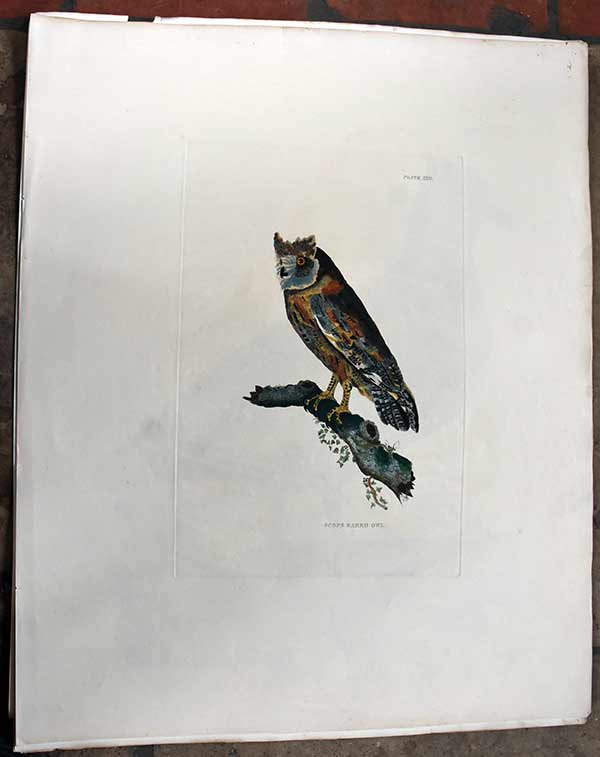
Scops Eared Owl Plate XXII £125
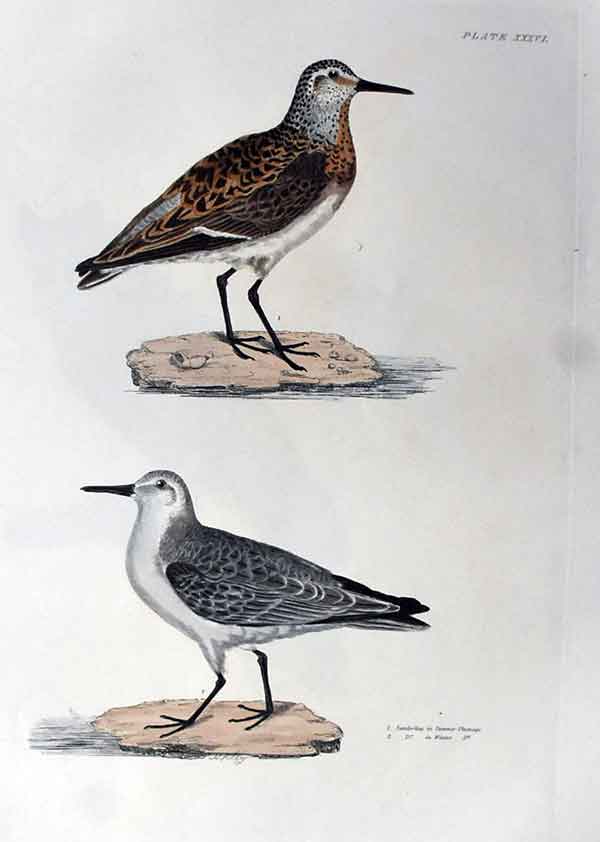
Sanderling Plate XXXVI
Plate from Illustrations of British Ornithology, 1821 34 by
Prideaux John Selby, hand-coloured engraving . Selby s large-scale
engravings were the first work of British ornithology to depict
many birds in the size of life. Comprising two volumes with a
total of 222 engravings, Illustrations of British Ornithology was
published in Edinburgh in 19 parts from 1821 to 1834. Created
during the same period that Audubon was publishing the Birds of
America, Both Audubon and Selby employed the Scottish engraver W.
H. Lizars. A highly skilled engraver himself, Selby employed
Lizars services only for printing and coloring his own exquisite
copper plates. Copies vary, and depending on the folio 222 or 218
of the engravings were hand-coloured, many by Daniel McNee.
Twenty-six of the plates were drawn by Selby s brother-in-law,
Admiral Mitford, and the rest were executed by Selby, who obtained
most of the specimens for the drawings himself. Selby engravings
are printed on elephant folio size Whatman paper that is
watermarked with the date the paper was made. Audubon also used
Whatman paper for the Havell edition of Birds of America. This
major work was etched/engraved by Selby, mostly after his own
drawings, with the assistance of his brother-in-law Captain Robert
Mitford. In 1816 Mitford was taught to etch and engrave by Thomas
Bewick in Newcastle; he then taught Selby at Twizell House . These
are shown large full size image plus the birds to compare sizing.
Elephant folio size, 20.375 x 25.5 inches. £185
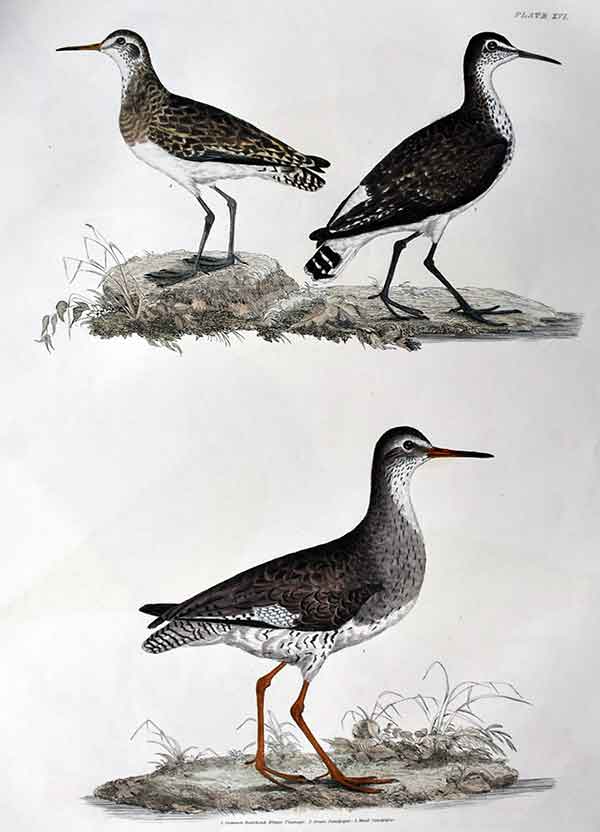
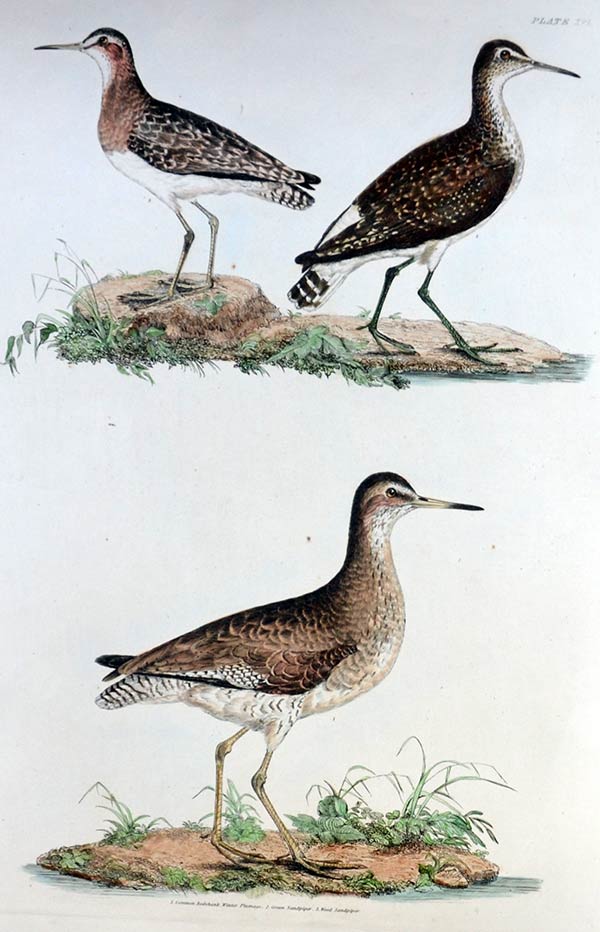
Redshank, Sandpiper Plate XVI
Plate from Illustrations of British Ornithology, 1821 34 by
Prideaux John Selby, hand-coloured engraving . Selby s large-scale
engravings were the first work of British ornithology to depict
many birds in the size of life. Comprising two volumes with a
total of 222 engravings, Illustrations of British Ornithology was
published in Edinburgh in 19 parts from 1821 to 1834. Created
during the same period that Audubon was publishing the Birds of
America, Both Audubon and Selby employed the Scottish engraver W.
H. Lizars. A highly skilled engraver himself, Selby employed
Lizars services only for printing and coloring his own exquisite
copper plates. Copies vary, and depending on the folio 222 or 218
of the engravings were hand-coloured, many by Daniel McNee.
Twenty-six of the plates were drawn by Selby s brother-in-law,
Admiral Mitford, and the rest were executed by Selby, who obtained
most of the specimens for the drawings himself. Selby engravings
are printed on elephant folio size Whatman paper that is
watermarked with the date the paper was made. Audubon also used
Whatman paper for the Havell edition of Birds of America. This
major work was etched/engraved by Selby, mostly after his own
drawings, with the assistance of his brother-in-law Captain Robert
Mitford. In 1816 Mitford was taught to etch and engrave by Thomas
Bewick in Newcastle; he then taught Selby at Twizell House . These
are shown large full size image plus the birds to compare sizing.
Elephant folio size, 20.375 x 25.5 inches. £155
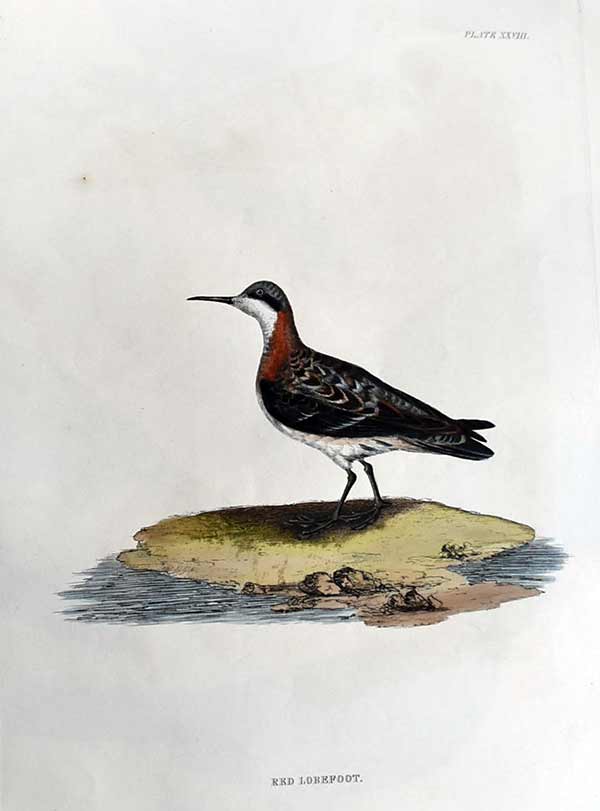
Phalarope Plate XXVIII
Plate from Illustrations of British Ornithology, 1821 34 by
Prideaux John Selby, hand-coloured engraving . Selby s large-scale
engravings were the first work of British ornithology to depict
many birds in the size of life. Comprising two volumes with a
total of 222 engravings, Illustrations of British Ornithology was
published in Edinburgh in 19 parts from 1821 to 1834. Created
during the same period that Audubon was publishing the Birds of
America, Both Audubon and Selby employed the Scottish engraver W.
H. Lizars. A highly skilled engraver himself, Selby employed
Lizars services only for printing and coloring his own exquisite
copper plates. Copies vary, and depending on the folio 222 or 218
of the engravings were hand-coloured, many by Daniel McNee.
Twenty-six of the plates were drawn by Selby s brother-in-law,
Admiral Mitford, and the rest were executed by Selby, who obtained
most of the specimens for the drawings himself. Selby engravings
are printed on elephant folio size Whatman paper that is
watermarked with the date the paper was made. Audubon also used
Whatman paper for the Havell edition of Birds of America. This
major work was etched/engraved by Selby, mostly after his own
drawings, with the assistance of his brother-in-law Captain Robert
Mitford. In 1816 Mitford was taught to etch and engrave by Thomas
Bewick in Newcastle; he then taught Selby at Twizell House . These
are shown large full size image plus the birds to compare sizing.
Elephant folio size, 20.375 x 25.5 inches. £185
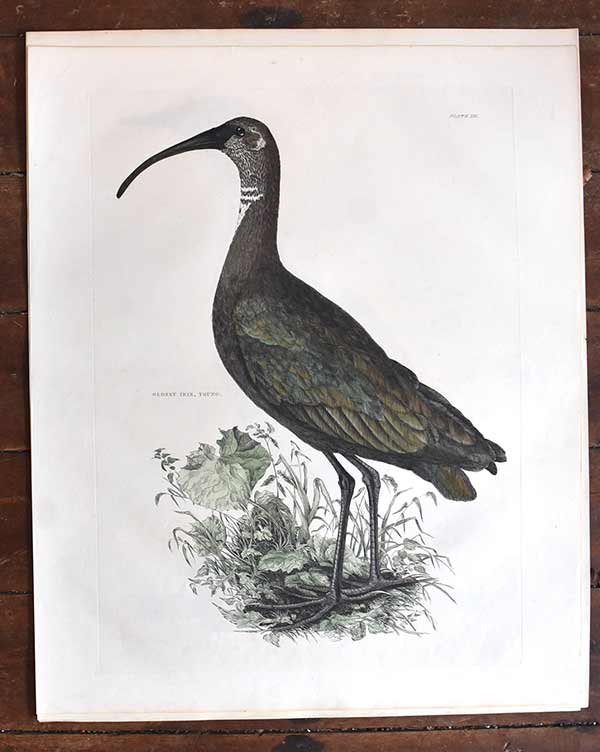
Glossy Ibis
Plate from Illustrations of British Ornithology, 1821 34 by
Prideaux John Selby, hand-coloured engraving . Selby s large-scale
engravings were the first work of British ornithology to depict
many birds in the size of life. Comprising two volumes with a
total of 222 engravings, Illustrations of British Ornithology was
published in Edinburgh in 19 parts from 1821 to 1834. Created
during the same period that Audubon was publishing the Birds of
America, Both Audubon and Selby employed the Scottish engraver W.
H. Lizars. A highly skilled engraver himself, Selby employed
Lizars services only for printing and coloring his own exquisite
copper plates. Copies vary, and depending on the folio 222 or 218
of the engravings were hand-coloured, many by Daniel McNee.
Twenty-six of the plates were drawn by Selby s brother-in-law,
Admiral Mitford, and the rest were executed by Selby, who obtained
most of the specimens for the drawings himself. Selby engravings
are printed on elephant folio size Whatman paper that is
watermarked with the date the paper was made. Audubon also used
Whatman paper for the Havell edition of Birds of America. This
major work was etched/engraved by Selby, mostly after his own
drawings, with the assistance of his brother-in-law Captain Robert
Mitford. In 1816 Mitford was taught to etch and engrave by Thomas
Bewick in Newcastle; he then taught Selby at Twizell House . These
are shown large full size image plus the birds to compare sizing.
Elephant folio size, 20.375 x 25.5 inches. £385 Now
cleaned shown as 'before'
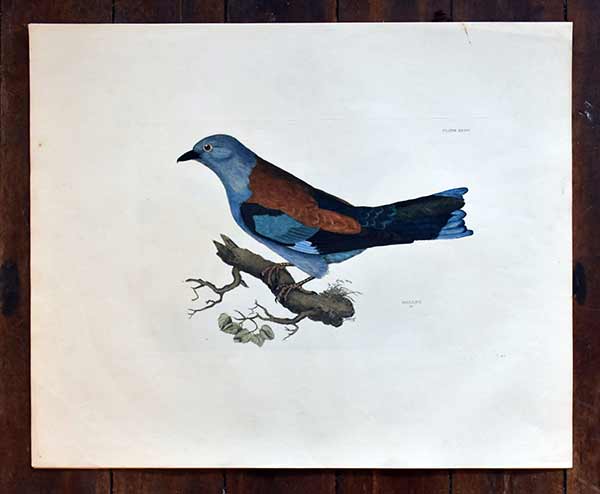
Roller male Plt XXXIV Plate from Illustrations of British
Ornithology, 1821–34 by Prideaux John Selby, hand-colored
engraving represented in the plate in about one-half the
natural size. Named for the English wood engraver and natural
history author, Thomas Bewick (1753–1828), the species is
currently named Tundra swan in the USA/Canada , Cyngus columbianus
bewickii.Selby’s large-scale engravings were the first work of
British ornithology to depict many birds in the size of life.
Comprising two volumes with a total of 222 engravings,
Illustrations of British Ornithology was published in Edinburgh in
19 parts from 1821 to 1834. Created during the same period that
Audubon was publishing the Birds of America, Both Audubon and
Selby employed the Scottish engraver W. H. Lizars. A highly
skilled engraver himself, Selby employed Lizars’ services only for
printing and coloring his own exquisite copper plates. Copies
vary, and depending on the folio 222 or 218 of the engravings were
hand-colored, many by Daniel McNee. Twenty-six of the plates were
drawn by Selby’s brother-in-law, Admiral Mitford, and the rest
were executed by Selby, who obtained most of the specimens for the
drawings himself. Selby engravings are printed on elephant folio
size Whatman paper that is watermarked with the date the paper was
made. Audubon also used Whatman paper for the Havell edition of
Birds of America. Elephant folio size, 20.375 x 25.5
inches. £225 inc delivery x 2 available one with more
subtle colouring
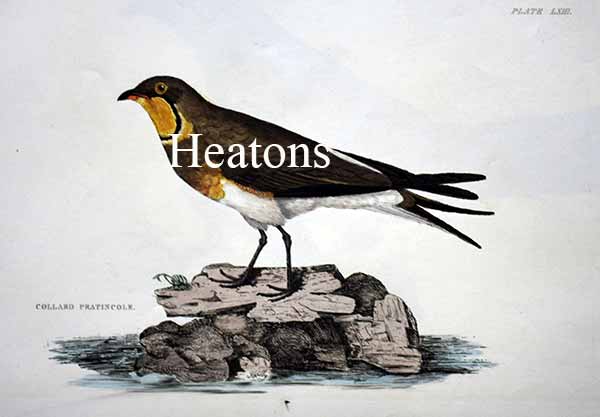
Collard Pratincole Vol. 2, Pl. 47
Plate from Illustrations of British Ornithology, 1821 34 by
Prideaux John Selby, hand-coloured engraving . Selby s large-scale
engravings were the first work of British ornithology to depict
many birds in the size of life. Comprising two volumes with a
total of 222 engravings, Illustrations of British Ornithology was
published in Edinburgh in 19 parts from 1821 to 1834. Created
during the same period that Audubon was publishing the Birds of
America, Both Audubon and Selby employed the Scottish engraver W.
H. Lizars. A highly skilled engraver himself, Selby employed
Lizars services only for printing and coloring his own exquisite
copper plates. Copies vary, and depending on the folio 222 or 218
of the engravings were hand-coloured, many by Daniel McNee.
Twenty-six of the plates were drawn by Selby s brother-in-law,
Admiral Mitford, and the rest were executed by Selby, who obtained
most of the specimens for the drawings himself. Selby engravings
are printed on elephant folio size Whatman paper that is
watermarked with the date the paper was made. Audubon also used
Whatman paper for the Havell edition of Birds of America. This
major work was etched/engraved by Selby, mostly after his own
drawings, with the assistance of his brother-in-law Captain Robert
Mitford. In 1816 Mitford was taught to etch and engrave by Thomas
Bewick in Newcastle; he then taught Selby at Twizell House . These
are shown large full size image plus the birds to compare sizing.
Elephant folio size, 20.375 x 25.5 inches. £125
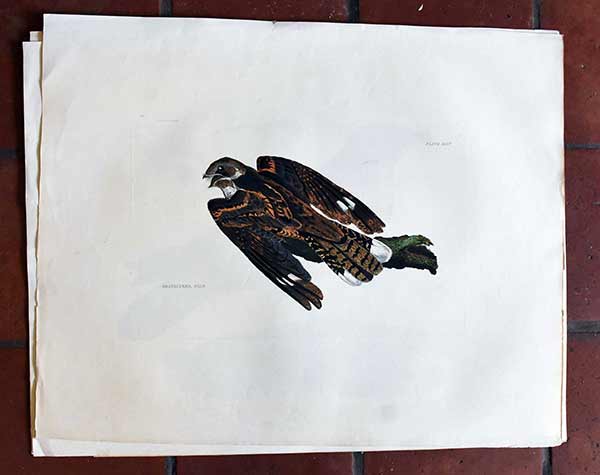
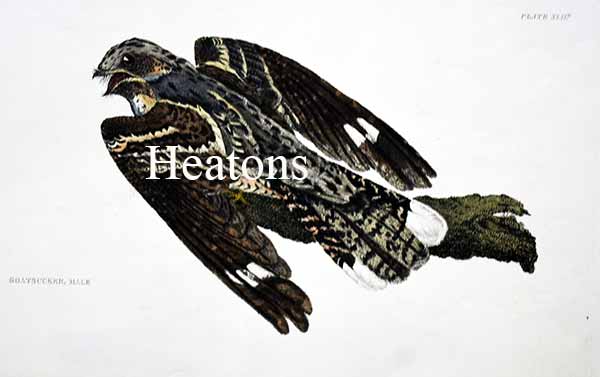
Goatsucker male
Plate from Illustrations of British Ornithology, 1821 34 by
Prideaux John Selby, hand-coloured engraving . Selby s large-scale
engravings were the first work of British ornithology to depict
many birds in the size of life. Comprising two volumes with a
total of 222 engravings, Illustrations of British Ornithology was
published in Edinburgh in 19 parts from 1821 to 1834. Created
during the same period that Audubon was publishing the Birds of
America, Both Audubon and Selby employed the Scottish engraver W.
H. Lizars. A highly skilled engraver himself, Selby employed
Lizars services only for printing and coloring his own exquisite
copper plates. Copies vary, and depending on the folio 222 or 218
of the engravings were hand-coloured, many by Daniel McNee.
Twenty-six of the plates were drawn by Selby s brother-in-law,
Admiral Mitford, and the rest were executed by Selby, who obtained
most of the specimens for the drawings himself. Selby engravings
are printed on elephant folio size Whatman paper that is
watermarked with the date the paper was made. Audubon also used
Whatman paper for the Havell edition of Birds of America. This
major work was etched/engraved by Selby, mostly after his own
drawings, with the assistance of his brother-in-law Captain Robert
Mitford. In 1816 Mitford was taught to etch and engrave by Thomas
Bewick in Newcastle; he then taught Selby at Twizell House . These
are shown large full size image plus the birds to compare sizing.
Elephant folio size, 20.375 x 25.5 inches. £105 x 2 av
Sparrow Hawk male
Plate from Illustrations of British Ornithology, 1821 34 by
Prideaux John Selby, hand-coloured engraving . Selby s large-scale
engravings were the first work of British ornithology to depict
many birds in the size of life. Comprising two volumes with a
total of 222 engravings, Illustrations of British Ornithology was
published in Edinburgh in 19 parts from 1821 to 1834. Created
during the same period that Audubon was publishing the Birds of
America, Both Audubon and Selby employed the Scottish engraver W.
H. Lizars. A highly skilled engraver himself, Selby employed
Lizars services only for printing and coloring his own exquisite
copper plates. Copies vary, and depending on the folio 222 or 218
of the engravings were hand-coloured, many by Daniel McNee.
Twenty-six of the plates were drawn by Selby s brother-in-law,
Admiral Mitford, and the rest were executed by Selby, who obtained
most of the specimens for the drawings himself. Selby engravings
are printed on elephant folio size Whatman paper that is
watermarked with the date the paper was made. Audubon also used
Whatman paper for the Havell edition of Birds of America. This
major work was etched/engraved by Selby, mostly after his own
drawings, with the assistance of his brother-in-law Captain Robert
Mitford. In 1816 Mitford was taught to etch and engrave by Thomas
Bewick in Newcastle; he then taught Selby at Twizell House . These
are shown large full size image plus the birds to compare sizing.
Elephant folio size, 20.375 x 25.5 inches. £125 inc delivery
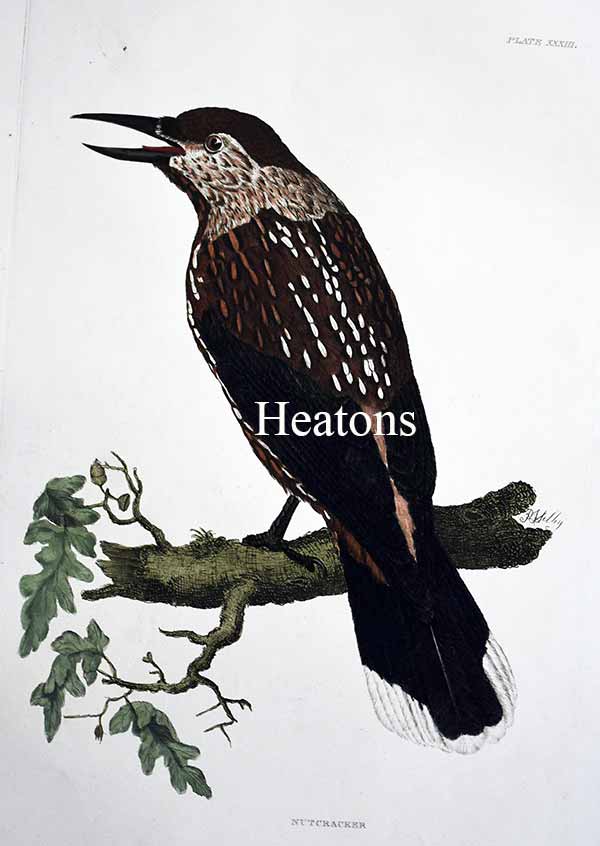
Nutcracker
Plate from Illustrations of British Ornithology, 1821 34 by
Prideaux John Selby, hand-coloured engraving . Selby s large-scale
engravings were the first work of British ornithology to depict
many birds in the size of life. Comprising two volumes with a
total of 222 engravings, Illustrations of British Ornithology was
published in Edinburgh in 19 parts from 1821 to 1834. Created
during the same period that Audubon was publishing the Birds of
America, Both Audubon and Selby employed the Scottish engraver W.
H. Lizars. A highly skilled engraver himself, Selby employed
Lizars services only for printing and coloring his own exquisite
copper plates. Copies vary, and depending on the folio 222 or 218
of the engravings were hand-coloured, many by Daniel McNee.
Twenty-six of the plates were drawn by Selby s brother-in-law,
Admiral Mitford, and the rest were executed by Selby, who obtained
most of the specimens for the drawings himself. Selby engravings
are printed on elephant folio size Whatman paper that is
watermarked with the date the paper was made. Audubon also used
Whatman paper for the Havell edition of Birds of America. This
major work was etched/engraved by Selby, mostly after his own
drawings, with the assistance of his brother-in-law Captain Robert
Mitford. In 1816 Mitford was taught to etch and engrave by Thomas
Bewick in Newcastle; he then taught Selby at Twizell House . These
are shown large full size image plus the birds to compare sizing.
Elephant folio size, 20.375 x 25.5 inches. £125 inc delivery
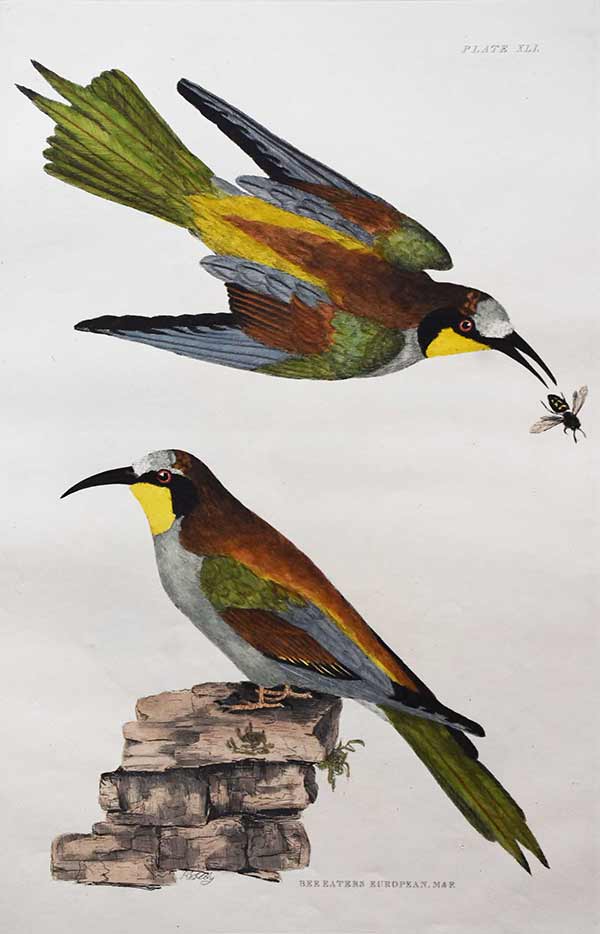
Bee eaters £155 Plate from Illustrations of British
Ornithology, 1821 34 by Prideaux John Selby, hand-coloured
engraving . Selby s large-scale engravings were the first work of
British ornithology to depict many birds in the size of life.
Comprising two volumes with a total of 222 engravings,
Illustrations of British Ornithology was published in Edinburgh in
19 parts from 1821 to 1834. Created during the same period that
Audubon was publishing the Birds of America, Both Audubon and
Selby employed the Scottish engraver W. H. Lizars. A highly
skilled engraver himself, Selby employed Lizars services only for
printing and coloring his own exquisite copper plates. Copies
vary, and depending on the folio 222 or 218 of the engravings were
hand-coloured, many by Daniel McNee. Twenty-six of the plates were
drawn by Selby s brother-in-law, Admiral Mitford, and the rest
were executed by Selby, who obtained most of the specimens for the
drawings himself. Selby engravings are printed on elephant folio
size Whatman paper that is watermarked with the date the paper was
made. Audubon also used Whatman paper for the Havell edition of
Birds of America. This major work was etched/engraved by Selby,
mostly after his own drawings, with the assistance of his
brother-in-law Captain Robert Mitford. In 1816 Mitford was taught
to etch and engrave by Thomas Bewick in Newcastle; he then taught
Selby at Twizell House . These are shown large full size image
plus the birds to compare sizing. Elephant folio size, 20.375 x
25.5 inches £155
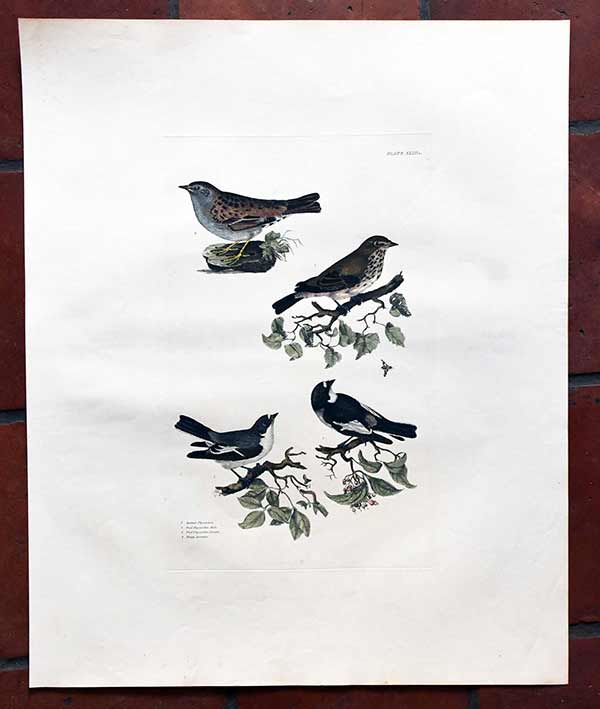
Spotted +Pied Flycatchers £155
Plate from Illustrations of British Ornithology, 1821 34 by
Prideaux John Selby, hand-coloured engraving . Selby s large-scale
engravings were the first work of British ornithology to depict
many birds in the size of life. Comprising two volumes with a
total of 222 engravings, Illustrations of British Ornithology was
published in Edinburgh in 19 parts from 1821 to 1834. Created
during the same period that Audubon was publishing the Birds of
America, Both Audubon and Selby employed the Scottish engraver W.
H. Lizars. A highly skilled engraver himself, Selby employed
Lizars services only for printing and coloring his own exquisite
copper plates. Copies vary, and depending on the folio 222 or 218
of the engravings were hand-coloured, many by Daniel McNee.
Twenty-six of the plates were drawn by Selby s brother-in-law,
Admiral Mitford, and the rest were executed by Selby, who obtained
most of the specimens for the drawings himself. Selby engravings
are printed on elephant folio size Whatman paper that is
watermarked with the date the paper was made. Audubon also used
Whatman paper for the Havell edition of Birds of America. This
major work was etched/engraved by Selby, mostly after his own
drawings, with the assistance of his brother-in-law Captain Robert
Mitford. In 1816 Mitford was taught to etch and engrave by Thomas
Bewick in Newcastle; he then taught Selby at Twizell House . These
are shown large full size image plus the birds to compare sizing.
Elephant folio size, 20.375 x 25.5 inches
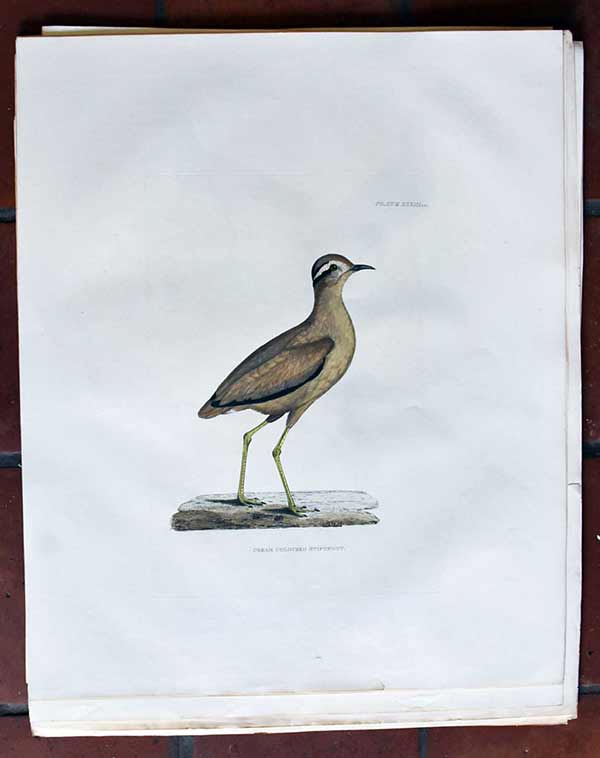
Cream Coloured Swiftfoot Plate from Illustrations of British
Ornithology, 1821 34 by Prideaux John Selby, hand-coloured
engraving . Selby s large-scale engravings were the first work of
British ornithology to depict many birds in the size of life.
Comprising two volumes with a total of 222 engravings,
Illustrations of British Ornithology was published in Edinburgh in
19 parts from 1821 to 1834. Created during the same period that
Audubon was publishing the Birds of America, Both Audubon and
Selby employed the Scottish engraver W. H. Lizars. A highly
skilled engraver himself, Selby employed Lizars services only for
printing and coloring his own exquisite copper plates. Copies
vary, and depending on the folio 222 or 218 of the engravings were
hand-coloured, many by Daniel McNee. Twenty-six of the plates were
drawn by Selby s brother-in-law, Admiral Mitford, and the rest
were executed by Selby, who obtained most of the specimens for the
drawings himself. Selby engravings are printed on elephant folio
size Whatman paper that is watermarked with the date the paper was
made. Audubon also used Whatman paper for the Havell edition of
Birds of America. This major work was etched/engraved by Selby,
mostly after his own drawings, with the assistance of his
brother-in-law Captain Robert Mitford. In 1816 Mitford was taught
to etch and engrave by Thomas Bewick in Newcastle; he then taught
Selby at Twizell House . These are shown large full size image
plus the birds to compare sizing. Elephant folio size, 20.375 x
25.5 inches. £135 inc delivery 2 ava
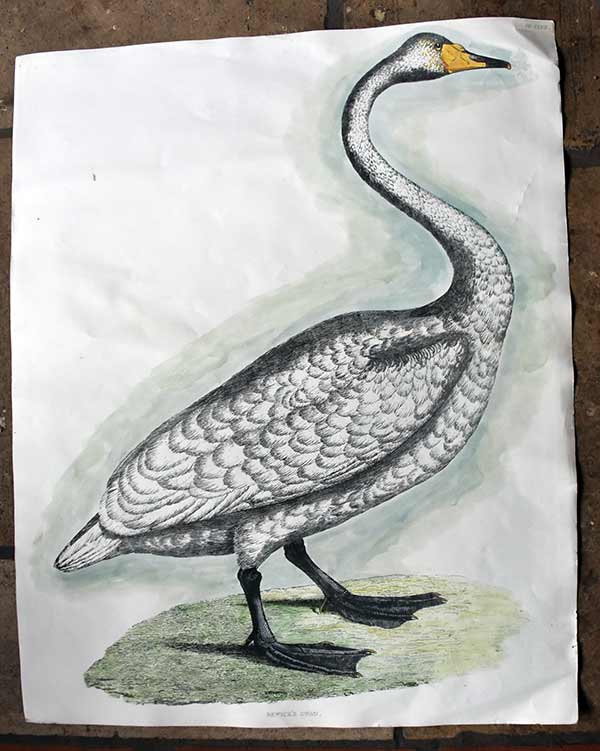
A Bewick's Swan, Vol. 2, Pl. 47 Plate from Illustrations of
British Ornithology, 1821–34 by Prideaux John Selby, hand-colored
engraving represented in the plate in about one-half the
natural size. Named for the English wood engraver and natural
history author, Thomas Bewick (1753–1828), the species is
currently named Tundra swan in the USA/Canada , Cyngus columbianus
bewickii.Selby’s large-scale engravings were the first work of
British ornithology to depict many birds in the size of life.
Comprising two volumes with a total of 222 engravings,
Illustrations of British Ornithology was published in Edinburgh in
19 parts from 1821 to 1834. Created during the same period that
Audubon was publishing the Birds of America, Both Audubon and
Selby employed the Scottish engraver W. H. Lizars. A highly
skilled engraver himself, Selby employed Lizars’ services only for
printing and coloring his own exquisite copper plates. Copies
vary, and depending on the folio 222 or 218 of the engravings were
hand-colored, many by Daniel McNee. Twenty-six of the plates were
drawn by Selby’s brother-in-law, Admiral Mitford, and the rest
were executed by Selby, who obtained most of the specimens for the
drawings himself. Selby engravings are printed on elephant folio
size Whatman paper that is watermarked with the date the paper was
made. Audubon also used Whatman paper for the Havell edition of
Birds of America.In the text, Selby notes “This recently
discovered species, in size about one-third less than the
Whistling Swan, is amongst our British winter visitants; and
though less numerous as a species than the other, is occasionally
met with in England during every severe winter." He notes that the
species was discovered in the winter of 1828-29 and the
differences noted in the species attracted the attention of "other
naturalists to investigate the subject, and Mr. Yarrell [William
Yarrell 1784–1856], whose knowledge as an ornithologist, and whose
discrimination as a comparative anatomist, stand deservedly high,
soon discovered additional proofs..., and, at is suggestion, the
appellation of Cyngus Bewickii was conferred upon the species."
Elephant folio size, 20.375 x 25.5 inches.
Temminck's Tringa, Spring Plumage, Little Tringa Summer Plumage
Plt XXVII Light mottling in the paper £145
Plate from Illustrations of British Ornithology, 1821 34 by
Prideaux John Selby, hand-coloured engraving . Selby s large-scale
engravings were the first work of British ornithology to depict
many birds in the size of life. Comprising two volumes with a
total of 222 engravings, Illustrations of British Ornithology was
published in Edinburgh in 19 parts from 1821 to 1834. Created
during the same period that Audubon was publishing the Birds of
America, Both Audubon and Selby employed the Scottish engraver W.
H. Lizars. A highly skilled engraver himself, Selby employed
Lizars services only for printing and coloring his own exquisite
copper plates. Copies vary, and depending on the folio 222 or 218
of the engravings were hand-coloured, many by Daniel McNee.
Twenty-six of the plates were drawn by Selby s brother-in-law,
Admiral Mitford, and the rest were executed by Selby, who obtained
most of the specimens for the drawings himself. Selby engravings
are printed on elephant folio size Whatman paper that is
watermarked with the date the paper was made. Audubon also used
Whatman paper for the Havell edition of Birds of America. This
major work was etched/engraved by Selby, mostly after his own
drawings, with the assistance of his brother-in-law Captain Robert
Mitford. In 1816 Mitford was taught to etch and engrave by Thomas
Bewick in Newcastle; he then taught Selby at Twizell House . These
are shown large full size image plus the birds to compare sizing.
Elephant folio size, 20.375 x 25.5 inches
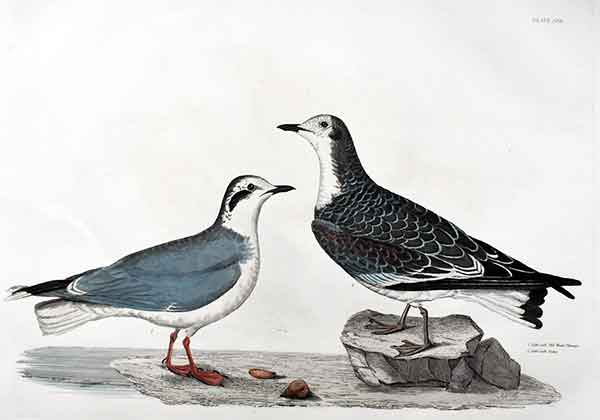
Little Gull Plate XCII x 2
Plate from Illustrations of British Ornithology, 1821 34 by
Prideaux John Selby, hand-coloured engraving . Selby s large-scale
engravings were the first work of British ornithology to depict
many birds in the size of life. Comprising two volumes with a
total of 222 engravings, Illustrations of British Ornithology was
published in Edinburgh in 19 parts from 1821 to 1834. Created
during the same period that Audubon was publishing the Birds of
America, Both Audubon and Selby employed the Scottish engraver W.
H. Lizars. A highly skilled engraver himself, Selby employed
Lizars services only for printing and coloring his own exquisite
copper plates. Copies vary, and depending on the folio 222 or 218
of the engravings were hand-coloured, many by Daniel McNee.
Twenty-six of the plates were drawn by Selby s brother-in-law,
Admiral Mitford, and the rest were executed by Selby, who obtained
most of the specimens for the drawings himself. Selby engravings
are printed on elephant folio size Whatman paper that is
watermarked with the date the paper was made. Audubon also used
Whatman paper for the Havell edition of Birds of America. This
major work was etched/engraved by Selby, mostly after his own
drawings, with the assistance of his brother-in-law Captain Robert
Mitford. In 1816 Mitford was taught to etch and engrave by Thomas
Bewick in Newcastle; he then taught Selby at Twizell House . These
are shown large full size image plus the birds to compare sizing.
Elephant folio size, 20.375 x 25.5 inches £125
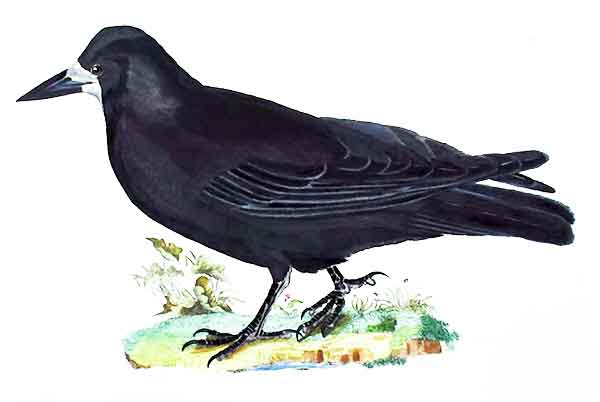
Rook Plate XXX ** Image lightened to show details due to
being a dark bird**
Plate from Illustrations of British Ornithology, 1821 34 by
Prideaux John Selby, hand-coloured engraving . Selby s large-scale
engravings were the first work of British ornithology to depict
many birds in the size of life. Comprising two volumes with a
total of 222 engravings, Illustrations of British Ornithology was
published in Edinburgh in 19 parts from 1821 to 1834. Created
during the same period that Audubon was publishing the Birds of
America, Both Audubon and Selby employed the Scottish engraver W.
H. Lizars. A highly skilled engraver himself, Selby employed
Lizars services only for printing and coloring his own exquisite
copper plates. Copies vary, and depending on the folio 222 or 218
of the engravings were hand-coloured, many by Daniel McNee.
Twenty-six of the plates were drawn by Selby s brother-in-law,
Admiral Mitford, and the rest were executed by Selby, who obtained
most of the specimens for the drawings himself. Selby engravings
are printed on elephant folio size Whatman paper that is
watermarked with the date the paper was made. Audubon also used
Whatman paper for the Havell edition of Birds of America. This
major work was etched/engraved by Selby, mostly after his own
drawings, with the assistance of his brother-in-law Captain Robert
Mitford. In 1816 Mitford was taught to etch and engrave by Thomas
Bewick in Newcastle; he then taught Selby at Twizell House . These
are shown large full size image plus the birds to compare sizing.
Elephant folio size, 20.375 x 25.5 inches £125
Carrion Crow Plate XXVIII ** Image lightened to show details
due to being a dark bird** £125 Plate from Illustrations of
British Ornithology, 1821 34 by Prideaux John Selby, hand-coloured
engraving . Selby s large-scale engravings were the first work of
British ornithology to depict many birds in the size of life.
Comprising two volumes with a total of 222 engravings,
Illustrations of British Ornithology was published in Edinburgh in
19 parts from 1821 to 1834. Created during the same period that
Audubon was publishing the Birds of America, Both Audubon and
Selby employed the Scottish engraver W. H. Lizars. A highly
skilled engraver himself, Selby employed Lizars services only for
printing and coloring his own exquisite copper plates. Copies
vary, and depending on the folio 222 or 218 of the engravings were
hand-coloured, many by Daniel McNee. Twenty-six of the plates were
drawn by Selby s brother-in-law, Admiral Mitford, and the rest
were executed by Selby, who obtained most of the specimens for the
drawings himself. Selby engravings are printed on elephant folio
size Whatman paper that is watermarked with the date the paper was
made. Audubon also used Whatman paper for the Havell edition of
Birds of America. This major work was etched/engraved by Selby,
mostly after his own drawings, with the assistance of his
brother-in-law Captain Robert Mitford. In 1816 Mitford was taught
to etch and engrave by Thomas Bewick in Newcastle; he then taught
Selby at Twizell House . These are shown large full size image
plus the birds to compare sizing. Elephant folio size, 20.375 x
25.5 inches
SOLD
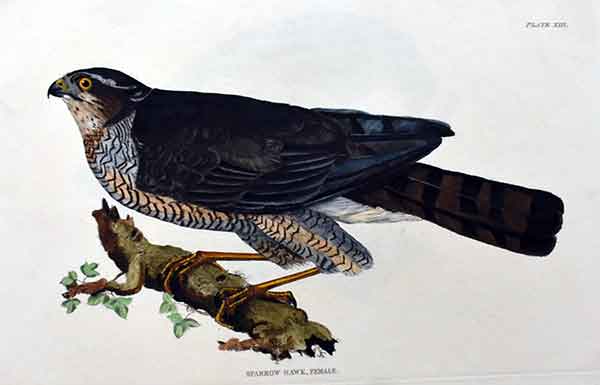
Sparrow Hawk Female Plate XIII
Plate from Illustrations of British Ornithology, 1821 34 by
Prideaux John Selby, hand-coloured engraving . Selby s large-scale
engravings were the first work of British ornithology to depict
many birds in the size of life. Comprising two volumes with a
total of 222 engravings, Illustrations of British Ornithology was
published in Edinburgh in 19 parts from 1821 to 1834. Created
during the same period that Audubon was publishing the Birds of
America, Both Audubon and Selby employed the Scottish engraver W.
H. Lizars. A highly skilled engraver himself, Selby employed
Lizars services only for printing and coloring his own exquisite
copper plates. Copies vary, and depending on the folio 222 or 218
of the engravings were hand-coloured, many by Daniel McNee.
Twenty-six of the plates were drawn by Selby s brother-in-law,
Admiral Mitford, and the rest were executed by Selby, who obtained
most of the specimens for the drawings himself. Selby engravings
are printed on elephant folio size Whatman paper that is
watermarked with the date the paper was made. Audubon also used
Whatman paper for the Havell edition of Birds of America. This
major work was etched/engraved by Selby, mostly after his own
drawings, with the assistance of his brother-in-law Captain Robert
Mitford. In 1816 Mitford was taught to etch and engrave by Thomas
Bewick in Newcastle; he then taught Selby at Twizell House . These
are shown large full size image plus the birds to compare sizing.
Elephant folio size, 20.375 x 25.5 inches £125
Merlin Male
Plate from Illustrations of British Ornithology, 1821 34 by
Prideaux John Selby, hand-coloured engraving . Selby s large-scale
engravings were the first work of British ornithology to depict
many birds in the size of life. Comprising two volumes with a
total of 222 engravings, Illustrations of British Ornithology was
published in Edinburgh in 19 parts from 1821 to 1834. Created
during the same period that Audubon was publishing the Birds of
America, Both Audubon and Selby employed the Scottish engraver W.
H. Lizars. A highly skilled engraver himself, Selby employed
Lizars services only for printing and coloring his own exquisite
copper plates. Copies vary, and depending on the folio 222 or 218
of the engravings were hand-coloured, many by Daniel McNee.
Twenty-six of the plates were drawn by Selby s brother-in-law,
Admiral Mitford, and the rest were executed by Selby, who obtained
most of the specimens for the drawings himself. Selby engravings
are printed on elephant folio size Whatman paper that is
watermarked with the date the paper was made. Audubon also used
Whatman paper for the Havell edition of Birds of America. This
major work was etched/engraved by Selby, mostly after his own
drawings, with the assistance of his brother-in-law Captain Robert
Mitford. In 1816 Mitford was taught to etch and engrave by Thomas
Bewick in Newcastle; he then taught Selby at Twizell House . These
are shown large full size image plus the birds to compare sizing.
Elephant folio size, 20.375 x 25.5 inches Plate XVIII £225
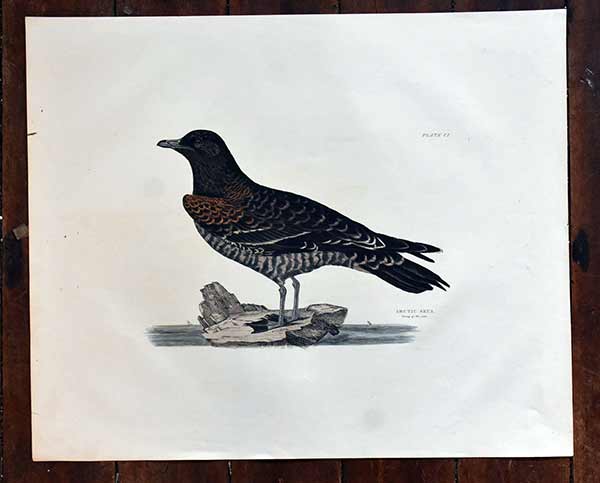
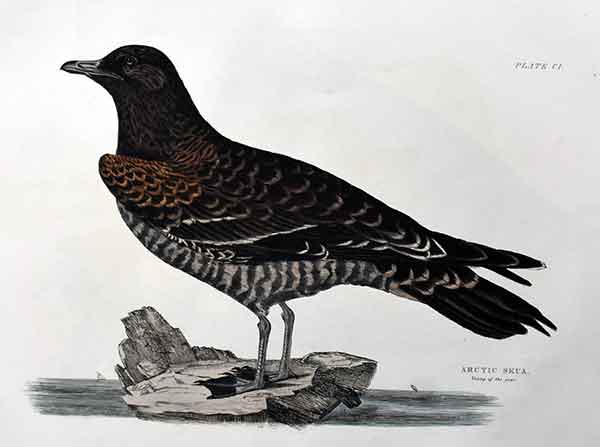
Arctic Skua Plate CI
Plate from Illustrations of British Ornithology, 1821 34 by
Prideaux John Selby, hand-coloured engraving . Selby s large-scale
engravings were the first work of British ornithology to depict
many birds in the size of life. Comprising two volumes with a
total of 222 engravings, Illustrations of British Ornithology was
published in Edinburgh in 19 parts from 1821 to 1834. Created
during the same period that Audubon was publishing the Birds of
America, Both Audubon and Selby employed the Scottish engraver W.
H. Lizars. A highly skilled engraver himself, Selby employed
Lizars services only for printing and coloring his own exquisite
copper plates. Copies vary, and depending on the folio 222 or 218
of the engravings were hand-coloured, many by Daniel McNee.
Twenty-six of the plates were drawn by Selby s brother-in-law,
Admiral Mitford, and the rest were executed by Selby, who obtained
most of the specimens for the drawings himself. Selby engravings
are printed on elephant folio size Whatman paper that is
watermarked with the date the paper was made. Audubon also used
Whatman paper for the Havell edition of Birds of America. This
major work was etched/engraved by Selby, mostly after his own
drawings, with the assistance of his brother-in-law Captain Robert
Mitford. In 1816 Mitford was taught to etch and engrave by Thomas
Bewick in Newcastle; he then taught Selby at Twizell House . These
are shown large full size image plus the birds to compare sizing.
Elephant folio size, 20.375 x 25.5 inches £255
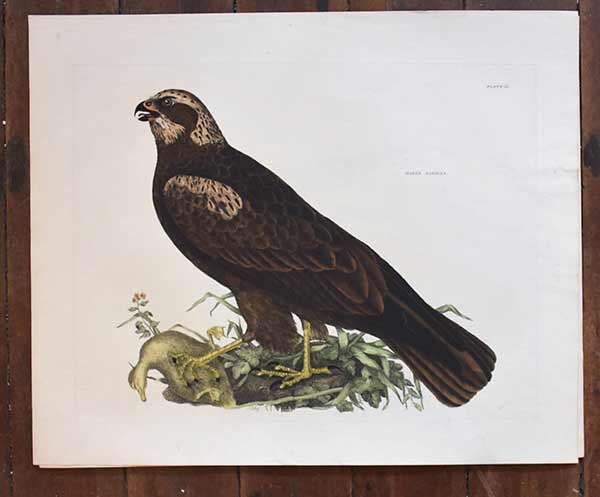
Marsh Harrier Plate IX
Plate from Illustrations of British Ornithology, 1821 34 by
Prideaux John Selby, hand-coloured engraving . Selby s large-scale
engravings were the first work of British ornithology to depict
many birds in the size of life. Comprising two volumes with a
total of 222 engravings, Illustrations of British Ornithology was
published in Edinburgh in 19 parts from 1821 to 1834. Created
during the same period that Audubon was publishing the Birds of
America, Both Audubon and Selby employed the Scottish engraver W.
H. Lizars. A highly skilled engraver himself, Selby employed
Lizars services only for printing and coloring his own exquisite
copper plates. Copies vary, and depending on the folio 222 or 218
of the engravings were hand-coloured, many by Daniel McNee.
Twenty-six of the plates were drawn by Selby s brother-in-law,
Admiral Mitford, and the rest were executed by Selby, who obtained
most of the specimens for the drawings himself. Selby engravings
are printed on elephant folio size Whatman paper that is
watermarked with the date the paper was made. Audubon also used
Whatman paper for the Havell edition of Birds of America. This
major work was etched/engraved by Selby, mostly after his own
drawings, with the assistance of his brother-in-law Captain Robert
Mitford. In 1816 Mitford was taught to etch and engrave by Thomas
Bewick in Newcastle; he then taught Selby at Twizell House . These
are shown large full size image plus the birds to compare sizing.
Elephant folio size, 20.375 x 25.5 inches £425
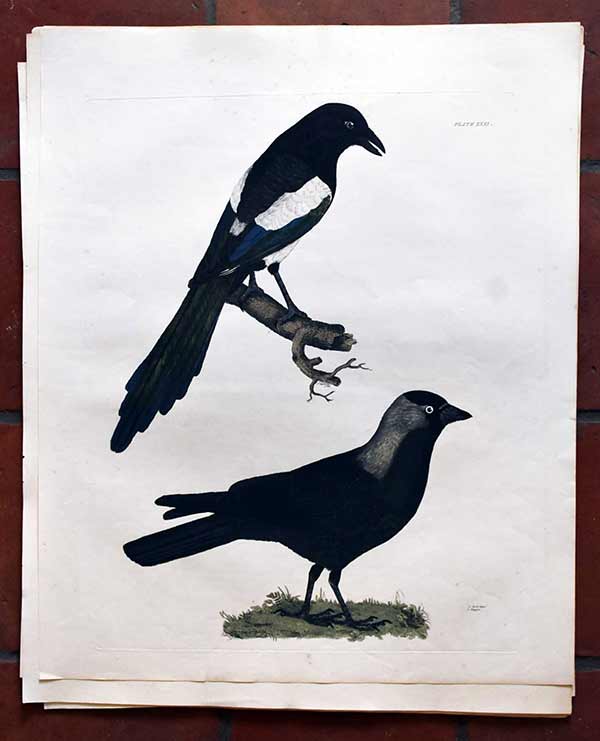
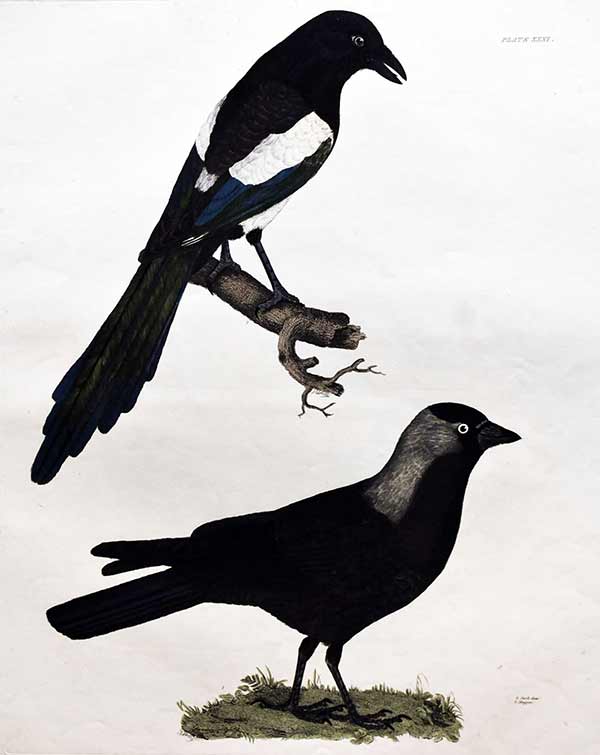
Jackdaw + Magpie £115
Plate from Illustrations of British Ornithology, 1821 34 by
Prideaux John Selby, hand-coloured engraving . Selby s large-scale
engravings were the first work of British ornithology to depict
many birds in the size of life. Comprising two volumes with a
total of 222 engravings, Illustrations of British Ornithology was
published in Edinburgh in 19 parts from 1821 to 1834. Created
during the same period that Audubon was publishing the Birds of
America, Both Audubon and Selby employed the Scottish engraver W.
H. Lizars. A highly skilled engraver himself, Selby employed
Lizars services only for printing and coloring his own exquisite
copper plates. Copies vary, and depending on the folio 222 or 218
of the engravings were hand-coloured, many by Daniel McNee.
Twenty-six of the plates were drawn by Selby s brother-in-law,
Admiral Mitford, and the rest were executed by Selby, who obtained
most of the specimens for the drawings himself. Selby engravings
are printed on elephant folio size Whatman paper that is
watermarked with the date the paper was made. Audubon also used
Whatman paper for the Havell edition of Birds of America. This
major work was etched/engraved by Selby, mostly after his own
drawings, with the assistance of his brother-in-law Captain Robert
Mitford. In 1816 Mitford was taught to etch and engrave by Thomas
Bewick in Newcastle; he then taught Selby at Twizell House . These
are shown large full size image plus the birds to compare sizing.
Elephant folio size, 20.375 x 25.5 inches
Cuckoo Male Plate XXXVIIThe plate measures 660 x 520 mm. (26
x 20 1/2")
Plate from Illustrations of British Ornithology, 1821 34 by
Prideaux John Selby, hand-coloured engraving . Selby s large-scale
engravings were the first work of British ornithology to depict
many birds in the size of life. Comprising two volumes with a
total of 222 engravings, Illustrations of British Ornithology was
published in Edinburgh in 19 parts from 1821 to 1834. Created
during the same period that Audubon was publishing the Birds of
America, Both Audubon and Selby employed the Scottish engraver W.
H. Lizars. A highly skilled engraver himself, Selby employed
Lizars services only for printing and coloring his own exquisite
copper plates. Copies vary, and depending on the folio 222 or 218
of the engravings were hand-coloured, many by Daniel McNee.
Twenty-six of the plates were drawn by Selby s brother-in-law,
Admiral Mitford, and the rest were executed by Selby, who obtained
most of the specimens for the drawings himself. Selby engravings
are printed on elephant folio size Whatman paper that is
watermarked with the date the paper was made. Audubon also used
Whatman paper for the Havell edition of Birds of America. This
major work was etched/engraved by Selby, mostly after his own
drawings, with the assistance of his brother-in-law Captain Robert
Mitford. In 1816 Mitford was taught to etch and engrave by Thomas
Bewick in Newcastle; he then taught Selby at Twizell House . These
are shown large full size image plus the birds to compare sizing.
Elephant folio size, 20.375 x 25.5 inches £125
Eared Grebe Young Plate LXXIV
Plate from Illustrations of British Ornithology, 1821 34 by
Prideaux John Selby, hand-coloured engraving . Selby s large-scale
engravings were the first work of British ornithology to depict
many birds in the size of life. Comprising two volumes with a
total of 222 engravings, Illustrations of British Ornithology was
published in Edinburgh in 19 parts from 1821 to 1834. Created
during the same period that Audubon was publishing the Birds of
America, Both Audubon and Selby employed the Scottish engraver W.
H. Lizars. A highly skilled engraver himself, Selby employed
Lizars services only for printing and coloring his own exquisite
copper plates. Copies vary, and depending on the folio 222 or 218
of the engravings were hand-coloured, many by Daniel McNee.
Twenty-six of the plates were drawn by Selby s brother-in-law,
Admiral Mitford, and the rest were executed by Selby, who obtained
most of the specimens for the drawings himself. Selby engravings
are printed on elephant folio size Whatman paper that is
watermarked with the date the paper was made. Audubon also used
Whatman paper for the Havell edition of Birds of America. This
major work was etched/engraved by Selby, mostly after his own
drawings, with the assistance of his brother-in-law Captain Robert
Mitford. In 1816 Mitford was taught to etch and engrave by Thomas
Bewick in Newcastle; he then taught Selby at Twizell House . These
are shown large full size image plus the birds to compare sizing.
Elephant folio size, 20.375 x 25.5 inches £105 shown as 'before'
Common Gallinule Plate XXXI
Plate from Illustrations of British Ornithology, 1821 34 by
Prideaux John Selby, hand-coloured engraving . Selby s large-scale
engravings were the first work of British ornithology to depict
many birds in the size of life. Comprising two volumes with a
total of 222 engravings, Illustrations of British Ornithology was
published in Edinburgh in 19 parts from 1821 to 1834. Created
during the same period that Audubon was publishing the Birds of
America, Both Audubon and Selby employed the Scottish engraver W.
H. Lizars. A highly skilled engraver himself, Selby employed
Lizars services only for printing and coloring his own exquisite
copper plates. Copies vary, and depending on the folio 222 or 218
of the engravings were hand-coloured, many by Daniel McNee.
Twenty-six of the plates were drawn by Selby s brother-in-law,
Admiral Mitford, and the rest were executed by Selby, who obtained
most of the specimens for the drawings himself. Selby engravings
are printed on elephant folio size Whatman paper that is
watermarked with the date the paper was made. Audubon also used
Whatman paper for the Havell edition of Birds of America. This
major work was etched/engraved by Selby, mostly after his own
drawings, with the assistance of his brother-in-law Captain Robert
Mitford. In 1816 Mitford was taught to etch and engrave by Thomas
Bewick in Newcastle; he then taught Selby at Twizell House . These
are shown large full size image plus the birds to compare sizing.
Elephant folio size, 20.375 x 25.5 inches x 2 £225
Common Thick Knee Plate XL
Plate from Illustrations of British Ornithology, 1821 34 by
Prideaux John Selby, hand-coloured engraving . Selby s large-scale
engravings were the first work of British ornithology to depict
many birds in the size of life. Comprising two volumes with a
total of 222 engravings, Illustrations of British Ornithology was
published in Edinburgh in 19 parts from 1821 to 1834. Created
during the same period that Audubon was publishing the Birds of
America, Both Audubon and Selby employed the Scottish engraver W.
H. Lizars. A highly skilled engraver himself, Selby employed
Lizars services only for printing and coloring his own exquisite
copper plates. Copies vary, and depending on the folio 222 or 218
of the engravings were hand-coloured, many by Daniel McNee.
Twenty-six of the plates were drawn by Selby s brother-in-law,
Admiral Mitford, and the rest were executed by Selby, who obtained
most of the specimens for the drawings himself. Selby engravings
are printed on elephant folio size Whatman paper that is
watermarked with the date the paper was made. Audubon also used
Whatman paper for the Havell edition of Birds of America. This
major work was etched/engraved by Selby, mostly after his own
drawings, with the assistance of his brother-in-law Captain Robert
Mitford. In 1816 Mitford was taught to etch and engrave by Thomas
Bewick in Newcastle; he then taught Selby at Twizell House . These
are shown large full size image plus the birds to compare sizing.
Elephant folio size, 20.375 x 25.5 inches £195
Common Turnstone
Plate XXXIII £185 +
Plate from Illustrations of British Ornithology, 1821 34 by
Prideaux John Selby, hand-coloured engraving . Selby s large-scale
engravings were the first work of British ornithology to depict
many birds in the size of life. Comprising two volumes with a
total of 222 engravings, Illustrations of British Ornithology was
published in Edinburgh in 19 parts from 1821 to 1834. Created
during the same period that Audubon was publishing the Birds of
America, Both Audubon and Selby employed the Scottish engraver W.
H. Lizars. A highly skilled engraver himself, Selby employed
Lizars services only for printing and coloring his own exquisite
copper plates. Copies vary, and depending on the folio 222 or 218
of the engravings were hand-coloured, many by Daniel McNee.
Twenty-six of the plates were drawn by Selby s brother-in-law,
Admiral Mitford, and the rest were executed by Selby, who obtained
most of the specimens for the drawings himself. Selby engravings
are printed on elephant folio size Whatman paper that is
watermarked with the date the paper was made. Audubon also used
Whatman paper for the Havell edition of Birds of America. This
major work was etched/engraved by Selby, mostly after his own
drawings, with the assistance of his brother-in-law Captain Robert
Mitford. In 1816 Mitford was taught to etch and engrave by Thomas
Bewick in Newcastle; he then taught Selby at Twizell House . These
are shown large full size image plus the birds to compare sizing.
Elephant folio size, 20.375 x 25.5 inches £125
Grey Lapwing + Sandpiper Plate XXXV £185
Plate from Illustrations of British Ornithology, 1821 34 by
Prideaux John Selby, hand-coloured engraving . Selby s large-scale
engravings were the first work of British ornithology to depict
many birds in the size of life. Comprising two volumes with a
total of 222 engravings, Illustrations of British Ornithology was
published in Edinburgh in 19 parts from 1821 to 1834. Created
during the same period that Audubon was publishing the Birds of
America, Both Audubon and Selby employed the Scottish engraver W.
H. Lizars. A highly skilled engraver himself, Selby employed
Lizars services only for printing and coloring his own exquisite
copper plates. Copies vary, and depending on the folio 222 or 218
of the engravings were hand-coloured, many by Daniel McNee.
Twenty-six of the plates were drawn by Selby s brother-in-law,
Admiral Mitford, and the rest were executed by Selby, who obtained
most of the specimens for the drawings himself. Selby engravings
are printed on elephant folio size Whatman paper that is
watermarked with the date the paper was made. Audubon also used
Whatman paper for the Havell edition of Birds of America. This
major work was etched/engraved by Selby, mostly after his own
drawings, with the assistance of his brother-in-law Captain Robert
Mitford. In 1816 Mitford was taught to etch and engrave by Thomas
Bewick in Newcastle; he then taught Selby at Twizell House . These
are shown large full size image plus the birds to compare sizing.
Elephant folio size, 20.375 x 25.5 inches £95 suspect Bohn
edition
Common Crake Plate XXX £185
Plate from Illustrations of British Ornithology, 1821 34 by
Prideaux John Selby, hand-coloured engraving . Selby s large-scale
engravings were the first work of British ornithology to depict
many birds in the size of life. Comprising two volumes with a
total of 222 engravings, Illustrations of British Ornithology was
published in Edinburgh in 19 parts from 1821 to 1834. Created
during the same period that Audubon was publishing the Birds of
America, Both Audubon and Selby employed the Scottish engraver W.
H. Lizars. A highly skilled engraver himself, Selby employed
Lizars services only for printing and coloring his own exquisite
copper plates. Copies vary, and depending on the folio 222 or 218
of the engravings were hand-coloured, many by Daniel McNee.
Twenty-six of the plates were drawn by Selby s brother-in-law,
Admiral Mitford, and the rest were executed by Selby, who obtained
most of the specimens for the drawings himself. Selby engravings
are printed on elephant folio size Whatman paper that is
watermarked with the date the paper was made. Audubon also used
Whatman paper for the Havell edition of Birds of America. This
major work was etched/engraved by Selby, mostly after his own
drawings, with the assistance of his brother-in-law Captain Robert
Mitford. In 1816 Mitford was taught to etch and engrave by Thomas
Bewick in Newcastle; he then taught Selby at Twizell House . These
are shown large full size image plus the birds to compare sizing.
Elephant folio size, 20.375 x 25.5 inches
Spotted,Baillons+ Little Crakes £295
Plate from Illustrations of British Ornithology, 1821 34 by
Prideaux John Selby, hand-coloured engraving . Selby s large-scale
engravings were the first work of British ornithology to depict
many birds in the size of life. Comprising two volumes with a
total of 222 engravings, Illustrations of British Ornithology was
published in Edinburgh in 19 parts from 1821 to 1834. Created
during the same period that Audubon was publishing the Birds of
America, Both Audubon and Selby employed the Scottish engraver W.
H. Lizars. A highly skilled engraver himself, Selby employed
Lizars services only for printing and coloring his own exquisite
copper plates. Copies vary, and depending on the folio 222 or 218
of the engravings were hand-coloured, many by Daniel McNee.
Twenty-six of the plates were drawn by Selby s brother-in-law,
Admiral Mitford, and the rest were executed by Selby, who obtained
most of the specimens for the drawings himself. Selby engravings
are printed on elephant folio size Whatman paper that is
watermarked with the date the paper was made. Audubon also used
Whatman paper for the Havell edition of Birds of America. This
major work was etched/engraved by Selby, mostly after his own
drawings, with the assistance of his brother-in-law Captain Robert
Mitford. In 1816 Mitford was taught to etch and engrave by Thomas
Bewick in Newcastle; he then taught Selby at Twizell House . These
are shown large full size image plus the birds to compare sizing.
Elephant folio size, 20.375 x 25.5 inches
Spotted Sandpiper Plate XVII £185
Golden Plover Plate XXXVII £225
Plate from Illustrations of British Ornithology, 1821 34 by
Prideaux John Selby, hand-coloured engraving . Selby s large-scale
engravings were the first work of British ornithology to depict
many birds in the size of life. Comprising two volumes with a
total of 222 engravings, Illustrations of British Ornithology was
published in Edinburgh in 19 parts from 1821 to 1834. Created
during the same period that Audubon was publishing the Birds of
America, Both Audubon and Selby employed the Scottish engraver W.
H. Lizars. A highly skilled engraver himself, Selby employed
Lizars services only for printing and coloring his own exquisite
copper plates. Copies vary, and depending on the folio 222 or 218
of the engravings were hand-coloured, many by Daniel McNee.
Twenty-six of the plates were drawn by Selby s brother-in-law,
Admiral Mitford, and the rest were executed by Selby, who obtained
most of the specimens for the drawings himself. Selby engravings
are printed on elephant folio size Whatman paper that is
watermarked with the date the paper was made. Audubon also used
Whatman paper for the Havell edition of Birds of America. This
major work was etched/engraved by Selby, mostly after his own
drawings, with the assistance of his brother-in-law Captain Robert
Mitford. In 1816 Mitford was taught to etch and engrave by Thomas
Bewick in Newcastle; he then taught Selby at Twizell House . These
are shown large full size image plus the birds to compare sizing.
Elephant folio size, 20.375 x 25.5 inches
Swallow, House Martin + Sand Martin ,
Plate from Illustrations of British Ornithology, 1821 34 by
Prideaux John Selby, hand-coloured engraving . Selby s large-scale
engravings were the first work of British ornithology to depict
many birds in the size of life. Comprising two volumes with a
total of 222 engravings, Illustrations of British Ornithology was
published in Edinburgh in 19 parts from 1821 to 1834. Created
during the same period that Audubon was publishing the Birds of
America, Both Audubon and Selby employed the Scottish engraver W.
H. Lizars. A highly skilled engraver himself, Selby employed
Lizars services only for printing and coloring his own exquisite
copper plates. Copies vary, and depending on the folio 222 or 218
of the engravings were hand-coloured, many by Daniel McNee.
Twenty-six of the plates were drawn by Selby s brother-in-law,
Admiral Mitford, and the rest were executed by Selby, who obtained
most of the specimens for the drawings himself. Selby engravings
are printed on elephant folio size Whatman paper that is
watermarked with the date the paper was made. Audubon also used
Whatman paper for the Havell edition of Birds of America. This
major work was etched/engraved by Selby, mostly after his own
drawings, with the assistance of his brother-in-law Captain Robert
Mitford. In 1816 Mitford was taught to etch and engrave by Thomas
Bewick in Newcastle; he then taught Selby at Twizell House . These
are shown large full size image plus the birds to compare sizing.
Elephant folio size, 20.375 x 25.5 inches £135
Stormy Petrel,
Plate from Illustrations of British Ornithology, 1821 34 by
Prideaux John Selby, hand-coloured engraving . Selby s large-scale
engravings were the first work of British ornithology to depict
many birds in the size of life. Comprising two volumes with a
total of 222 engravings, Illustrations of British Ornithology was
published in Edinburgh in 19 parts from 1821 to 1834. Created
during the same period that Audubon was publishing the Birds of
America, Both Audubon and Selby employed the Scottish engraver W.
H. Lizars. A highly skilled engraver himself, Selby employed
Lizars services only for printing and coloring his own exquisite
copper plates. Copies vary, and depending on the folio 222 or 218
of the engravings were hand-coloured, many by Daniel McNee.
Twenty-six of the plates were drawn by Selby s brother-in-law,
Admiral Mitford, and the rest were executed by Selby, who obtained
most of the specimens for the drawings himself. Selby engravings
are printed on elephant folio size Whatman paper that is
watermarked with the date the paper was made. Audubon also used
Whatman paper for the Havell edition of Birds of America. This
major work was etched/engraved by Selby, mostly after his own
drawings, with the assistance of his brother-in-law Captain Robert
Mitford. In 1816 Mitford was taught to etch and engrave by Thomas
Bewick in Newcastle; he then taught Selby at Twizell House . These
are shown large full size image plus the birds to compare sizing.
Elephant folio size, 20.375 x 25.5 inches £185
Lobefoot
Plate from Illustrations of British Ornithology, 1821 34 by
Prideaux John Selby, hand-coloured engraving . Selby s large-scale
engravings were the first work of British ornithology to depict
many birds in the size of life. Comprising two volumes with a
total of 222 engravings, Illustrations of British Ornithology was
published in Edinburgh in 19 parts from 1821 to 1834. Created
during the same period that Audubon was publishing the Birds of
America, Both Audubon and Selby employed the Scottish engraver W.
H. Lizars. A highly skilled engraver himself, Selby employed
Lizars services only for printing and coloring his own exquisite
copper plates. Copies vary, and depending on the folio 222 or 218
of the engravings were hand-coloured, many by Daniel McNee.
Twenty-six of the plates were drawn by Selby s brother-in-law,
Admiral Mitford, and the rest were executed by Selby, who obtained
most of the specimens for the drawings himself. Selby engravings
are printed on elephant folio size Whatman paper that is
watermarked with the date the paper was made. Audubon also used
Whatman paper for the Havell edition of Birds of America. This
major work was etched/engraved by Selby, mostly after his own
drawings, with the assistance of his brother-in-law Captain Robert
Mitford. In 1816 Mitford was taught to etch and engrave by Thomas
Bewick in Newcastle; he then taught Selby at Twizell House . These
are shown large full size image plus the birds to compare sizing.
Elephant folio size, 20.375 x 25.5 inches £95 it's tiddly
Grasshopper, Hedge + Reed Warblers,
Plate from Illustrations of British Ornithology, 1821 34 by
Prideaux John Selby, hand-coloured engraving . Selby s large-scale
engravings were the first work of British ornithology to depict
many birds in the size of life. Comprising two volumes with a
total of 222 engravings, Illustrations of British Ornithology was
published in Edinburgh in 19 parts from 1821 to 1834. Created
during the same period that Audubon was publishing the Birds of
America, Both Audubon and Selby employed the Scottish engraver W.
H. Lizars. A highly skilled engraver himself, Selby employed
Lizars services only for printing and coloring his own exquisite
copper plates. Copies vary, and depending on the folio 222 or 218
of the engravings were hand-coloured, many by Daniel McNee.
Twenty-six of the plates were drawn by Selby s brother-in-law,
Admiral Mitford, and the rest were executed by Selby, who obtained
most of the specimens for the drawings himself. Selby engravings
are printed on elephant folio size Whatman paper that is
watermarked with the date the paper was made. Audubon also used
Whatman paper for the Havell edition of Birds of America. This
major work was etched/engraved by Selby, mostly after his own
drawings, with the assistance of his brother-in-law Captain Robert
Mitford. In 1816 Mitford was taught to etch and engrave by Thomas
Bewick in Newcastle; he then taught Selby at Twizell House . These
are shown large full size image plus the birds to compare sizing.
Elephant folio size, 20.375 x 25.5 inches £155
Skylark + Wood Lark,
Plate from Illustrations of British Ornithology, 1821 34 by
Prideaux John Selby, hand-coloured engraving . Selby s large-scale
engravings were the first work of British ornithology to depict
many birds in the size of life. Comprising two volumes with a
total of 222 engravings, Illustrations of British Ornithology was
published in Edinburgh in 19 parts from 1821 to 1834. Created
during the same period that Audubon was publishing the Birds of
America, Both Audubon and Selby employed the Scottish engraver W.
H. Lizars. A highly skilled engraver himself, Selby employed
Lizars services only for printing and coloring his own exquisite
copper plates. Copies vary, and depending on the folio 222 or 218
of the engravings were hand-coloured, many by Daniel McNee.
Twenty-six of the plates were drawn by Selby s brother-in-law,
Admiral Mitford, and the rest were executed by Selby, who obtained
most of the specimens for the drawings himself. Selby engravings
are printed on elephant folio size Whatman paper that is
watermarked with the date the paper was made. Audubon also used
Whatman paper for the Havell edition of Birds of America. This
major work was etched/engraved by Selby, mostly after his own
drawings, with the assistance of his brother-in-law Captain Robert
Mitford. In 1816 Mitford was taught to etch and engrave by Thomas
Bewick in Newcastle; he then taught Selby at Twizell House . These
are shown large full size image plus the birds to compare sizing.
Elephant folio size, 20.375 x 25.5 inches
Nuthatch + Creeper,
Plate from Illustrations of British Ornithology, 1821 34 by
Prideaux John Selby, hand-coloured engraving . Selby s large-scale
engravings were the first work of British ornithology to depict
many birds in the size of life. Comprising two volumes with a
total of 222 engravings, Illustrations of British Ornithology was
published in Edinburgh in 19 parts from 1821 to 1834. Created
during the same period that Audubon was publishing the Birds of
America, Both Audubon and Selby employed the Scottish engraver W.
H. Lizars. A highly skilled engraver himself, Selby employed
Lizars services only for printing and coloring his own exquisite
copper plates. Copies vary, and depending on the folio 222 or 218
of the engravings were hand-coloured, many by Daniel McNee.
Twenty-six of the plates were drawn by Selby s brother-in-law,
Admiral Mitford, and the rest were executed by Selby, who obtained
most of the specimens for the drawings himself. Selby engravings
are printed on elephant folio size Whatman paper that is
watermarked with the date the paper was made. Audubon also used
Whatman paper for the Havell edition of Birds of America. This
major work was etched/engraved by Selby, mostly after his own
drawings, with the assistance of his brother-in-law Captain Robert
Mitford. In 1816 Mitford was taught to etch and engrave by Thomas
Bewick in Newcastle; he then taught Selby at Twizell House . These
are shown large full size image plus the birds to compare sizing.
Elephant folio size, 20.375 x 25.5 inches reserved
Grey Plover. Ring Plover Plate XXXVIII £185
Dipper Plate XLV
Plate from Illustrations of British Ornithology, 1821 34 by
Prideaux John Selby, hand-coloured engraving . Selby s large-scale
engravings were the first work of British ornithology to depict
many birds in the size of life. Comprising two volumes with a
total of 222 engravings, Illustrations of British Ornithology was
published in Edinburgh in 19 parts from 1821 to 1834. Created
during the same period that Audubon was publishing the Birds of
America, Both Audubon and Selby employed the Scottish engraver W.
H. Lizars. A highly skilled engraver himself, Selby employed
Lizars services only for printing and coloring his own exquisite
copper plates. Copies vary, and depending on the folio 222 or 218
of the engravings were hand-coloured, many by Daniel McNee.
Twenty-six of the plates were drawn by Selby s brother-in-law,
Admiral Mitford, and the rest were executed by Selby, who obtained
most of the specimens for the drawings himself. Selby engravings
are printed on elephant folio size Whatman paper that is
watermarked with the date the paper was made. Audubon also used
Whatman paper for the Havell edition of Birds of America. This
major work was etched/engraved by Selby, mostly after his own
drawings, with the assistance of his brother-in-law Captain Robert
Mitford. In 1816 Mitford was taught to etch and engrave by Thomas
Bewick in Newcastle; he then taught Selby at Twizell House . These
are shown large full size image plus the birds to compare sizing.
Elephant folio size, 20.375 x 25.5 inches £105 again
possibly Bohn edition
1) 'Woodcock, Solitary Snipe, Common Snipe, Young od Do,
Jack Snipe'; 2) 'Common Redshank, Winter Plumage, Green Sandpiper,
Wood Sandpiper'; 3) 'Dunlin Winter Plumage, Dunlin Summer Plumage;
And others, (5) Plate from Illustrations of British Ornithology,
1821–34 by Prideaux John Selby, hand-colored engraving
represented in the plate in about one-half the natural size.
.Selby’s large-scale engravings were the first work of British
ornithology to depict many birds in the size of life. Comprising
two volumes with a total of 222 engravings, Illustrations of
British Ornithology was published in Edinburgh in 19 parts from
1821 to 1834. Created during the same period that Audubon was
publishing the Birds of America, Both Audubon and Selby employed
the Scottish engraver W. H. Lizars. A highly skilled engraver
himself, Selby employed Lizars’ services only for printing and
coloring his own exquisite copper plates. Copies vary, and
depending on the folio 222 or 218 of the engravings were
hand-colored, many by Daniel McNee. Twenty-six of the plates were
drawn by Selby’s brother-in-law, Admiral Mitford, and the rest
were executed by Selby, who obtained most of the specimens for the
drawings himself. Selby engravings are printed on elephant folio
size Whatman paper that is watermarked with the date the paper was
made. Audubon also used Whatman paper for the Havell edition of
Birds of America. I Elephant folio size, 20.375 x 25.5
inches. £455 due to size sent rolled
Starling, Rose Coloured Pastor
Plate from Illustrations of British Ornithology, 1821 34 by
Prideaux John Selby, hand-coloured engraving . Selby s large-scale
engravings were the first work of British ornithology to depict
many birds in the size of life. Comprising two volumes with a
total of 222 engravings, Illustrations of British Ornithology was
published in Edinburgh in 19 parts from 1821 to 1834. Created
during the same period that Audubon was publishing the Birds of
America, Both Audubon and Selby employed the Scottish engraver W.
H. Lizars. A highly skilled engraver himself, Selby employed
Lizars services only for printing and coloring his own exquisite
copper plates. Copies vary, and depending on the folio 222 or 218
of the engravings were hand-coloured, many by Daniel McNee.
Twenty-six of the plates were drawn by Selby s brother-in-law,
Admiral Mitford, and the rest were executed by Selby, who obtained
most of the specimens for the drawings himself. Selby engravings
are printed on elephant folio size Whatman paper that is
watermarked with the date the paper was made. Audubon also used
Whatman paper for the Havell edition of Birds of America. This
major work was etched/engraved by Selby, mostly after his own
drawings, with the assistance of his brother-in-law Captain Robert
Mitford. In 1816 Mitford was taught to etch and engrave by Thomas
Bewick in Newcastle; he then taught Selby at Twizell House . These
are shown large full size image plus the birds to compare sizing.
Elephant folio size, 20.375 x 25.5 inches £195
Greater Bull Finch Cross Bill
Plate from Illustrations of British Ornithology, 1821 34 by
Prideaux John Selby, hand-coloured engraving . Selby s large-scale
engravings were the first work of British ornithology to depict
many birds in the size of life. Comprising two volumes with a
total of 222 engravings, Illustrations of British Ornithology was
published in Edinburgh in 19 parts from 1821 to 1834. Created
during the same period that Audubon was publishing the Birds of
America, Both Audubon and Selby employed the Scottish engraver W.
H. Lizars. A highly skilled engraver himself, Selby employed
Lizars services only for printing and coloring his own exquisite
copper plates. Copies vary, and depending on the folio 222 or 218
of the engravings were hand-coloured, many by Daniel McNee.
Twenty-six of the plates were drawn by Selby s brother-in-law,
Admiral Mitford, and the rest were executed by Selby, who obtained
most of the specimens for the drawings himself. Selby engravings
are printed on elephant folio size Whatman paper that is
watermarked with the date the paper was made. Audubon also used
Whatman paper for the Havell edition of Birds of America. This
major work was etched/engraved by Selby, mostly after his own
drawings, with the assistance of his brother-in-law Captain Robert
Mitford. In 1816 Mitford was taught to etch and engrave by Thomas
Bewick in Newcastle; he then taught Selby at Twizell House . These
are shown large full size image plus the birds to compare sizing.
Elephant folio size, 20.375 x 25.5 inches rolled in a museum
tube. If buying more than one ask re reduced price reserved
Cross Bills, £155
Plate from Illustrations of British Ornithology,
1821–34 by Prideaux John Selby,, hand-colored
engraving represented in the plate in about one-half the
natural size. .Selby’s large-scale engravings were the first work
of British ornithology to depict many birds in the size of life.
Comprising two volumes with a total of 222 engravings,
Illustrations of British Ornithology was published in Edinburgh in
19 parts from 1821 to 1834. Created during the same period that
Audubon was publishing the Birds of America, Both Audubon and
Selby employed the Scottish engraver W. H. Lizars. A highly
skilled engraver himself, Selby employed Lizars’ services only for
printing and coloring his own exquisite copper plates. Copies
vary, and depending on the folio 222 or 218 of the engravings were
hand-colored, many by Daniel McNee. Twenty-six of the plates were
drawn by Selby’s brother-in-law, Admiral Mitford, and the rest
were executed by Selby, who obtained most of the specimens for the
drawings himself. Selby engravings are printed on elephant folio
size Whatman paper that is watermarked with the date the paper was
made. Audubon also used Whatman paper for the Havell edition of
Birds of America. I Elephant folio size, 20.375 x 25.5
inches .£185 inc delivery rolled in a museum tube. If
buying more than one ask re reduced price

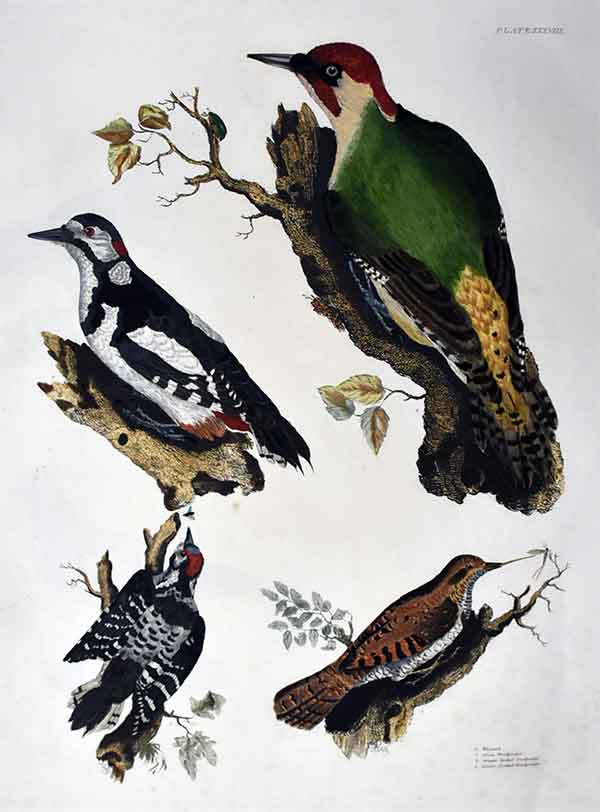

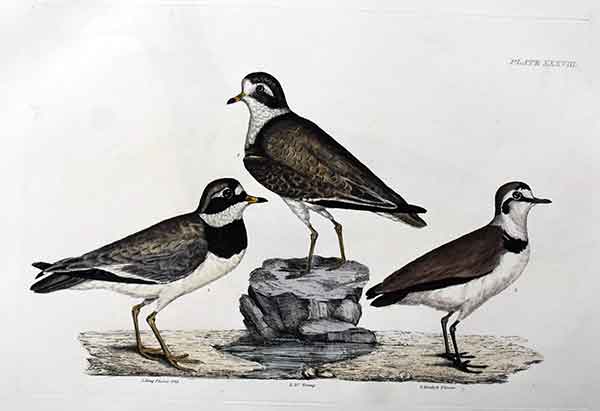

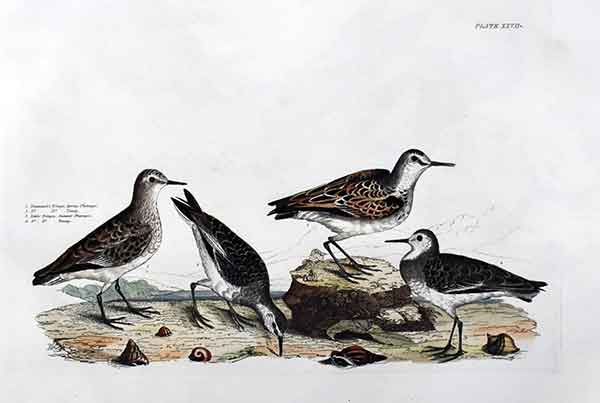
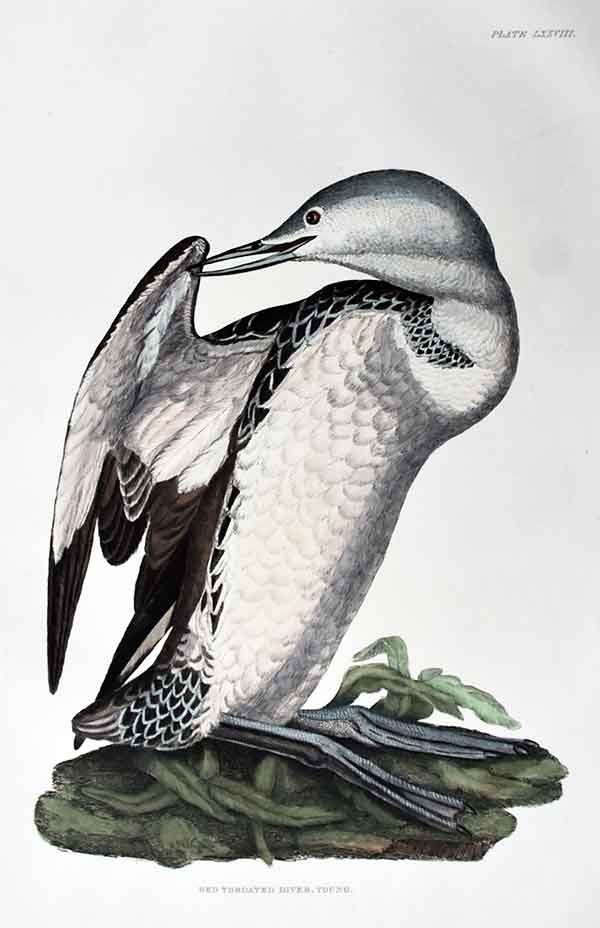


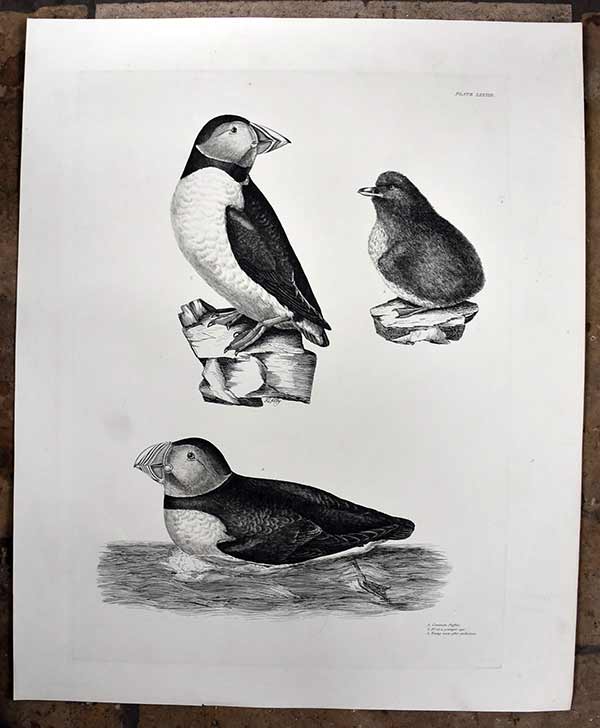
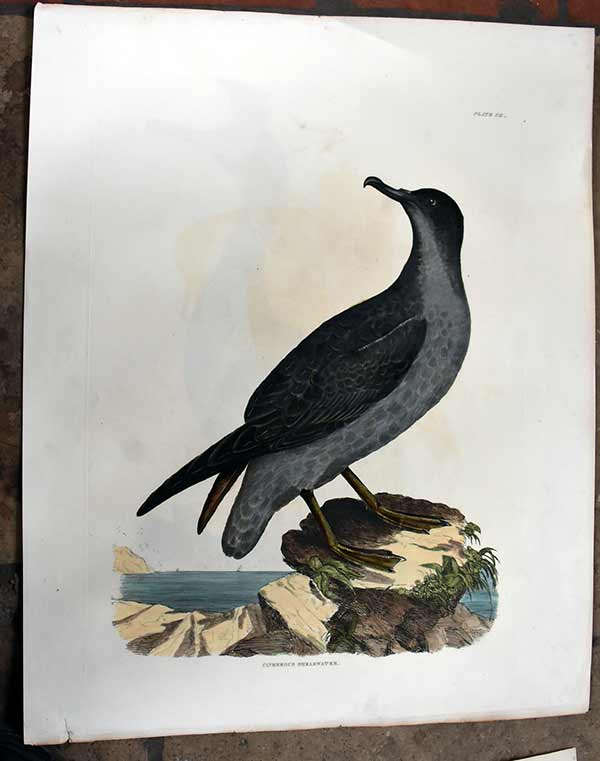

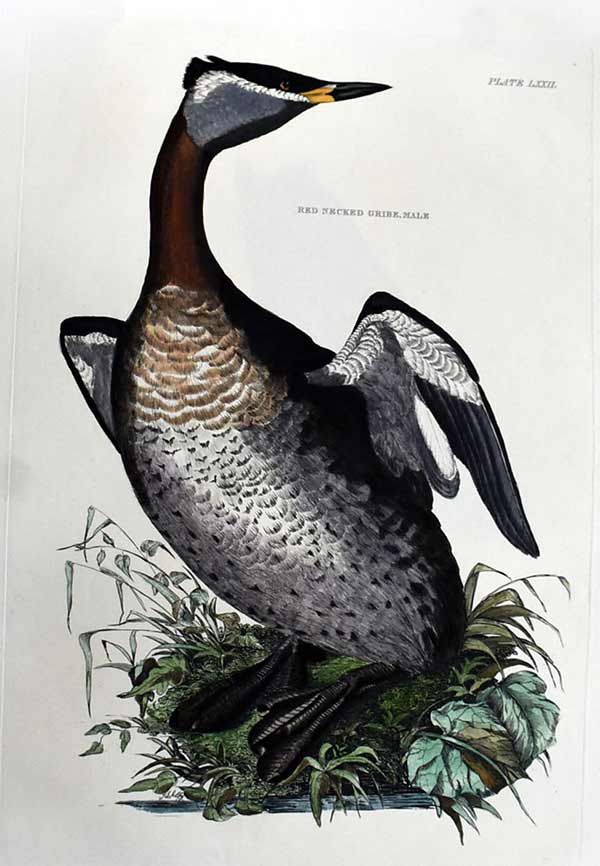
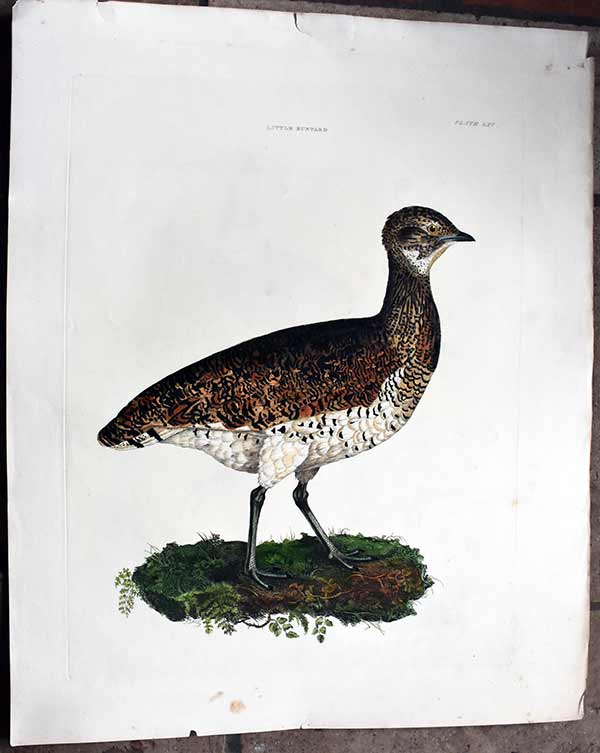


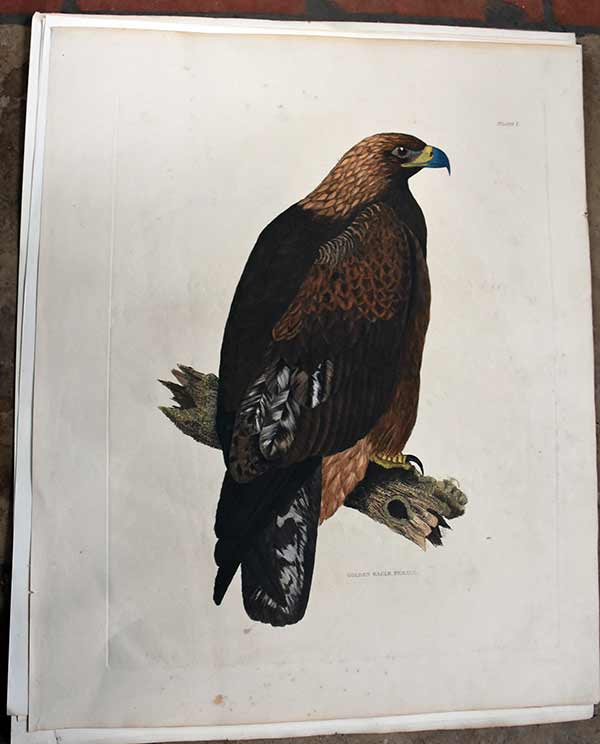
 Golden Eagle Female