Botanicals from 'La natura, e coltura de' fiori
fisicamente esposta.'by Filippo arena
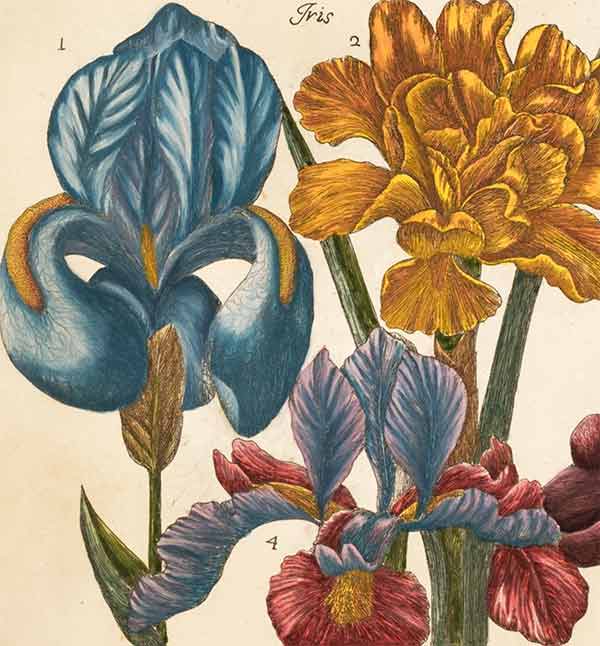
Close up of the colouring
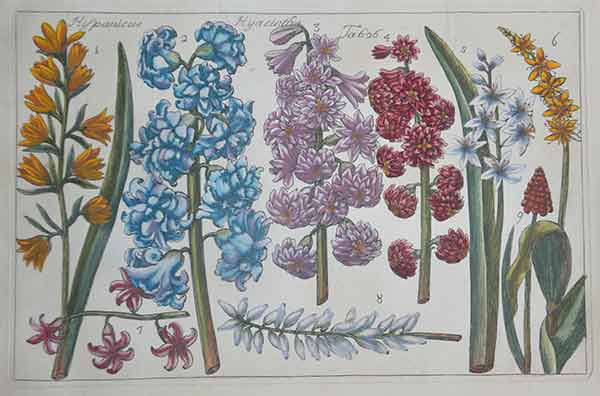
Hispanicus ,Hyacinth Tab 26
The rarest of the early Florilegium printed in Palermo, by Angelo Felicella, 1767-1768. the artist was Mario Cammerari. Text was written by Filippo Arena (1708-1789), a Jesuit professor of mathematics and philosophy at the University of Palermo, with a passion for botany. Arena also took it upon himself to engrave the 65 plates, which he did with the help of his Jesuit colleague Mario Cammerari/Cammereri. For this he copied Weinmann's Phytanthoza iconographia (1737-1745) for many images and Besler on others. The plates were printed in colour and hand finished with few complete copies known.Image size just over 8 x 12 inches £385 inc delivery
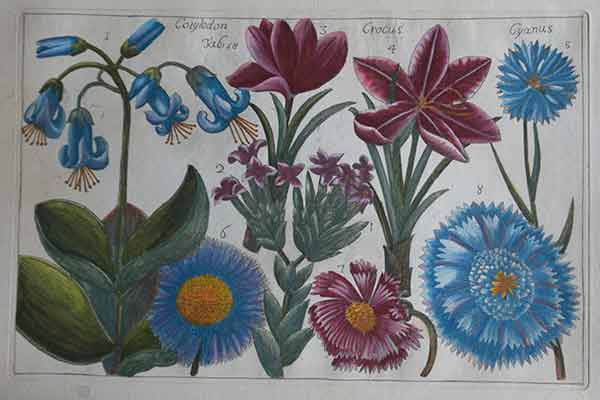
Bluebell, Crocus, Cornflower Tab 18
The rarest of the early Florilegium printed in Palermo, by Angelo Felicella, 1767-1768. the artist was Mario Cammerari. Text was written by Filippo Arena (1708-1789), a Jesuit professor of mathematics and philosophy at the University of Palermo, with a passion for botany. Arena also took it upon himself to engrave the 65 plates, which he did with the help of his Jesuit colleague Mario Cammerari/Cammereri. For this he copied Weinmann's Phytanthoza iconographia (1737-1745) for many images and Besler on others. The plates were printed in colour and hand finished with few complete copies known.Image size just over 8 x 12 inches £385 inc delivery
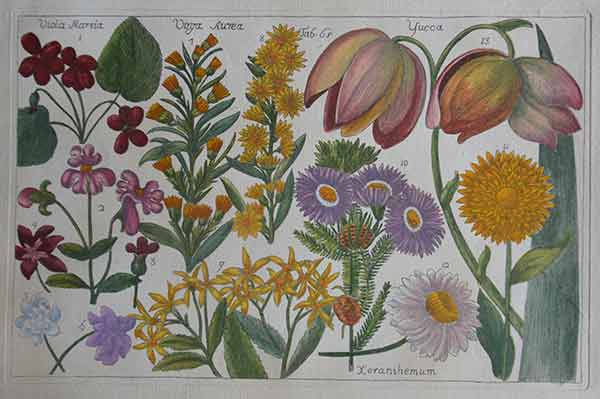
Viola, Yucca, Chrysanthemum Tab 65
The rarest of the early Florilegium printed in Palermo, by Angelo Felicella, 1767-1768. the artist was Mario Cammerari. Text was written by Filippo Arena (1708-1789), a Jesuit professor of mathematics and philosophy at the University of Palermo, with a passion for botany. Arena also took it upon himself to engrave the 65 plates, which he did with the help of his Jesuit colleague Mario Cammerari/Cammereri. For this he copied Weinmann's Phytanthoza iconographia (1737-1745) for many images and Besler on others. The plates were printed in colour and hand finished with few complete copies known.Image size just over 8 x 12 inches £385 inc delivery
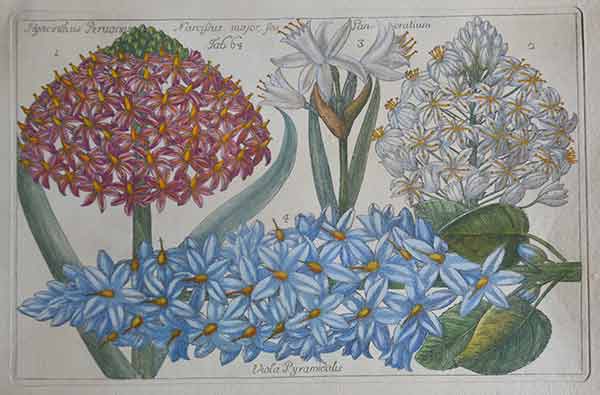
Hyacinth, Narcissus, Pancratium Tab 64
The rarest of the early Florilegium printed in Palermo, by Angelo Felicella, 1767-1768. the artist was Mario Cammerari. Text was written by Filippo Arena (1708-1789), a Jesuit professor of mathematics and philosophy at the University of Palermo, with a passion for botany. Arena also took it upon himself to engrave the 65 plates, which he did with the help of his Jesuit colleague Mario Cammerari/Cammereri. For this he copied Weinmann's Phytanthoza iconographia (1737-1745) for many images and Besler on others. The plates were printed in colour and hand finished with few complete copies known.Image size just over 8 x 12 inches £385 inc delivery
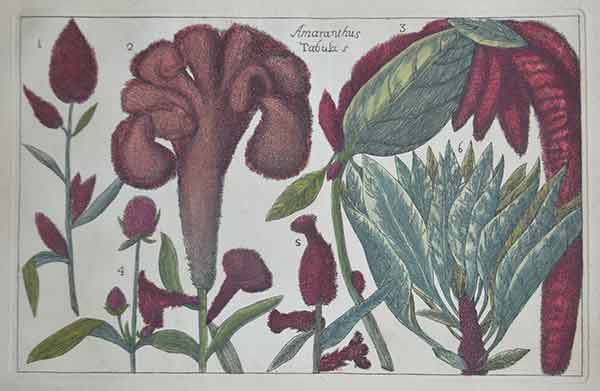
Amaranthus Tab 5
The rarest of the early Florilegium printed in Palermo, by Angelo Felicella, 1767-1768. the artist was Mario Cammerari. Text was written by Filippo Arena (1708-1789), a Jesuit professor of mathematics and philosophy at the University of Palermo, with a passion for botany. Arena also took it upon himself to engrave the 65 plates, which he did with the help of his Jesuit colleague Mario Cammerari/Cammereri. For this he copied Weinmann's Phytanthoza iconographia (1737-1745) for many images and Besler on others. The plates were printed in colour and hand finished with few complete copies known.Image size just over 8 x 12 inches £385 inc delivery

Foxglove , Michlemas Daisy Tab 20
The rarest of the early Florilegium printed in Palermo, by Angelo Felicella, 1767-1768. the artist was Mario Cammerari. Text was written by Filippo Arena (1708-1789), a Jesuit professor of mathematics and philosophy at the University of Palermo, with a passion for botany. Arena also took it upon himself to engrave the 65 plates, which he did with the help of his Jesuit colleague Mario Cammerari/Cammereri. For this he copied Weinmann's Phytanthoza iconographia (1737-1745) for many images and Besler on others. The plates were printed in colour and hand finished with few complete copies known.Image size just over 8 x 12 inches £385 inc delivery
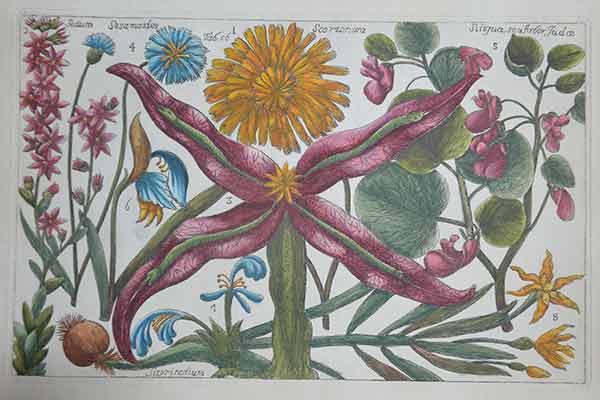
Sedum, Scorzonera etc Tab 56
The rarest of the early Florilegium printed in Palermo, by Angelo Felicella, 1767-1768. the artist was Mario Cammerari. Text was written by Filippo Arena (1708-1789), a Jesuit professor of mathematics and philosophy at the University of Palermo, with a passion for botany. Arena also took it upon himself to engrave the 65 plates, which he did with the help of his Jesuit colleague Mario Cammerari/Cammereri. For this he copied Weinmann's Phytanthoza iconographia (1737-1745) for many images and Besler on others. The plates were printed in colour and hand finished with few complete copies known.Image size just over 8 x 12 inches £385 inc delivery
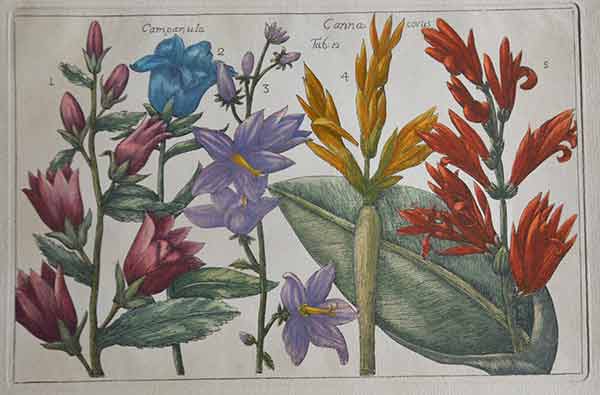
Campanula, Canna Lily Tab 12
The rarest of the early Florilegium printed in Palermo, by Angelo Felicella, 1767-1768. the artist was Mario Cammerari. Text was written by Filippo Arena (1708-1789), a Jesuit professor of mathematics and philosophy at the University of Palermo, with a passion for botany. Arena also took it upon himself to engrave the 65 plates, which he did with the help of his Jesuit colleague Mario Cammerari/Cammereri. For this he copied Weinmann's Phytanthoza iconographia (1737-1745) for many images and Besler on others. The plates were printed in colour and hand finished with few complete copies known.Image size just over 8 x 12 inches £385 inc delivery

Clematis, Passion Flower, Crocus Tab 16
The rarest of the early Florilegium printed in Palermo, by Angelo Felicella, 1767-1768. the artist was Mario Cammerari. Text was written by Filippo Arena (1708-1789), a Jesuit professor of mathematics and philosophy at the University of Palermo, with a passion for botany. Arena also took it upon himself to engrave the 65 plates, which he did with the help of his Jesuit colleague Mario Cammerari/Cammereri. For this he copied Weinmann's Phytanthoza iconographia (1737-1745) for many images and Besler on others. The plates were printed in colour and hand finished with few complete copies known.Image size just over 8 x 12 inches £385 inc delivery
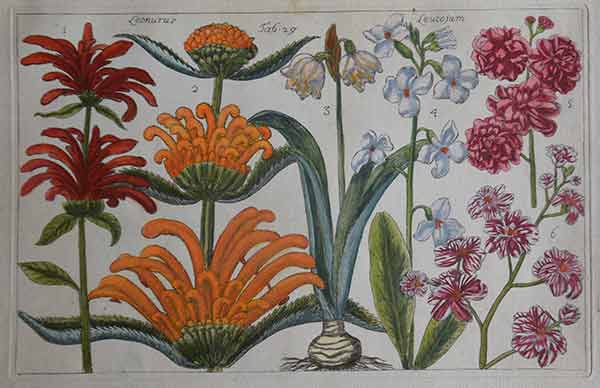
Leonurus, Leocjum Tab 29
The rarest of the early Florilegium printed in Palermo, by Angelo Felicella, 1767-1768. the artist was Mario Cammerari. Text was written by Filippo Arena (1708-1789), a Jesuit professor of mathematics and philosophy at the University of Palermo, with a passion for botany. Arena also took it upon himself to engrave the 65 plates, which he did with the help of his Jesuit colleague Mario Cammerari/Cammereri. For this he copied Weinmann's Phytanthoza iconographia (1737-1745) for many images and Besler on others. The plates were printed in colour and hand finished with few complete copies known.Image size just over 8 x 12 inches £385 inc delivery
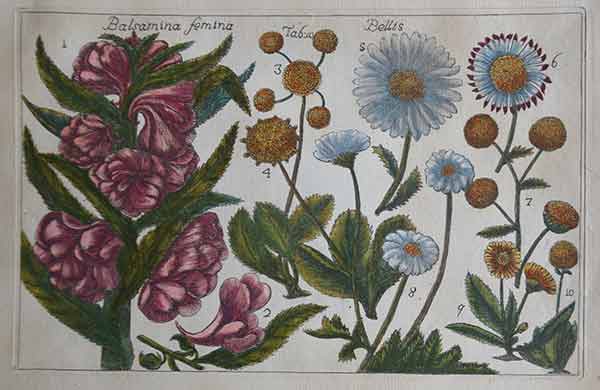
Balsam, Dailsy Tab 10
The rarest of the early Florilegium printed in Palermo, by Angelo Felicella, 1767-1768. the artist was Mario Cammerari. Text was written by Filippo Arena (1708-1789), a Jesuit professor of mathematics and philosophy at the University of Palermo, with a passion for botany. Arena also took it upon himself to engrave the 65 plates, which he did with the help of his Jesuit colleague Mario Cammerari/Cammereri. For this he copied Weinmann's Phytanthoza iconographia (1737-1745) for many images and Besler on others. The plates were printed in colour and hand finished with few complete copies known.Image size just over 8 x 12 inches £385 inc delivery
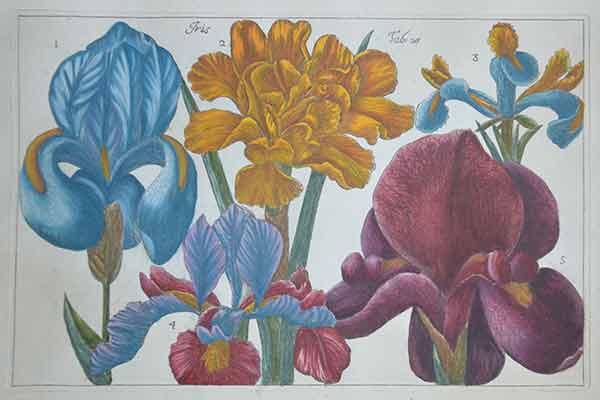
Iris Tab 28
The rarest of the early Florilegium printed in Palermo, by Angelo Felicella, 1767-1768. the artist was Mario Cammerari. Text was written by Filippo Arena (1708-1789), a Jesuit professor of mathematics and philosophy at the University of Palermo, with a passion for botany. Arena also took it upon himself to engrave the 65 plates, which he did with the help of his Jesuit colleague Mario Cammerari/Cammereri. For this he copied Weinmann's Phytanthoza iconographia (1737-1745) for many images and Besler on others. The plates were printed in colour and hand finished with few complete copies known.Image size just over 8 x 12 inches £385 inc delivery
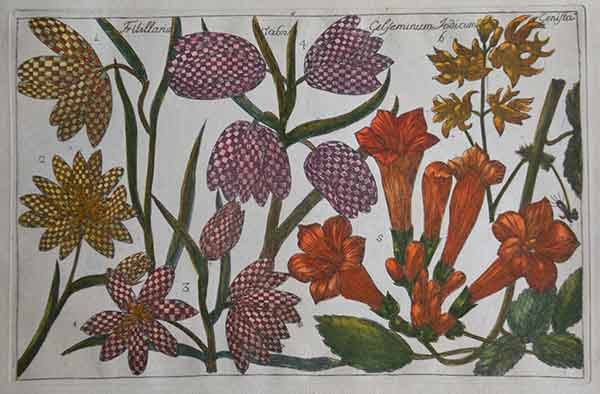
Fritillaria , Gentian Tab 21
The rarest of the early Florilegium printed in Palermo, by Angelo Felicella, 1767-1768. the artist was Mario Cammerari. Text was written by Filippo Arena (1708-1789), a Jesuit professor of mathematics and philosophy at the University of Palermo, with a passion for botany. Arena also took it upon himself to engrave the 65 plates, which he did with the help of his Jesuit colleague Mario Cammerari/Cammereri. For this he copied Weinmann's Phytanthoza iconographia (1737-1745) for many images and Besler on others. The plates were printed in colour and hand finished with few complete copies known.Image size just over 8 x 12 inches £385 inc delivery
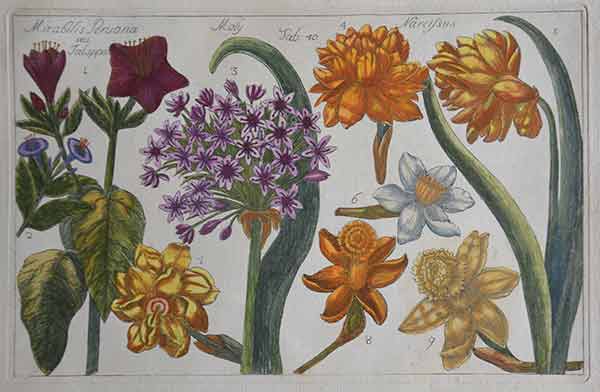
Mirabilis Peruana , Narcissus , Daffoldil Tab 40
The rarest of the early Florilegium printed in Palermo, by Angelo Felicella, 1767-1768. the artist was Mario Cammerari. Text was written by Filippo Arena (1708-1789), a Jesuit professor of mathematics and philosophy at the University of Palermo, with a passion for botany. Arena also took it upon himself to engrave the 65 plates, which he did with the help of his Jesuit colleague Mario Cammerari/Cammereri. For this he copied Weinmann's Phytanthoza iconographia (1737-1745) for many images and Besler on others. The plates were printed in colour and hand finished with few complete copies known.Image size just over 8 x 12 inches £385 inc delivery
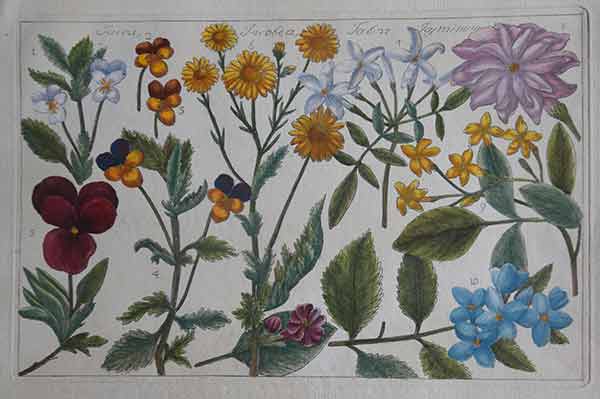
Jacobea, Jasmine Tab 27
The rarest of the early Florilegium printed in Palermo, by Angelo Felicella, 1767-1768. the artist was Mario Cammerari. Text was written by Filippo Arena (1708-1789), a Jesuit professor of mathematics and philosophy at the University of Palermo, with a passion for botany. Arena also took it upon himself to engrave the 65 plates, which he did with the help of his Jesuit colleague Mario Cammerari/Cammereri. For this he copied Weinmann's Phytanthoza iconographia (1737-1745) for many images and Besler on others. The plates were printed in colour and hand finished with few complete copies known.Image size just over 8 x 12 inches £385 inc delivery
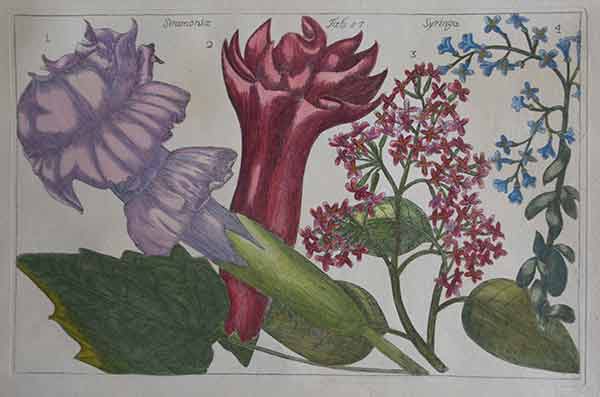
Syringa, Pitcher Plant/Stramonia Tab 57
The rarest of the early Florilegium printed in Palermo, by Angelo Felicella, 1767-1768. the artist was Mario Cammerari. Text was written by Filippo Arena (1708-1789), a Jesuit professor of mathematics and philosophy at the University of Palermo, with a passion for botany. Arena also took it upon himself to engrave the 65 plates, which he did with the help of his Jesuit colleague Mario Cammerari/Cammereri. For this he copied Weinmann's Phytanthoza iconographia (1737-1745) for many images and Besler on others. The plates were printed in colour and hand finished with few complete copies known.Image size just over 8 x 12 inches £385 inc delivery
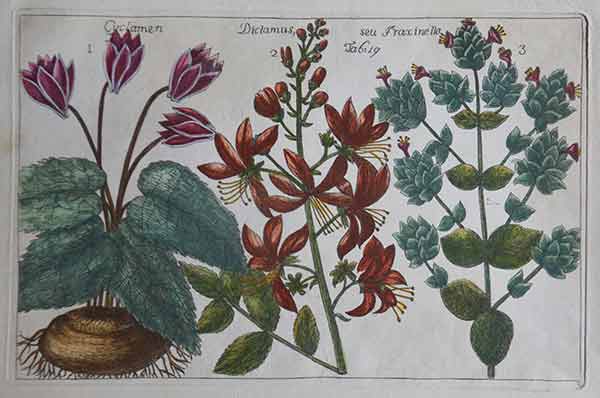
Cyclamen Tab 19
The rarest of the early Florilegium printed in Palermo, by Angelo Felicella, 1767-1768. the artist was Mario Cammerari. Text was written by Filippo Arena (1708-1789), a Jesuit professor of mathematics and philosophy at the University of Palermo, with a passion for botany. Arena also took it upon himself to engrave the 65 plates, which he did with the help of his Jesuit colleague Mario Cammerari/Cammereri. For this he copied Weinmann's Phytanthoza iconographia (1737-1745) for many images and Besler on others. The plates were printed in colour and hand finished with few complete copies known.Image size just over 8 x 12 inches £385 inc delivery
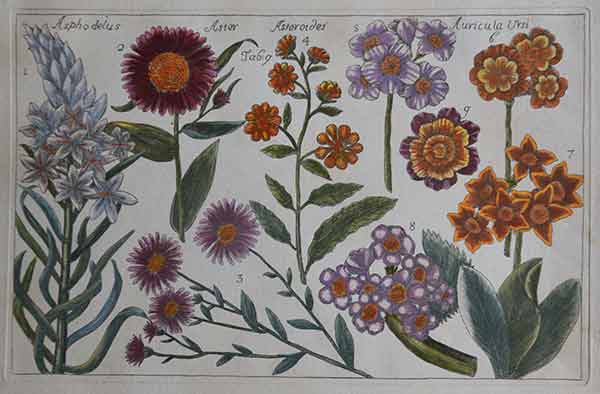
Aspodelus , Aster, Auricula Tab 9
The rarest of the early Florilegium printed in Palermo, by Angelo Felicella, 1767-1768. the artist was Mario Cammerari. Text was written by Filippo Arena (1708-1789), a Jesuit professor of mathematics and philosophy at the University of Palermo, with a passion for botany. Arena also took it upon himself to engrave the 65 plates, which he did with the help of his Jesuit colleague Mario Cammerari/Cammereri. For this he copied Weinmann's Phytanthoza iconographia (1737-1745) for many images and Besler on others. The plates were printed in colour and hand finished with few complete copies known.Image size just over 8 x 12 inches £385 inc delivery

Geranium Tab 22
The rarest of the early Florilegium printed in Palermo, by Angelo Felicella, 1767-1768. the artist was Mario Cammerari. Text was written by Filippo Arena (1708-1789), a Jesuit professor of mathematics and philosophy at the University of Palermo, with a passion for botany. Arena also took it upon himself to engrave the 65 plates, which he did with the help of his Jesuit colleague Mario Cammerari/Cammereri. For this he copied Weinmann's Phytanthoza iconographia (1737-1745) for many images and Besler on others. The plates were printed in colour and hand finished with few complete copies known.Image size just over 8 x 12 inches £385 inc delivery
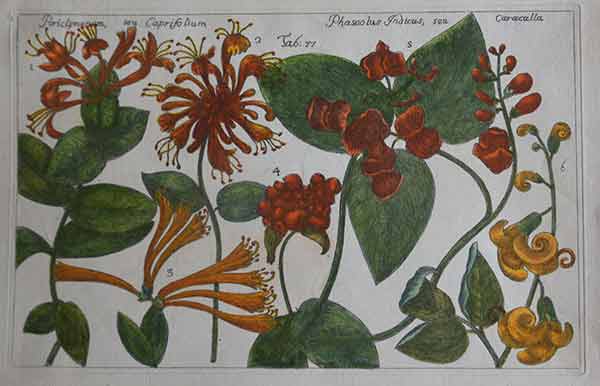
Honeysuckle, Phaseolus Tab 27
The rarest of the early Florilegium printed in Palermo, by Angelo Felicella, 1767-1768. the artist was Mario Cammerari. Text was written by Filippo Arena (1708-1789), a Jesuit professor of mathematics and philosophy at the University of Palermo, with a passion for botany. Arena also took it upon himself to engrave the 65 plates, which he did with the help of his Jesuit colleague Mario Cammerari/Cammereri. For this he copied Weinmann's Phytanthoza iconographia (1737-1745) for many images and Besler on others. The plates were printed in colour and hand finished with few complete copies known.Image size just over 8 x 12 inches £385 inc delivery
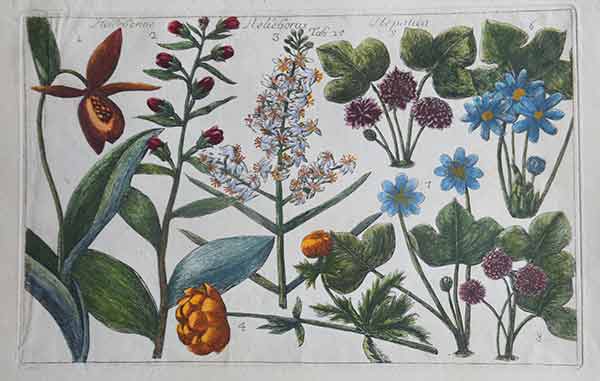
HeleboreTab 24
The rarest of the early Florilegium printed in Palermo, by Angelo Felicella, 1767-1768. the artist was Mario Cammerari. Text was written by Filippo Arena (1708-1789), a Jesuit professor of mathematics and philosophy at the University of Palermo, with a passion for botany. Arena also took it upon himself to engrave the 65 plates, which he did with the help of his Jesuit colleague Mario Cammerari/Cammereri. For this he copied Weinmann's Phytanthoza iconographia (1737-1745) for many images and Besler on others. The plates were printed in colour and hand finished with few complete copies known.Image size just over 8 x 12 inches £385 inc delivery
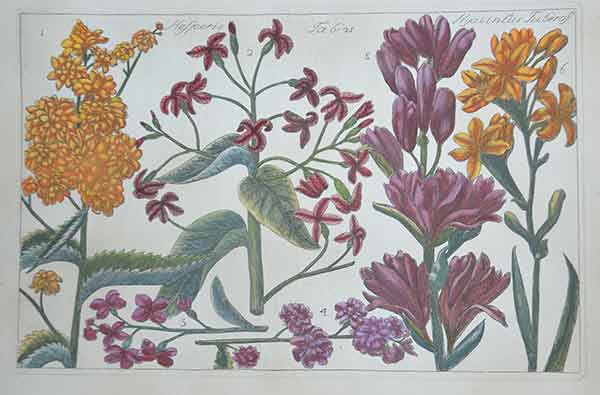
Hesperis, Hyacinth Tab 25
The rarest of the early Florilegium printed in Palermo, by Angelo Felicella, 1767-1768. the artist was Mario Cammerari. Text was written by Filippo Arena (1708-1789), a Jesuit professor of mathematics and philosophy at the University of Palermo, with a passion for botany. Arena also took it upon himself to engrave the 65 plates, which he did with the help of his Jesuit colleague Mario Cammerari/Cammereri. For this he copied Weinmann's Phytanthoza iconographia (1737-1745) for many images and Besler on others. The plates were printed in colour and hand finished with few complete copies known.Image size just over 8 x 12 inches £385 inc delivery
Botanical by Basilius Besler These will have occasional light age toning normally to the page edge though after 300 years they are doing well
Pictures are taken using flash as any defects within the paper show up but on some makes them a tad yellow. They are not but it reveals show through and accentuates it. The actual print show through will be less obvious
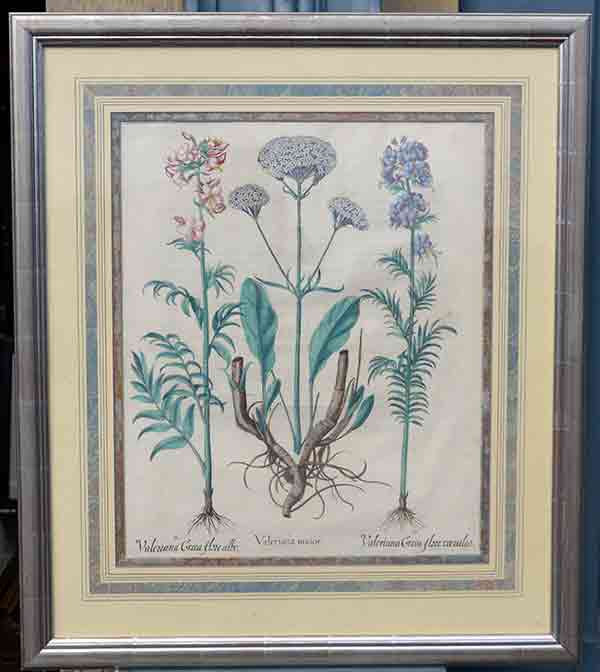
Valeriana maior [1613 - 1713],
by Besler "Hortus Eystettensis", published Nuremburg, pre 1713 Copper-engraved print, with older hand colour, from "Hortus Eystettensis", one of the earliest pictorial records of the flowers grown in the garden of Prince Bishop of Eichstatt, Johann Conrad von Gemmingen. The garden was begun by Joachim Camerarius in 1596 and, after his death in 1598, completed by Basil Besler, a pharmacist from Nuremberg. It is one of the earliest records of flowers from a specific, documented garden. Besler was asked to complete the work by Gemmingen in 1606; and he enlisted the help of his younger brother Hieronymus and Ludwig Jungermann, a nephew of Camerarius. Printing the Hortus may have begun as early as 1607. Drawings were made in situ and from specimens sent by the Bishop to Nuremberg; the Bishop reported to Hainhofer that he had boxes of fresh flowers sent every week to Besler at Nuremberg for sketching. A team of at least 10 engravers were employed to translate the drawings to copperplates. The gardens, along with most of the town of Eichstatt, were destroyed by the invading Swedish troops under Herzog Bernhard von Weimar in 1633-4, although they were partially restored by later bishops. Many of the original drawings survive in the University Library, Erlangen. Copper-engraved print, with fine hand colour. Dimensions: 540 by 447mm. . published Nuremburg, 1713 **£525 collected or UK courier may be possibleenquire re shipping as too large for some countries **crease centre page**
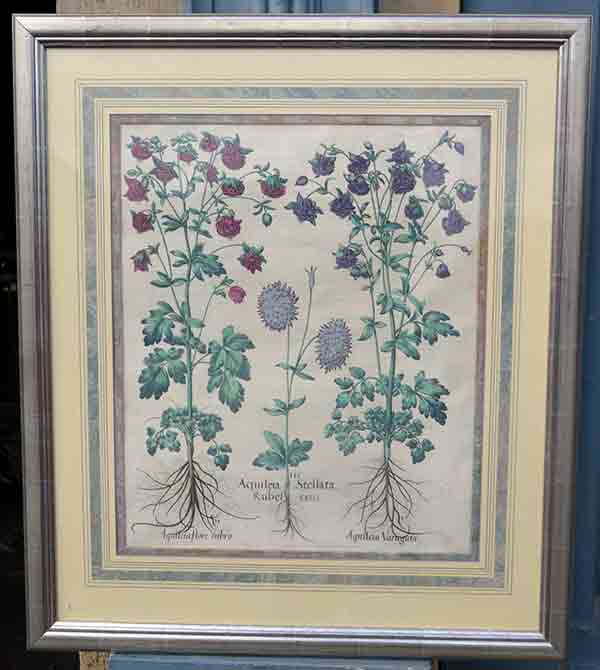
Aquileia Stellata Rubercens [1613 - 1713],
by Besler "Hortus Eystettensis", published Nuremburg, pre 1713 Copper-engraved print, with older hand colour, from "Hortus Eystettensis", one of the earliest pictorial records of the flowers grown in the garden of Prince Bishop of Eichstatt, Johann Conrad von Gemmingen. The garden was begun by Joachim Camerarius in 1596 and, after his death in 1598, completed by Basil Besler, a pharmacist from Nuremberg. It is one of the earliest records of flowers from a specific, documented garden. Besler was asked to complete the work by Gemmingen in 1606; and he enlisted the help of his younger brother Hieronymus and Ludwig Jungermann, a nephew of Camerarius. Printing the Hortus may have begun as early as 1607. Drawings were made in situ and from specimens sent by the Bishop to Nuremberg; the Bishop reported to Hainhofer that he had boxes of fresh flowers sent every week to Besler at Nuremberg for sketching. A team of at least 10 engravers were employed to translate the drawings to copperplates. The gardens, along with most of the town of Eichstatt, were destroyed by the invading Swedish troops under Herzog Bernhard von Weimar in 1633-4, although they were partially restored by later bishops. Many of the original drawings survive in the University Library, Erlangen. Copper-engraved print, with fine hand colour. Dimensions: 540 by 447mm. . published Nuremburg, 1713 **£525 collected or UK courier may be possible enquire re shipping as too large for some countries
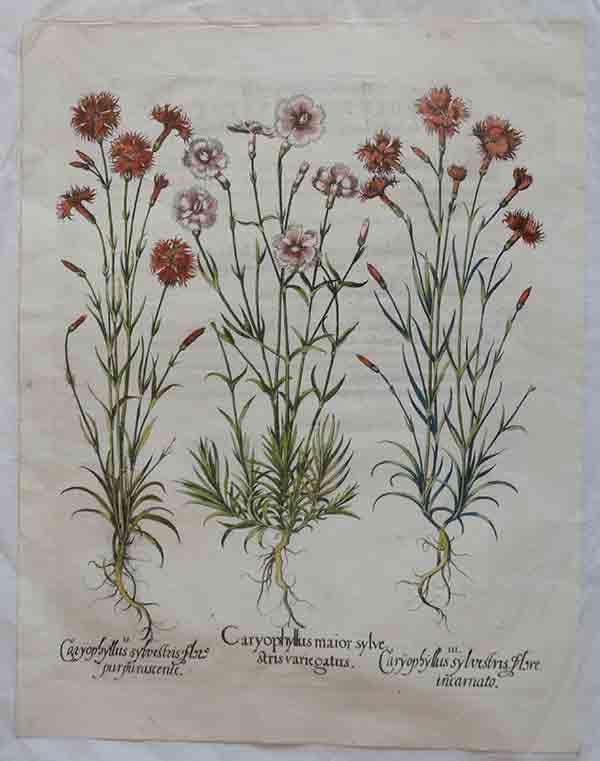
Pinks by Besler "Hortus Eystettensis", published Nuremburg, pre 1713 Copper-engraved print, with older hand colour, from "Hortus Eystettensis", one of the earliest pictorial records of the flowers grown in the garden of Prince Bishop of Eichstatt, Johann Conrad von Gemmingen. The garden was begun by Joachim Camerarius in 1596 and, after his death in 1598, completed by Basil Besler, a pharmacist from Nuremberg. It is one of the earliest records of flowers from a specific, documented garden. Besler was asked to complete the work by Gemmingen in 1606; and he enlisted the help of his younger brother Hieronymus and Ludwig Jungermann, a nephew of Camerarius. Printing the Hortus may have begun as early as 1607. Drawings were made in situ and from specimens sent by the Bishop to Nuremberg; the Bishop reported to Hainhofer that he had boxes of fresh flowers sent every week to Besler at Nuremberg for sketching. A team of at least 10 engravers were employed to translate the drawings to copperplates. The gardens, along with most of the town of Eichstatt, were destroyed by the invading Swedish troops under Herzog Bernhard von Weimar in 1633-4, although they were partially restored by later bishops. Many of the original drawings survive in the University Library, Erlangen. Copper-engraved print, with fine hand colour. Dimensions: 540 by 447mm. . published Nuremburg, 1713 **£455
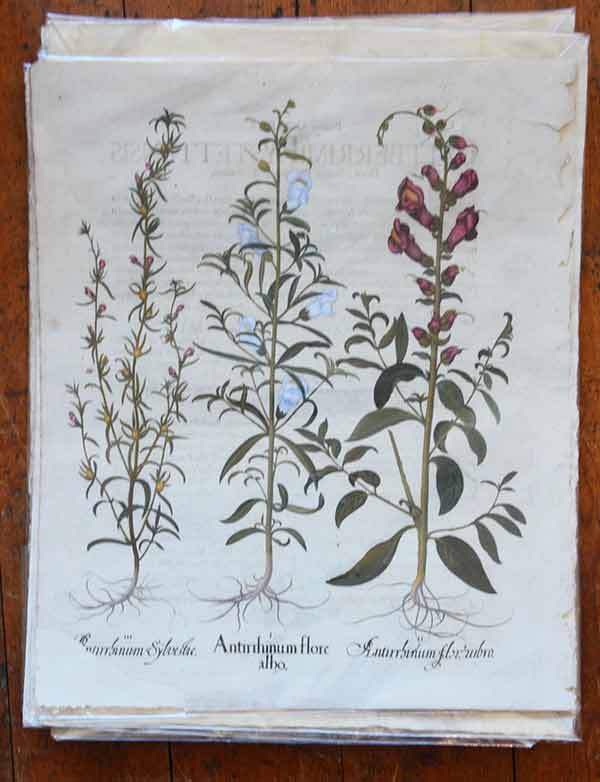
pic in dull daylight
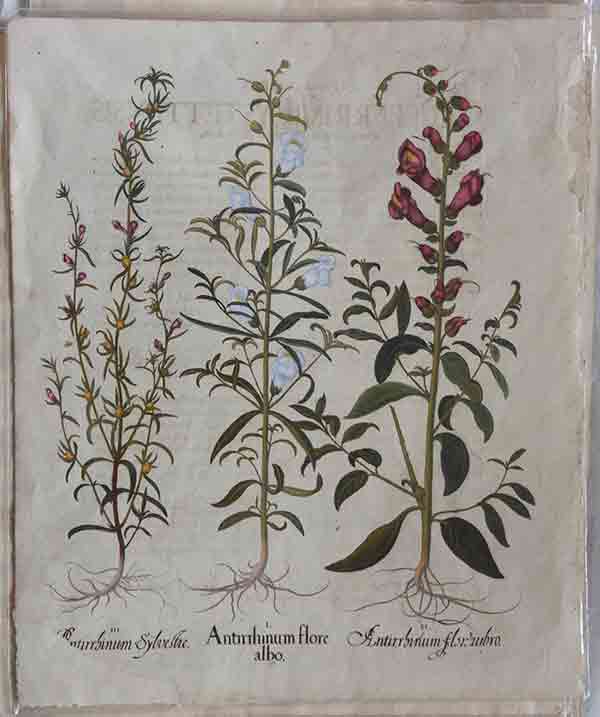
Antirrhinum Sylvestris, Antirrhinum Flore albo, Antirrhinum Flora
Copper-engraved print, with older hand colour, from "Hortus Eystettensis", one of the earliest pictorial records of the flowers grown in the garden of Prince Bishop of Eichstatt, Johann Conrad von Gemmingen. The garden was begun by Joachim Camerarius in 1596 and, after his death in 1598, completed by Basil Besler, a pharmacist from Nuremberg. It is one of the earliest records of flowers from a specific, documented garden. Besler was asked to complete the work by Gemmingen in 1606; and he enlisted the help of his younger brother Hieronymus and Ludwig Jungermann, a nephew of Camerarius. Printing the Hortus may have begun as early as 1607. Drawings were made in situ and from specimens sent by the Bishop to Nuremberg; the Bishop reported to Hainhofer that he had boxes of fresh flowers sent every week to Besler at Nuremberg for sketching. A team of at least 10 engravers were employed to translate the drawings to copperplates. The gardens, along with most of the town of Eichstatt, were destroyed by the invading Swedish troops under Herzog Bernhard von Weimar in 1633-4, although they were partially restored by later bishops. Many of the original drawings survive in the University Library, Erlangen. Copper-engraved print, with fine hand colour. Dimensions: 540 by 447mm. . published Nuremburg, 1713 ** This has a chewed right edge plus a repair to the base left corner resulting in title loss. light show trhough of text, plus slight central crease as in many This makes it cheaper and is less obvious when framed £455 inc delivery
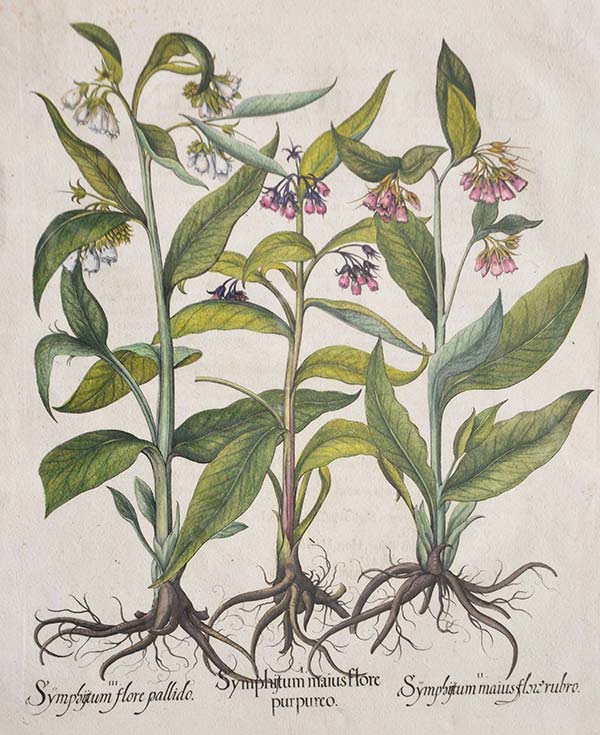
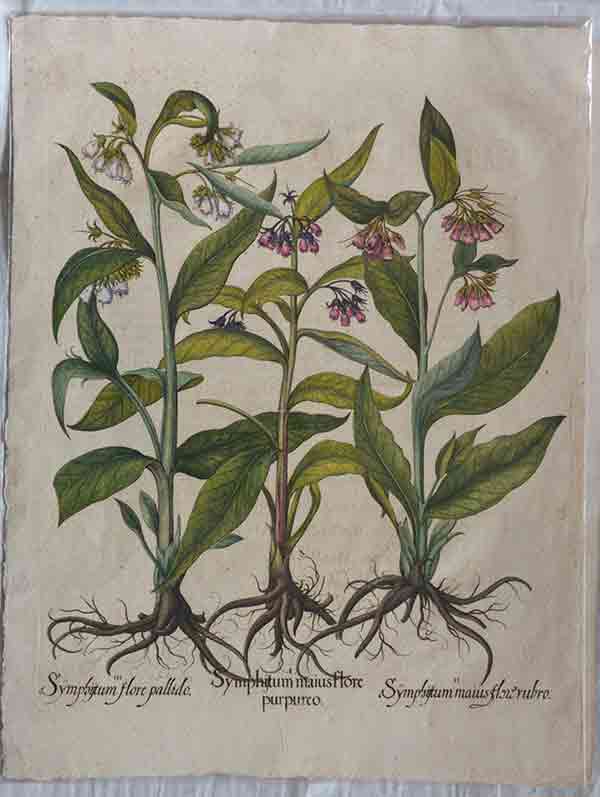
Comfrey/ Symphytum maius flore purpurco;
pic in muted daylight
Copper-engraved print, with older hand colour, from "Hortus Eystettensis", one of the earliest pictorial records of the flowers grown in the garden of Prince Bishop of Eichstatt, Johann Conrad von Gemmingen. The garden was begun by Joachim Camerarius in 1596 and, after his death in 1598, completed by Basil Besler, a pharmacist from Nuremberg. It is one of the earliest records of flowers from a specific, documented garden. Besler was asked to complete the work by Gemmingen in 1606; and he enlisted the help of his younger brother Hieronymus and Ludwig Jungermann, a nephew of Camerarius. Printing the Hortus may have begun as early as 1607. Drawings were made in situ and from specimens sent by the Bishop to Nuremberg; the Bishop reported to Hainhofer that he had boxes of fresh flowers sent every week to Besler at Nuremberg for sketching. A team of at least 10 engravers were employed to translate the drawings to copperplates. The gardens, along with most of the town of Eichstatt, were destroyed by the invading Swedish troops under Herzog Bernhard von Weimar in 1633-4, although they were partially restored by later bishops. Many of the original drawings survive in the University Library, Erlangen. Copper-engraved print, with fine hand colour. Dimensions: 540 by 447mm. . published Nuremburg, PRE 1713 ** This has some show through of the type to verso due to a heavy handed printer which is common in early wood and copper block printing on larger scale. This makes it cheaper and is less obvious when framed Older more muted colour + early paper type £515 inc delivery
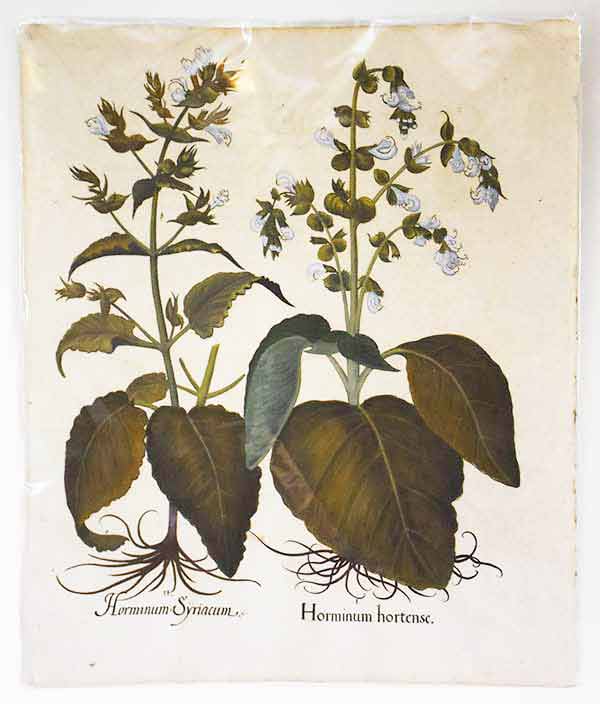
Horminum Syriacum , Horminium Hortense
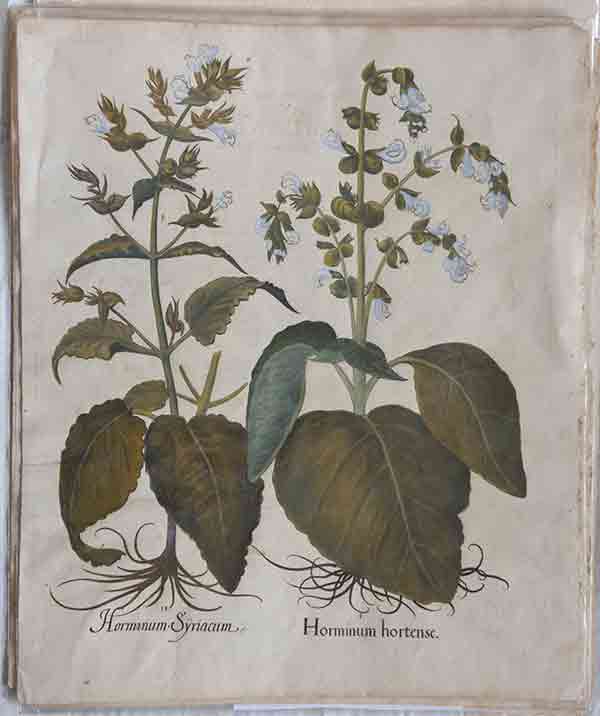
pic in dull daylight
Copper-engraved print, with older hand colour, from "Hortus Eystettensis", one of the earliest pictorial records of the flowers grown in the garden of Prince Bishop of Eichstatt, Johann Conrad von Gemmingen. The garden was begun by Joachim Camerarius in 1596 and, after his death in 1598, completed by Basil Besler, a pharmacist from Nuremberg. It is one of the earliest records of flowers from a specific, documented garden. Besler was asked to complete the work by Gemmingen in 1606; and he enlisted the help of his younger brother Hieronymus and Ludwig Jungermann, a nephew of Camerarius. Printing the Hortus may have begun as early as 1607. Drawings were made in situ and from specimens sent by the Bishop to Nuremberg; the Bishop reported to Hainhofer that he had boxes of fresh flowers sent every week to Besler at Nuremberg for sketching. A team of at least 10 engravers were employed to translate the drawings to copperplates. The gardens, along with most of the town of Eichstatt, were destroyed by the invading Swedish troops under Herzog Bernhard von Weimar in 1633-4, although they were partially restored by later bishops. Many of the original drawings survive in the University Library, Erlangen. Copper-engraved print, with fine hand colour. Dimensions: 540 by 447mm. . published Nuremburg, PRE 1713 ** This has some show through of the type to verso due to a heavy handed printer which is common in early wood and copper block printing on larger scale. This makes it cheaper and is less obvious when framed Older more muted colour + early paper type so from a pre 1713 3dition £515 inc delivery
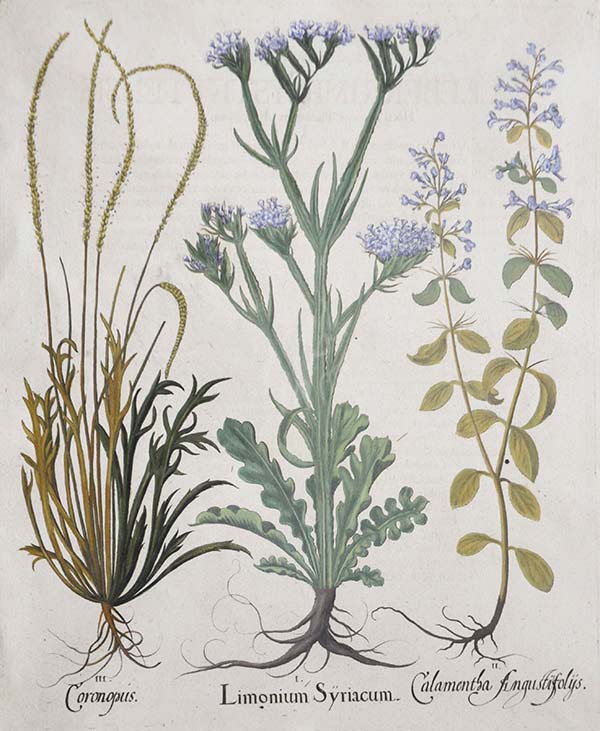
Coronopus, Limonium Syriacum, Calamentha Angustifolijs / Sea Lavender
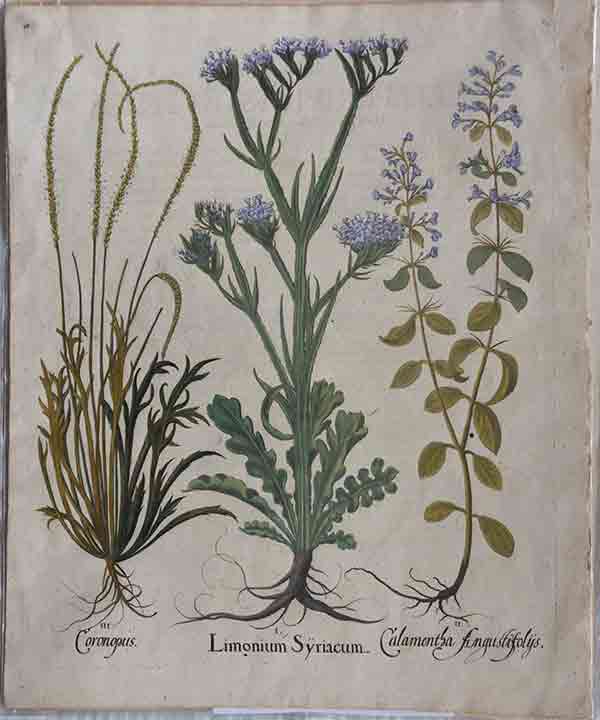
pic done in dull daylight
Copper-engraved print, with older hand colour, from "Hortus Eystettensis", one of the earliest pictorial records of the flowers grown in the garden of Prince Bishop of Eichstatt, Johann Conrad von Gemmingen. The garden was begun by Joachim Camerarius in 1596 and, after his death in 1598, completed by Basil Besler, a pharmacist from Nuremberg. It is one of the earliest records of flowers from a specific, documented garden. Besler was asked to complete the work by Gemmingen in 1606; and he enlisted the help of his younger brother Hieronymus and Ludwig Jungermann, a nephew of Camerarius. Printing the Hortus may have begun as early as 1607. Drawings were made in situ and from specimens sent by the Bishop to Nuremberg; the Bishop reported to Hainhofer that he had boxes of fresh flowers sent every week to Besler at Nuremberg for sketching. A team of at least 10 engravers were employed to translate the drawings to copperplates. The gardens, along with most of the town of Eichstatt, were destroyed by the invading Swedish troops under Herzog Bernhard von Weimar in 1633-4, although they were partially restored by later bishops. Many of the original drawings survive in the University Library, Erlangen. Copper-engraved print, with fine hand colour. Dimensions: 540 by 447mm. . published Nuremburg, PRE 1713 ** This has some show through of the type to verso due to a heavy handed printer which is common in early wood and copper block printing on larger scale. This makes it cheaper and is less obvious when framed Older more muted colour + early paper type so from a pre 1713 edition £515 inc delivery
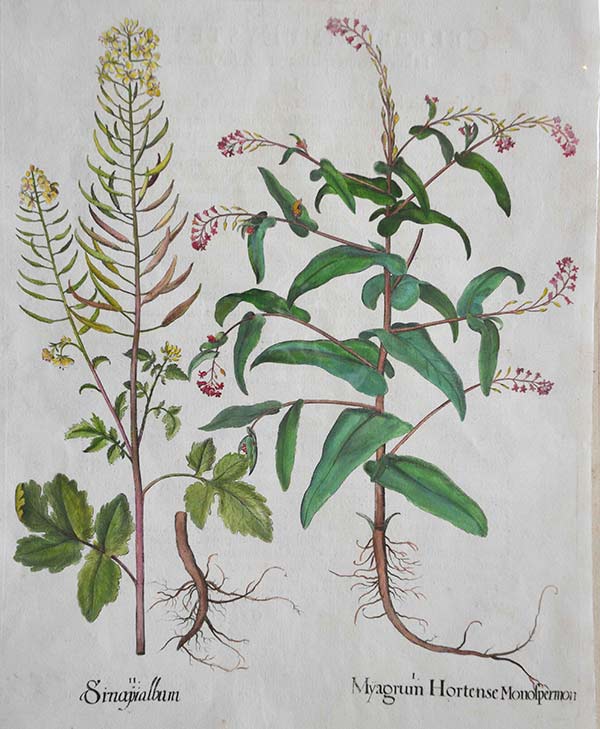
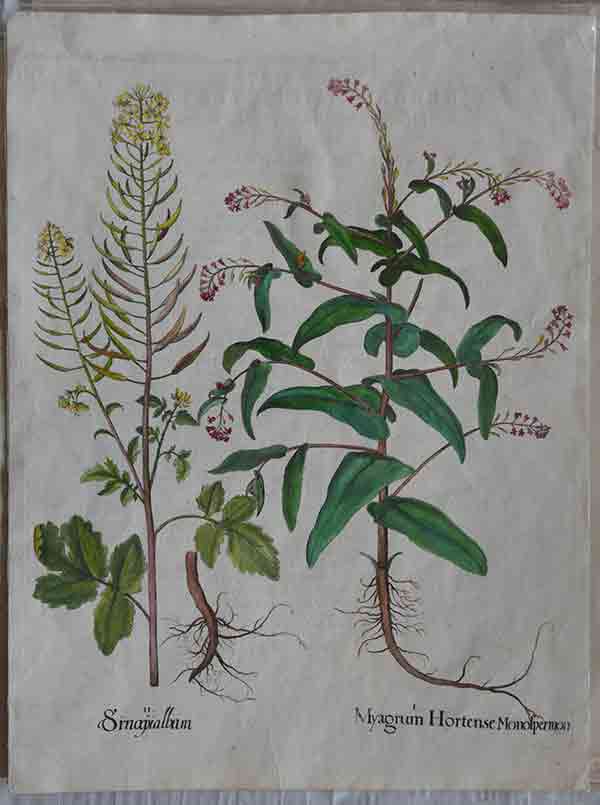
I. Myagrum Hortense Monospermon. II. Sinapi album.
pic in dull daylight
Copper-engraved print, with older hand colour, from "Hortus Eystettensis", one of the earliest pictorial records of the flowers grown in the garden of Prince Bishop of Eichstatt, Johann Conrad von Gemmingen. The garden was begun by Joachim Camerarius in 1596 and, after his death in 1598, completed by Basil Besler, a pharmacist from Nuremberg. It is one of the earliest records of flowers from a specific, documented garden. Besler was asked to complete the work by Gemmingen in 1606; and he enlisted the help of his younger brother Hieronymus and Ludwig Jungermann, a nephew of Camerarius. Printing the Hortus may have begun as early as 1607. Drawings were made in situ and from specimens sent by the Bishop to Nuremberg; the Bishop reported to Hainhofer that he had boxes of fresh flowers sent every week to Besler at Nuremberg for sketching. A team of at least 10 engravers were employed to translate the drawings to copperplates. The gardens, along with most of the town of Eichstatt, were destroyed by the invading Swedish troops under Herzog Bernhard von Weimar in 1633-4, although they were partially restored by later bishops. Many of the original drawings survive in the University Library, Erlangen. Copper-engraved print, with fine hand colour. Dimensions: 540 by 447mm. . published Nuremburg, 1713 ** This has some show through of the type to verso due to a heavy handed printer which is common in early wood and copper block printing on larger scale. This makes it cheaper and is less obvious when framed £455 inc delivery Two copies of this one with much older colour

Pic in muted daylight
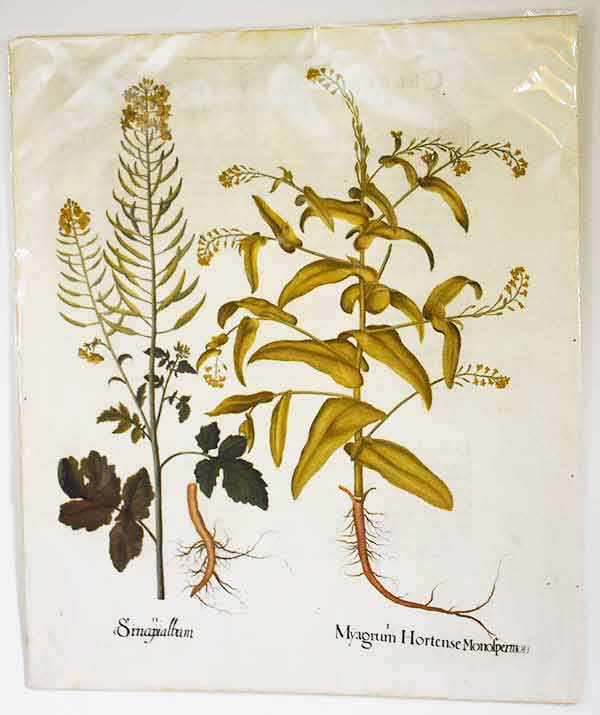
I. Myagrum Hortense Monospermon. II. Sinapi album. by Basilius Besler, Date pre : 1713
Copper-engraved print, with older hand colour, from "Hortus Eystettensis", one of the earliest pictorial records of the flowers grown in the garden of Prince Bishop of Eichstatt, Johann Conrad von Gemmingen. The garden was begun by Joachim Camerarius in 1596 and, after his death in 1598, completed by Basil Besler, a pharmacist from Nuremberg. It is one of the earliest records of flowers from a specific, documented garden. Besler was asked to complete the work by Gemmingen in 1606; and he enlisted the help of his younger brother Hieronymus and Ludwig Jungermann, a nephew of Camerarius. Printing the Hortus may have begun as early as 1607. Drawings were made in situ and from specimens sent by the Bishop to Nuremberg; the Bishop reported to Hainhofer that he had boxes of fresh flowers sent every week to Besler at Nuremberg for sketching. A team of at least 10 engravers were employed to translate the drawings to copperplates. The gardens, along with most of the town of Eichstatt, were destroyed by the invading Swedish troops under Herzog Bernhard von Weimar in 1633-4, although they were partially restored by later bishops. Many of the original drawings survive in the University Library, Erlangen. Copper-engraved print, with fine hand colour. Dimensions: 540 by 447mm. ** This has some show through of the type to verso due to a heavy handed printer which is common in early wood and copper block printing on larger scale. This makes it cheaper and is less obvious when framed Older more muted colour + early paper typeOlder more muted colour + early paper type £455 inc delivery
pic in dull daylight
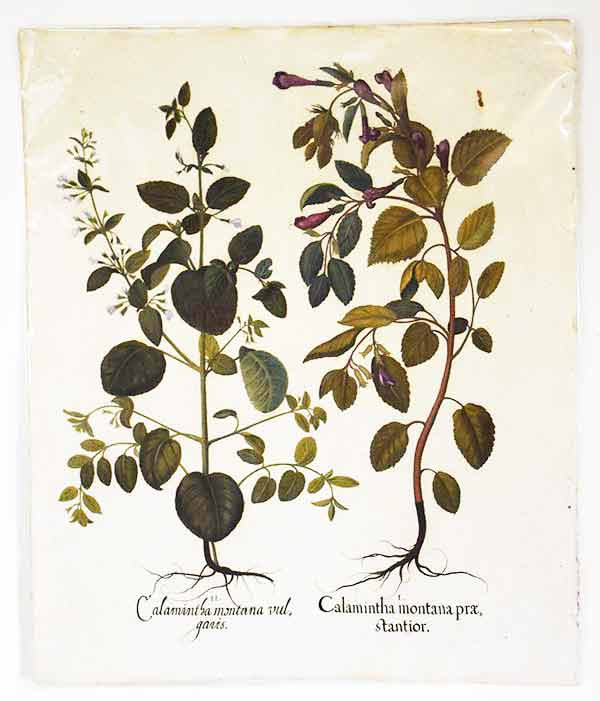
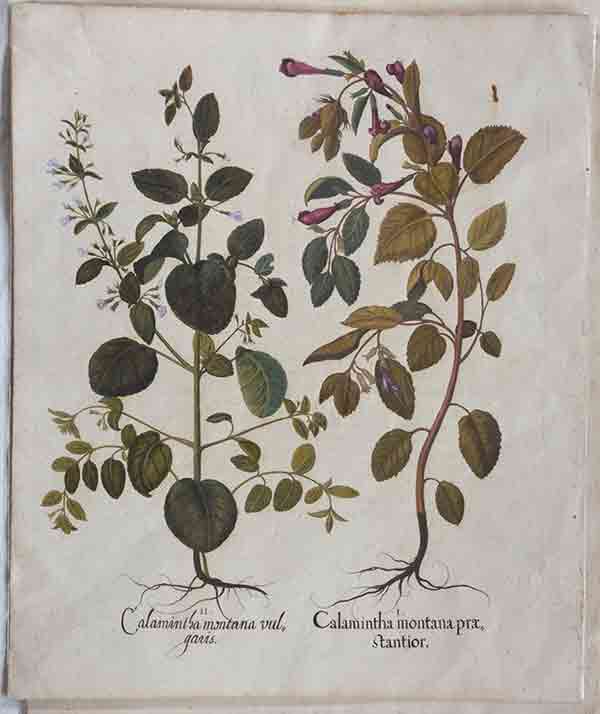
Calamintha Montana vulgaris , Calamintha Montana Stantior
Copper-engraved print, with older hand colour, from "Hortus Eystettensis", one of the earliest pictorial records of the flowers grown in the garden of Prince Bishop of Eichstatt, Johann Conrad von Gemmingen. The garden was begun by Joachim Camerarius in 1596 and, after his death in 1598, completed by Basil Besler, a pharmacist from Nuremberg. It is one of the earliest records of flowers from a specific, documented garden. Besler was asked to complete the work by Gemmingen in 1606; and he enlisted the help of his younger brother Hieronymus and Ludwig Jungermann, a nephew of Camerarius. Printing the Hortus may have begun as early as 1607. Drawings were made in situ and from specimens sent by the Bishop to Nuremberg; the Bishop reported to Hainhofer that he had boxes of fresh flowers sent every week to Besler at Nuremberg for sketching. A team of at least 10 engravers were employed to translate the drawings to copperplates. The gardens, along with most of the town of Eichstatt, were destroyed by the invading Swedish troops under Herzog Bernhard von Weimar in 1633-4, although they were partially restored by later bishops. Many of the original drawings survive in the University Library, Erlangen. Copper-engraved print, with fine hand colour. Dimensions: 540 by 447mm. ** This has some show through of the type to verso due to a heavy handed printer which is common in early wood and copper block printing on larger scale. This makes it cheaper and is less obvious when framed Older more muted colour + early paper type £515 inc delivery

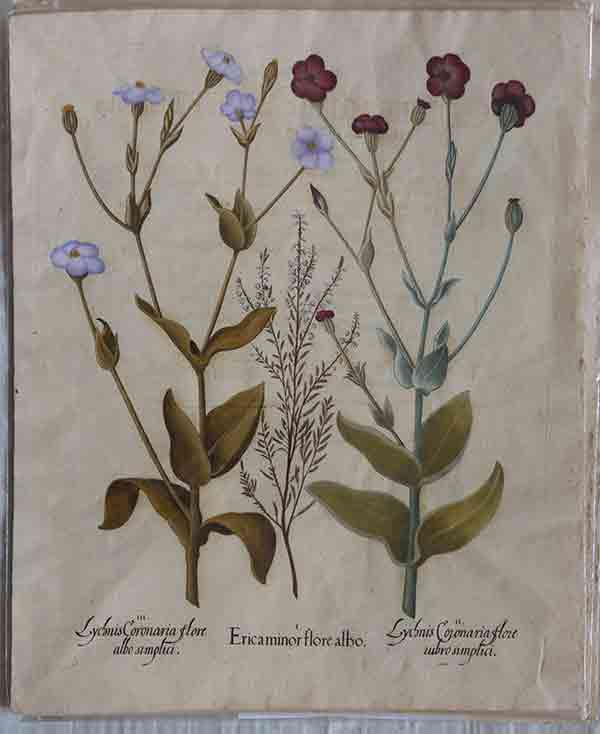
daylight on a dull day/ no lighting
Erica minor flore albo, Lychnis Coronaria, by Basilius Besler, Date pre 1713
Copper-engraved print, with older hand colour, from "Hortus Eystettensis", one of the earliest pictorial records of the flowers grown in the garden of Prince Bishop of Eichstatt, Johann Conrad von Gemmingen. The garden was begun by Joachim Camerarius in 1596 and, after his death in 1598, completed by Basil Besler, a pharmacist from Nuremberg. It is one of the earliest records of flowers from a specific, documented garden. Besler was asked to complete the work by Gemmingen in 1606; and he enlisted the help of his younger brother Hieronymus and Ludwig Jungermann, a nephew of Camerarius. Printing the Hortus may have begun as early as 1607. Drawings were made in situ and from specimens sent by the Bishop to Nuremberg; the Bishop reported to Hainhofer that he had boxes of fresh flowers sent every week to Besler at Nuremberg for sketching. A team of at least 10 engravers were employed to translate the drawings to copperplates. The gardens, along with most of the town of Eichstatt, were destroyed by the invading Swedish troops under Herzog Bernhard von Weimar in 1633-4, although they were partially restored by later bishops. Many of the original drawings survive in the University Library, Erlangen. Copper-engraved print, with fine hand colour. Dimensions: 540 by 447mm. **Older more muted colour + early paper type This has some show through of the type to verso due to a heavy handed printer which is common in early wood and copper block printing on larger scale plus printers crease (paper was not flat when printed) . This makes it cheaper and is less obvious when framed £515 inc delivery

Conyza media/ Aster Atticus minor flore coeruleo/ Aster atticus maior Flore coeruleo: Pic lightened to show detail
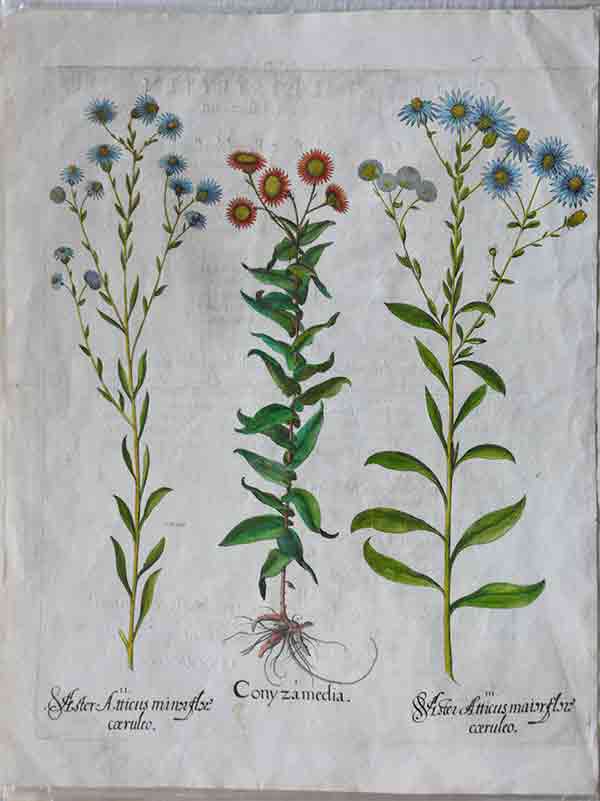
pic in daylight
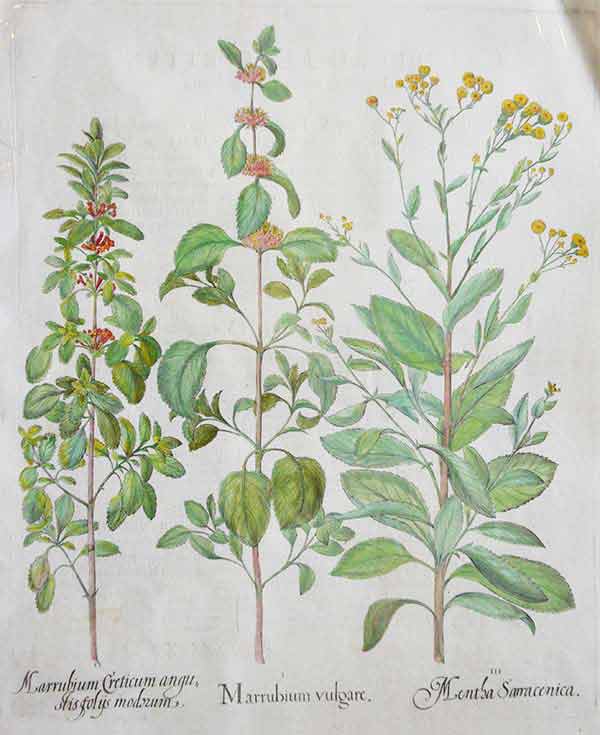
Marrubium vulgare, Pl. 231
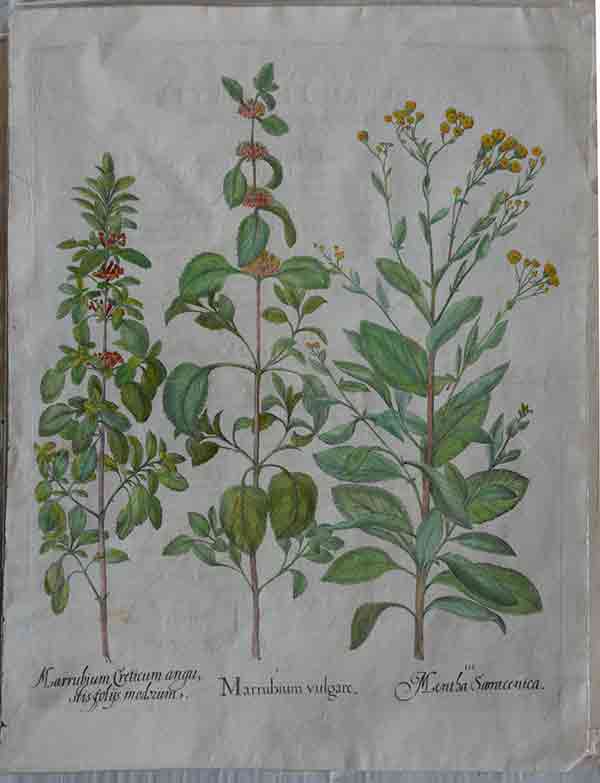
pic in dull daylight
Copper-engraved print, with older hand colour, from "Hortus Eystettensis", one of the earliest pictorial records of the flowers grown in the garden of Prince Bishop of Eichstatt, Johann Conrad von Gemmingen. The garden was begun by Joachim Camerarius in 1596 and, after his death in 1598, completed by Basil Besler, a pharmacist from Nuremberg. It is one of the earliest records of flowers from a specific, documented garden. Besler was asked to complete the work by Gemmingen in 1606; and he enlisted the help of his younger brother Hieronymus and Ludwig Jungermann, a nephew of Camerarius. Printing the Hortus may have begun as early as 1607. Drawings were made in situ and from specimens sent by the Bishop to Nuremberg; the Bishop reported to Hainhofer that he had boxes of fresh flowers sent every week to Besler at Nuremberg for sketching. A team of at least 10 engravers were employed to translate the drawings to copperplates. The gardens, along with most of the town of Eichstatt, were destroyed by the invading Swedish troops under Herzog Bernhard von Weimar in 1633-4, although they were partially restored by later bishops. Many of the original drawings survive in the University Library, Erlangen. Copper-engraved print, with fine hand colour. Dimensions: 540 by 447mm. . published Nuremburg, 1713 ** This has some show through of the type to verso due to a heavy handed printer which is common in early wood and copper block printing on larger scale. This makes it cheaper and is less obvious when framed £455inc delivery

The Birch Tree
Antique copperplate engraving from Sylva, or a Discourse of Forest Trees by John Evelyn, published in 1786. This influential volume was originally published in 1664 John Evelyn (1620-1706) was a life-long public servant and an avid gardener. These are untinted as printed, with engravings by J Miller £15 each edge tear to image edge tear to plate left

The White Beam Tree
Antique copperplate engraving from Sylva, or a Discourse of Forest Trees by John Evelyn, published in 1786. This influential volume was originally published in 1664 John Evelyn (1620-1706) was a life-long public servant and an avid gardener. These are untinted as printed, with engravings by J Miller £18 each edge tear to plate right

The Common Elm Tree
Antique copperplate engraving from Sylva, or a Discourse of Forest Trees by John Evelyn, published in 1786. This influential volume was originally published in 1664 John Evelyn (1620-1706) was a life-long public servant and an avid gardener. These are untinted as printed, with engravings by J Miller £18 each
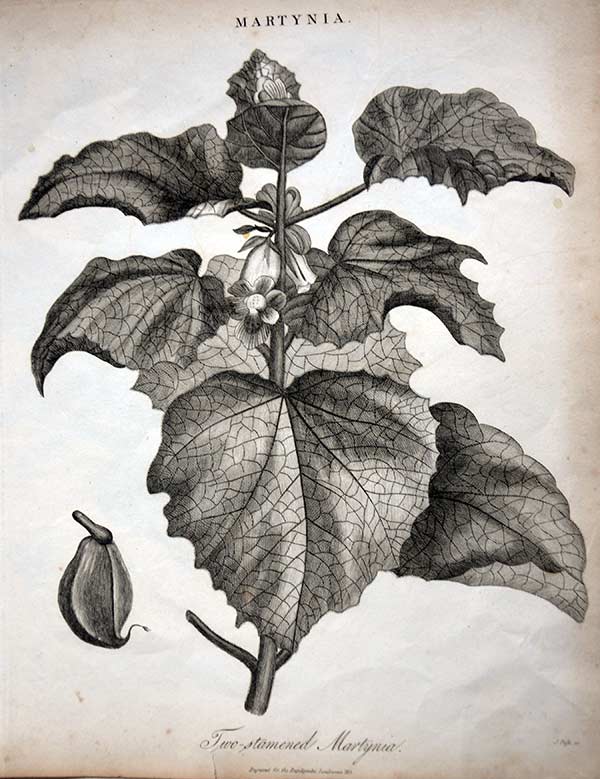
Martynia
Antique copperplate engraving from Sylva, or a Discourse of Forest Trees by John Evelyn, published in 1786. This influential volume was originally published in 1664 John Evelyn (1620-1706) was a life-long public servant and an avid gardener. These are untinted as printed, with engravings by J Miller £18 each
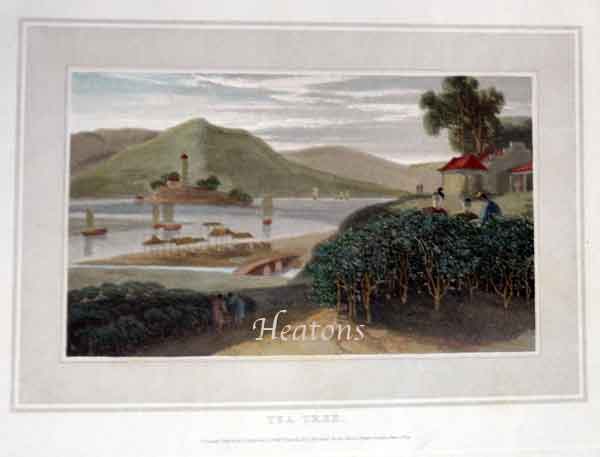
Tea Tree
Hand tinted aquatint plate from the book Interesting Selections from Animated Nature with Illustrative Scenery Designed and Engraved by William Daniell (London: T. Cadell and W. Davies, [ca. 1807-1812], 22 x 16 cm plus borders etc This contained 120 aquatint plates tree images included on botanic pages £30 inc delivery
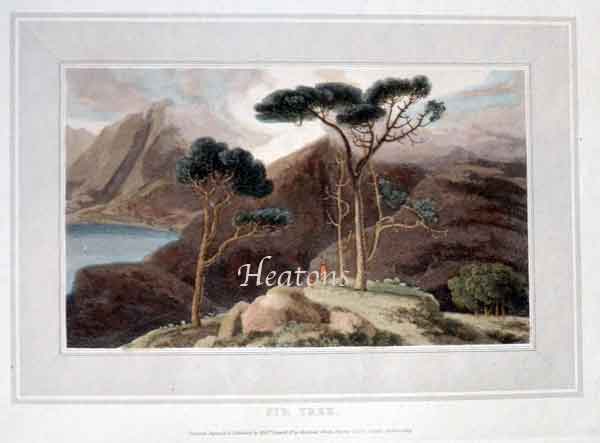
Fir Tree
Hand tinted aquatint plate from the book Interesting Selections from Animated Nature with Illustrative Scenery Designed and Engraved by William Daniell (London: T. Cadell and W. Davies, [ca. 1807-1812], This contained 120 aquatint plates tree images included on botanic pages £30 inc delivery x 2
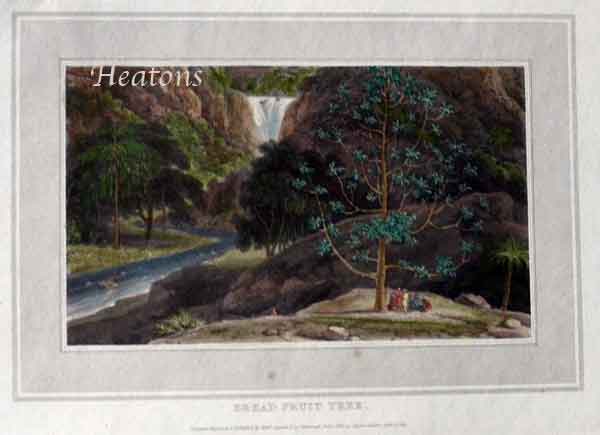
Breadfruit Tree
Hand tinted aquatint plate from the book Interesting Selections from Animated Nature with Illustrative Scenery Designed and Engraved by William Daniell (London: T. Cadell and W. Davies, [ca. 1807-1812], This contained 120 aquatint plates tree images included on botanic pages £30 inc delivery
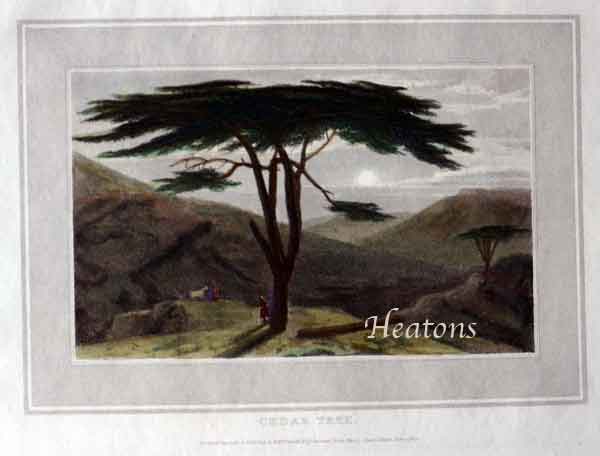
Cedar Tree
Hand tinted aquatint plate from the book Interesting Selections from Animated Nature with Illustrative Scenery Designed and Engraved by William Daniell (London: T. Cadell and W. Davies, [ca. 1807-1812], This contained 120 aquatint plates tree images included on botanic pages £30 inc delivery
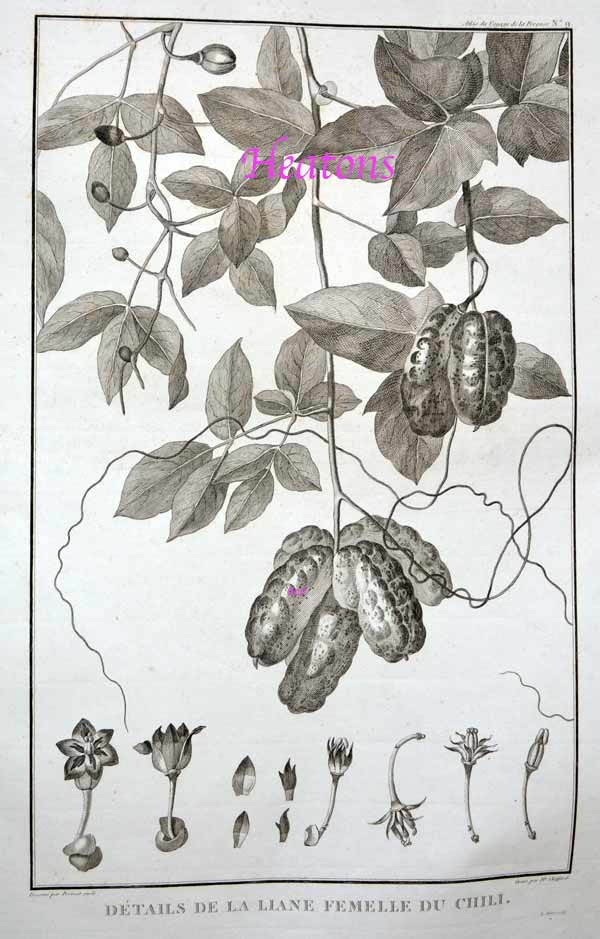
Details de la Liane femelle du Chili. Dessine par Prevost, oncle. Grave par PP. Choffard. L. Aubert scripsit. Atlas du Voyage de la Perouse, no. 9. (Paris: L'Imprimerie de la Republique, An V, dated 1797) the French government (Louis XVI) assembled a high class group of scientists around Captain Jean-Francois de Galaup de la Perouse (1741 - 1788). La Perouse sailed with two ships, the “Astrolabe" and the “Boussole" 1785 into the Pacific to match the earlier Cook expedition. The FIRST drawing of the chili plant Published in Paris, 1798 .£185 inc large plate page 59 x 45+ cm
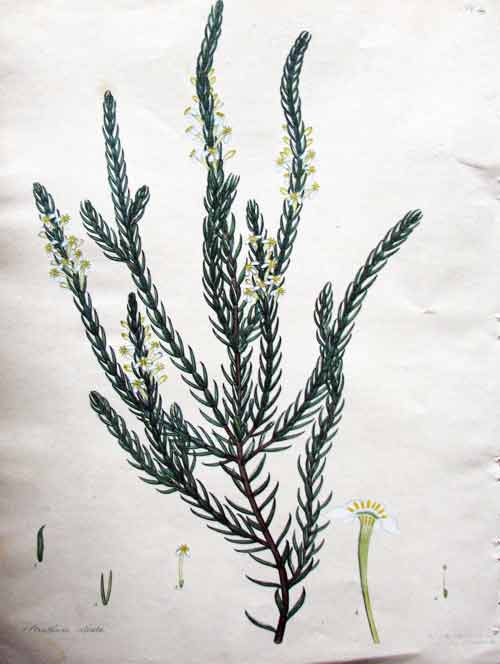
Struthiola Ciliata. Fringed-leaved Struthiola.
1802. Etching with original handcolour image is full sheet size on 27 x 20 cm . With accompanying text sheet giving botanical information, where the specimen was found etc. Botanical details are included along the lower edge of the plate. Plate 139 from "The Botanist's Repository, Comprising Colour'd Engravings of New and Rare Plants Only" by H.C. Andrews /Andrews, Henry C. (illus).Unmounted £40 inc delivery

The Great bale Oak at Welbeck
By Jacob George Strutt, from Sylva Britannica Or Portraits of Forest Trees Distinguished For Their Antiquity, Magnitude, Or Beauty. Published for the Author by Longman, Rees, Orme, Brown, and Green, London: not positive as to edition so either 1822 or 1838, 14.5 x 12.5 inches Jacob George Strutt, painter and etcher, studied in London, and was a contributor to the Royal Academy and British Institution at intervals between 1819 and 1858. For a few years he practiced portrait-painting, but from 1824 to 1831 exhibited studies of forest scenery, and he is now best known by two sets of etchings which he published at this period `Sylva Britannica, or portraits of Forest Trees distinguished for their Antiquity' (1822; reissued, in 1838), and `Delicia Sylvarum, or grand and romantic Forest Scenery in England and Scotland' (1828). About 1831 Strutt went abroad, and, after residing for a time at Lausanne, settled in Rome. In 1851 he returned to England, but was not active after 1858. £95 tinted
